Poncho
Clothing Definitions — definitions of garments and clothing terms from Apparel Search
Search Apparel Search
At a Glance
Definition: A poncho is a garment made from a single large sheet of fabric with an opening for the head — worn in waterproof cloth as rain gear, and in wool as a traditional and fashion garment.
Pronunciation: PON-choh
Category: Clothing Definitions
Word Origin
Poncho is a Spanish word taken into English from South America. Its deeper origin is debated — it is often traced to Mapudungun pontro, a blanket or woollen cloth, or to Quechua punchu — but the garment it names is Andean: a woven woollen sheet worn over the head, in use long before the word travelled.
A poncho is the simplest outer garment ever widely worn: one large sheet of fabric, one opening for the head, sometimes openings for the arms, and on some versions a hood. In waterproof cloth it is rain gear — the sheet sheds water over everything under it, clothing and pack included, which is why it remains standard military field kit and a staple for hiking and cycling. In wool it is a traditional garment of South America and a recurring fashion piece, loose and comfortable rather than weatherproof. This page explains the construction, the traditional forms, and how the same shape serves both purposes; the site's styling guide, How to Wear a Poncho, covers the fashion side in wear.
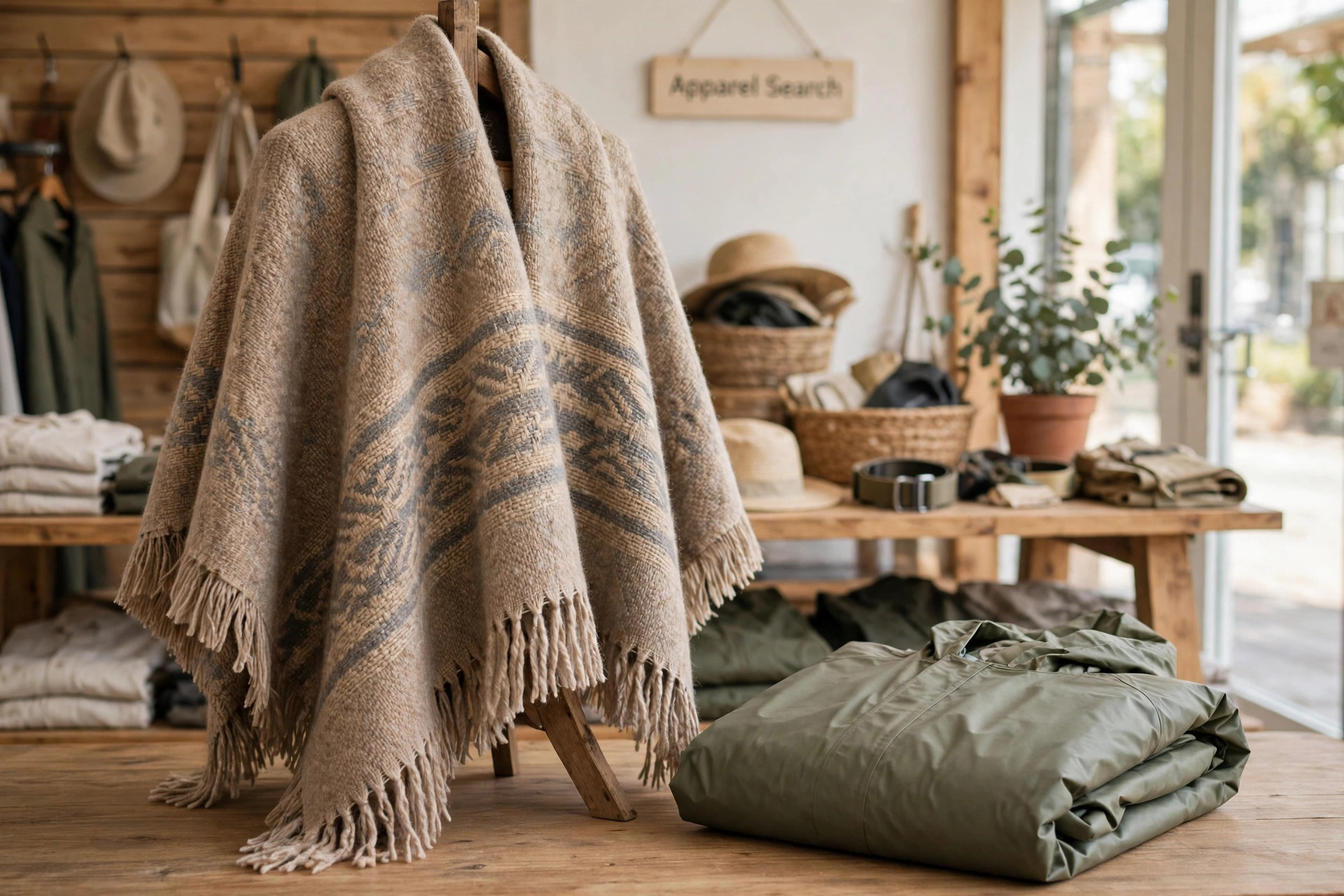
One Sheet, One Opening
The poncho's design refuses almost everything other rainwear includes. There are no sleeves to seam, no front opening to leak, no fitted parts to size. One sheet, one neck hole, and gravity does the waterproofing: rain runs off the sloping cloth as it runs off a tent. Wearing it is equally simple — the neck opening sits at the shoulders, the cloth is arranged evenly front and back, and the wearer's own clothes stay dry underneath, which no jacket of the same weight can promise for the pack and equipment as well.
That simplicity is why the pattern is so old and so widespread, appearing wherever woven cloth and weather meet, and why it needs no alteration to serve wearers of every size. Modern rain versions add the few refinements the basic sheet allows: press-stud sides that can open the garment back into a flat sheet, taped or welded seams at the neck and hood, and a hood that draws close at the face.
A Traditional Garment of South America
The woven wool poncho is traditional dress in the Andes of South America, a working garment and, in its finer weaves, festive dress, long before fashion borrowed the shape. Local names and variants mark how far the family spread. The chamanto of central Chile is the best-documented South American relative. Europe kept its own versions: the Kotze, or Wetterfleck, a dark green or brown hunting cape of Austria, Switzerland and Bavaria; the paenula, a cape-like garment of ancient Rome; and church dress such as the Kasel, or Pluviale. Sleeveless weather garments of the same family — the pelerine, the redingote and the cape — shade into the poncho at their simplest, and the distinctions are set out in the Not to Be Confused With box below.
The Military and Rain Poncho
Armies still issue the poncho because it does several jobs in one flat-packed sheet: it covers the soldier, the pack and the weapon at once, doubles as a ground sheet or a shelter half, and fits every size in the unit. The modern rain materials are rubberised cloth, coated nylon and PVC. As civilian kit it is the raincoat of hiking and biking — the lightest complete answer to rain, carried flat and pulled over everything when the weather turns, in the same weatherproofing family as the Mackintosh, the trench coat, the parka and the anorak, all of which shape cloth to the body where the poncho simply drapes over it. The product side is covered in the Fashion Influence guide to raincoats.
The Fashion Poncho, and Care
The fashion poncho keeps the geometry and changes the brief. Knitted or woven in wool and wool blends, fringed, patterned or plain, it is a loose outer layer pulled over ordinary clothes for warmth and appearance — closer in spirit to its South American originals than to the rain sheet. A belt worn over it gives the loose cloth shape when wanted; the styling possibilities are worked through in How to Wear a Poncho.
Care splits by material. Coated rain ponchos are sponged clean and dried open, so the coating does not mildew in storage, and are never machine washed hot. Wool ponchos follow ordinary wool care — gentle washing, drying flat, and storage folded rather than hung, since a heavy woven poncho stretches on a hanger. Judged by endurance, few garments compete with a design that can serve a shepherd, a soldier, a cyclist and a fashion season in the same century without changing its pattern. It is also among the easiest garments to pack: the rain version folds or rolls to almost nothing, and the wool version travels as its own blanket — two more reasons the pattern has never needed a successor.
Not to Be Confused With
Three draped garments, three constructions. A poncho is a closed sheet with a hole for the head: it goes on over the head and cannot open at the front. A ruana, the Andean wrap of Colombia and Venezuela, is open all the way down the front — it is draped over the shoulders and wrapped or belted, with no head hole at all. A cape fastens at the neck and hangs from the shoulders, open at the front like a sleeveless coat; it is put on at the throat, not pulled over the head. If the garment has a neck hole, it is a poncho; if it opens, it is a wrap or a cape.
Common Questions
What is a poncho?
A poncho is a garment made from a single large sheet of fabric with an opening for the head, and sometimes openings for the arms, with a hood on some versions. In its first form it keeps the body dry in rain; in its fashion form the same shape is made in wool and other decorative fabrics.
What is the difference between a rain poncho and a fashion poncho?
A rain poncho is made of waterproof material and is cut to shed water over clothing and equipment — the standard military and hiking form. A fashion poncho keeps the one-piece shape and the head opening but is made of wool or a similar material for warmth, appearance and comfort, with no rain protection intended.
What are the traditional variants of the poncho?
Local names and variants include the chamanto of central Chile, the Kotze or Wetterfleck hunting cape of Austria, Switzerland and Bavaria, the paenula of ancient Rome, and church garments such as the Kasel or Pluviale, alongside sleeveless weather garments such as the pelerine and the cape.