Chamanto
Clothing Definitions — definitions of garments and clothing terms from Apparel Search
Search Apparel Search
At a Glance
Definition: A chamanto is a traditional decorative garment from central Chile, similar to a poncho, woven in silk thread and wool with figured designs woven into the cloth, and finished with ribbon edging.
Pronunciation: chah-MAHN-toh
Category: Clothing Definitions
A chamanto is a traditional decorative garment from central Chile, similar to a poncho and woven in silk thread and wool. Its entire contour is finished with ribbon edging, and the difference from a common poncho lies in the weaving: a chamanto is reversible, finely figured with designs worked into the cloth itself rather than embroidered on afterwards. Chamantos are the festive dress of the Chilean huaso, the horseman of the central valley. This page explains how they are made, what their designs mean, and how they are worn.
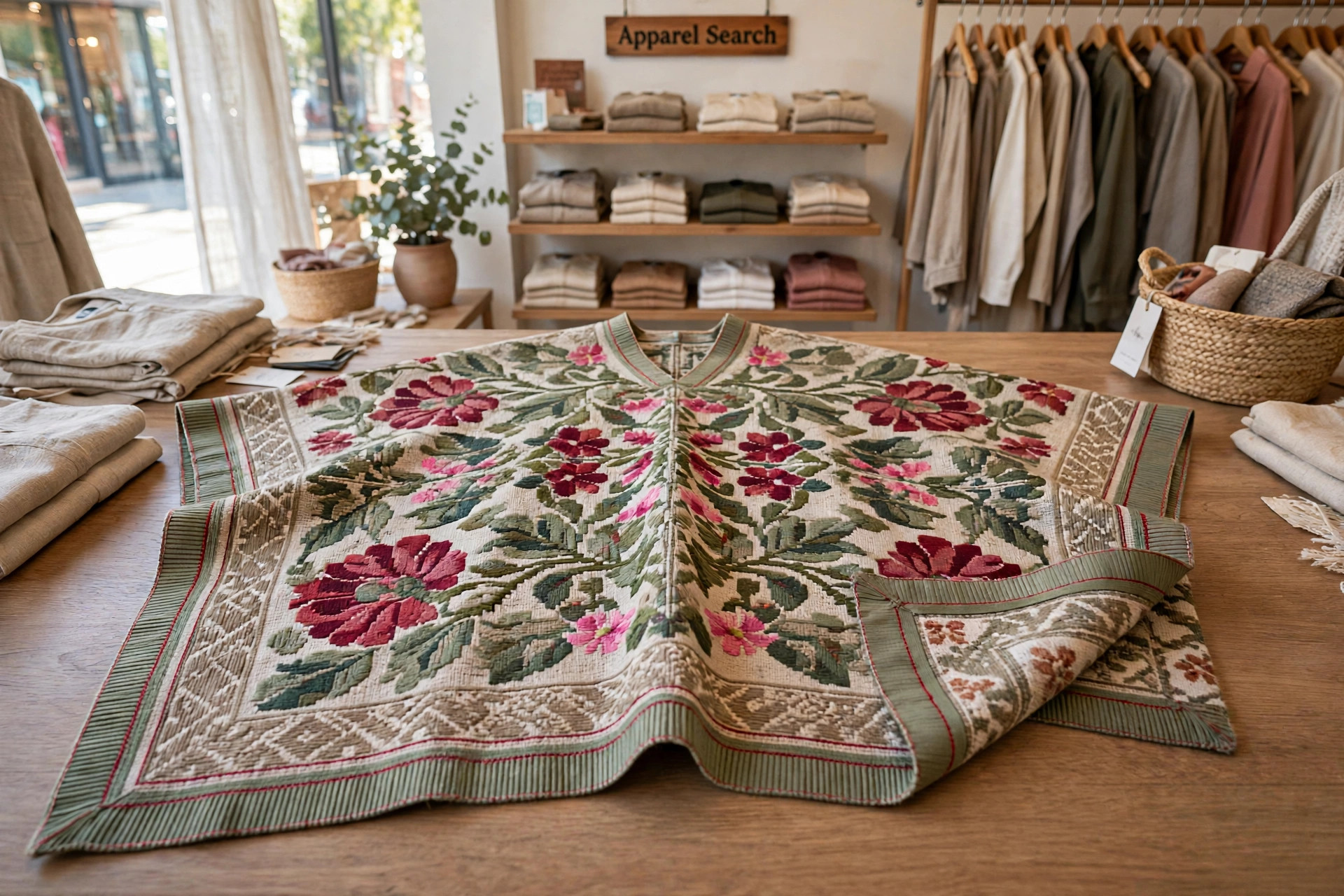
Woven, Not Embroidered
The making of a chamanto demands great diligence, because the design is created entirely by crossing the threads: the weaver controls the pattern in the warp and weft on the loom, so the figures are the cloth, not a decoration applied to it. The difference between a chamanto and other ponchos is its reversibility — both sides, one traditionally light and one dark, are fully finished, with the dark side used during the day and the light side mostly worn at night. There is no wrong side to hide mistakes in, which is why clean reversibility is the recognised mark of quality.
The figures embellishing chamantos are drawn from Chilean country life and nature: copihues, Chile's national flower; ears of barley and wheat; blackberries and bunches of grapes; fuchsias and pansies; and various birds representative of the national fauna. Because the silk in the weave gives the heavy wool cloth a subtle sheen, the woven figures shift between pattern and shadow as the garment moves and catches the light — an effect no surface embroidery can reproduce.
The Weaver's Craft
Making a chamanto is slow work on a traditional loom, counted in weeks or months for a fine piece, and the craft is concentrated in particular weaving communities of central Chile, notably Doñihue, long known for its chamanto weavers. The exquisiteness involved in weaving silk and wool together, plus the intricacy of the design sketched by crossing the threads, makes each fine chamanto effectively a piece of textile art produced one at a time.
That labour is reflected in the garment's status. A fine chamanto is expensive and durable, treated as an heirloom garment — bought once and worn for a lifetime of festivals. Fine examples are presented as state gifts and held in museum collections as examples of Chilean textile art, and the garment's value is recognised formally as well as socially.
Judging a chamanto means reading the weaving. In a fine piece the figured designs are sharp on both faces, the light and dark sides are equally finished, the ribbon edging is sewn evenly around the whole contour, and the cloth drapes with the weight of wool softened by silk rather than hanging stiffly. Because the work is hand weaving, no two fine chamantos are exactly alike, and the weaver's handling of the traditional motifs — how cleanly a copihue or a bird is resolved in crossed threads — is the signature buyers and collectors look for.
Dress of the Huaso
A chamanto is worn over the shirt for rodeos, cueca dancing and national celebrations, as the crowning piece of the huaso's dress: short jacket, sash, and the flat straw hat called a chupalla. For the wearer, the test of a chamanto is how it moves when dancing the cueca, Chile's national dance — the garment has to swing, settle and catch the light through the turns of the dance, which is part of why the silk content and the balanced weight of the cloth matter.
Chamantos gained world notoriety when they were worn by the twenty-one leaders of the Asia-Pacific Economic Cooperation forum for the official photograph of the 2004 summit in Chile — a moment that fixed the garment in international minds as a symbol of Chile itself. In the family of draped outer garments gathered in this section, the chamanto stands with the cloak and the cape as clothing made from a single shaped cloth, but it is distinguished from both by its woven figuration and its festive, national role.
Not to Be Confused With
A poncho is generally a plainer, heavier working garment. A chamanto is the poncho family's ceremonial piece: finer materials including silk, designs woven in on the loom so the pattern reads on both faces, and ribbon edging around the entire contour. If it is not reversible and finely figured, it is a poncho, not a chamanto.
Common Questions
What is a chamanto?
A chamanto is a traditional Chilean garment like a poncho, woven finely in silk thread and wool with detailed figured designs woven into the fabric. It is finished with ribbon edging around its entire contour and is worn as the festive dress of the huaso, the Chilean horseman.
How is a chamanto different from a poncho?
A poncho is generally a plainer, heavier working garment, while a chamanto is a fine, reversible ceremonial piece: its designs are woven in on the loom so the pattern reads on both sides, its materials include silk, and its finish — ribbon edging all around — is decorative rather than purely practical.
What designs appear on a chamanto?
Chamanto designs are woven motifs drawn from Chilean country life and nature, including the copihue, Chile's national flower, along with birds, fruit, vines and geometric bands. The fineness and complexity of the woven figures are a large part of the garment's value.