Anorak
Clothing Definitions — definitions of garments and clothing terms from Apparel Search
An anorak or parka is a type of heavy jacket with a hood, generally lined with fur or faux fur, made to protect the face from a combination of freezing temperatures and wind. It was invented by the Inuit, who needed clothing that protected them from windchill and wet while hunting and kayaking in the Arctic. This page explains the garment's origins and care — Inuit anoraks were regularly soaked with fish oil to keep their water resistance — and clarifies the naming: anorak is mainly British usage, parka the near-universal American and Canadian term for the same class of jacket.
 An
anorak or
parka is a type of
heavy
jacket with a
hood, generally lined with
fur or
fun fur, so as to protect the face from a combination
of freezing temperatures and wind.
Originally invented by the Inuit, who needed clothing which protected them from windchill and wet, while hunting and kayaking in the arctic region. Underneath the anorak the Inuit wear warm clothes. Inuit anoraks have to be regularly soaked with fish oil to keep their water resistance. Today, the jacket is named after it because it attempts to be just as waterproof.
Although of Inuit origin, the word "anorak" is mainly used in Britain, while "parka" is the almost universal name in the United States and Canada. "Parka" is used interchangeably with anorak in Britain. An anorak or parka specifically implied a pull-over jacket without a zipper, button or frogged opening, but this distinction is now largely lost. In the marketing of outdoor clothing in America, parka refers to a jacket with a full-length zipper, while anorak refers to a pull-over jacket with a half-length or less zipper from chin to mid-chest.
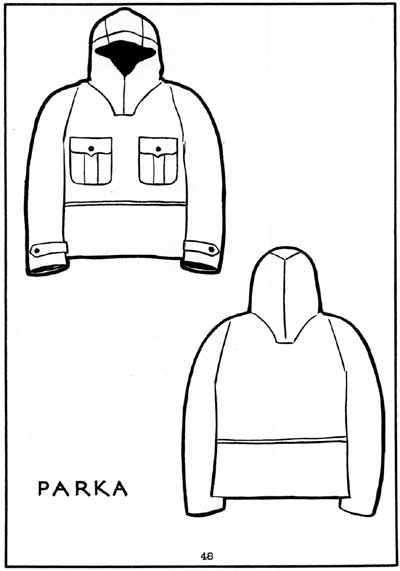
Diagram of the parka part of an early
National Parks Service uniform
See also
The above
article is licensed under the
GNU
Free Documentation License. From Wikipedia, the free encyclopedia
(
https://en.wikipedia.org/wiki/anorak ).
8/4/05 Every feature of the anorak answers an Arctic problem. The hood, lined with fur or faux fur, creates a pocket of still air around the face, which is the body's most exposed surface in windchill; the heavy body of the jacket blocks wind that would strip away the warmth of the clothing worn underneath; and the water resistance — maintained in Inuit practice by regularly soaking the garment with fish oil — sheds the wet of kayaking and sea-ice hunting. Modern versions pursue the same three goals with synthetic shells, insulated linings and treated fabrics, but the design brief has not changed since the garment was invented for hunting and kayaking in the far north. For a modern buyer, the practical difference follows the American outdoor trade's usage. A pull-over anorak, with no opening or only a half-length zipper from chin to mid-chest, has fewer failure points and seals well against wind, but it must be pulled on over the head and offers less ventilation control. A parka with a full-length zipper opens completely, layers more easily over other clothing, and vents more readily when the wearer warms up. Both should be judged on the same criteria the design began with: a hood that genuinely shelters the face, a shell that resists wind and water, and enough room for warm layers beneath. Length matters too — a jacket that covers the hips keeps wind from reaching the body's core far better than one that stops at the waist. Care follows from construction: fur or faux-fur hood trims should be kept clean and dry so the lining continues to trap air, and water-resistant finishes on modern shells benefit from periodic renewal so the jacket keeps shedding rain and spray rather than soaking through. The anorak was invented by the Inuit, who needed clothing that protected them from windchill and wet while hunting and kayaking in the Arctic region. Underneath the anorak the Inuit wore warm clothes, and the anorak itself was kept water-resistant with regular soakings of fish oil. The words name the same type of heavy hooded jacket: anorak is mainly used in Britain, while parka is the almost universal name in the United States and Canada. In American outdoor marketing, a parka has a full-length zipper, while an anorak is a pull-over with a half-length zipper or less. No. An anorak or parka originally implied a pull-over jacket without a zipper, button or frogged opening. That distinction is now largely lost, and many garments sold under either name use front fastenings of one kind or another.
Why the Anorak Is Built the Way It Is
Choosing Between Anorak and Parka Styles
Common Questions
Who invented the anorak?
What is the difference between an anorak and a parka?
Did anoraks originally have zippers?