Smoking Jacket
Clothing Definitions — definitions of garments and clothing terms from Apparel Search
Search Apparel Search
At a Glance
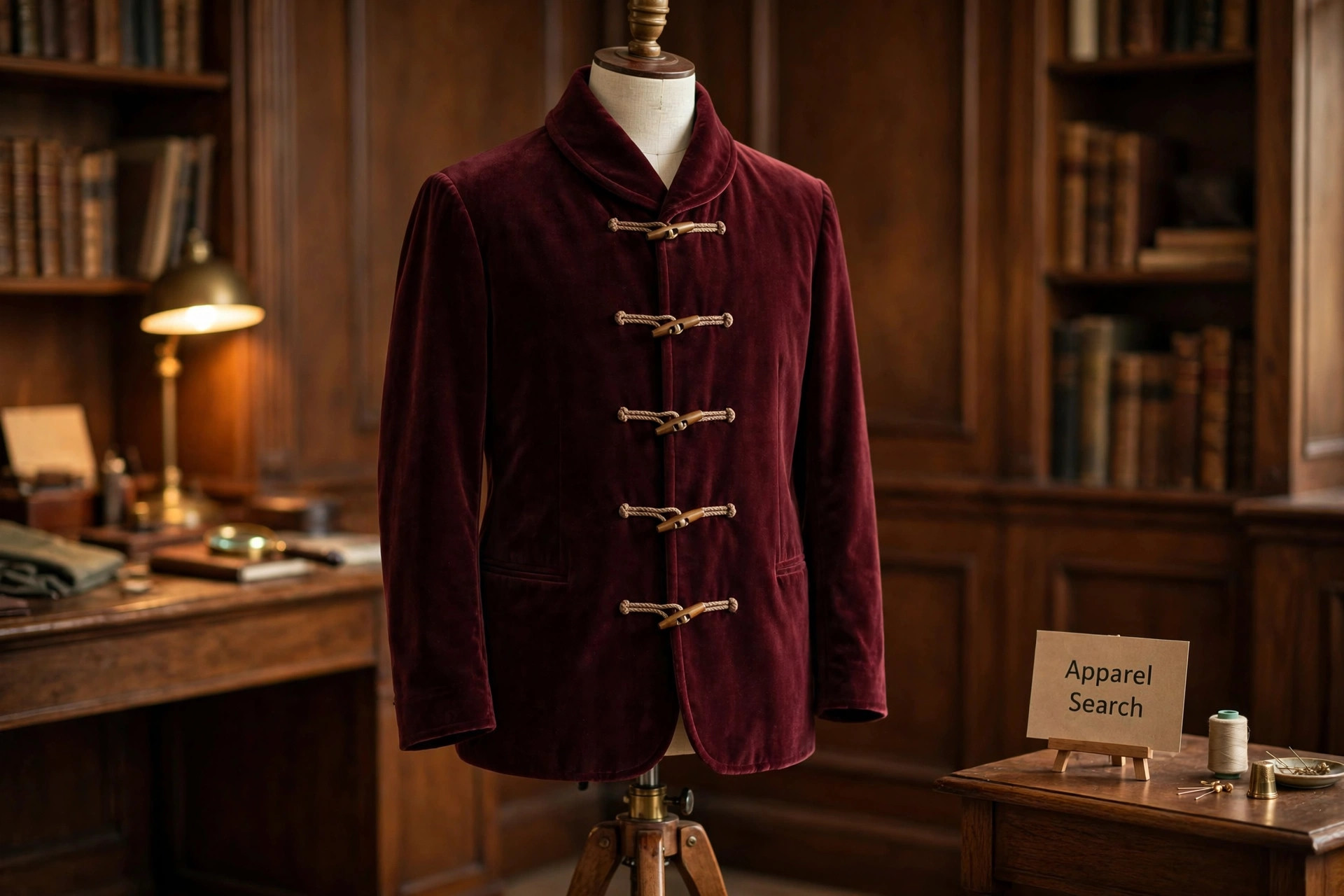
Definition: A smoking jacket is a waist-length at-home jacket of velvet or silk with a shawl collar, turn-up cuffs and toggle fastenings, made to be worn while smoking after dinner so that tobacco odour stayed off the wearer's ordinary clothes.
Category: Clothing Definitions
The smoking jacket is clothing designed around a single hour of the day. It is a short, comfortable jacket for wearing at home, changed into before a cigar or pipe was lit and changed out of afterwards, so that the smell of tobacco left the room with the jacket rather than with the man. Now relatively rare, it survives as one of the most recognisable silhouettes in evening and lounge wear. This page describes the classic form, the etiquette that created it, and the curious second life of its name in other languages.
The Classic Form
Styles vary, but the classic smoking jacket is waist length, made of velvet or sometimes silk, in a rich colour such as burgundy or bottle green. Its marks are a shawl collar that rolls continuously into the front, turn-up cuffs, and toggle fastenings in place of buttons. Everything about the specification is deliberate: dense, smooth fabrics shed ash and resist taking up odour better than ordinary suiting, the loose cut is comfortable for an evening at home, and the toggles and rich cloth mark the garment as leisure dress rather than a working jacket or a formal coat.
A quality smoking jacket is a substantial piece of making, closer to tailoring than to a dressing gown, and it was priced accordingly. That cost is part of the garment's later history: a well-made example can last a lifetime, so surviving jackets circulate for decades and set the pattern by which the garment is still recognised.
An Etiquette Garment
The smoking jacket became a standard accessory in Victorian times, when smoking after dinner was a separated ritual, often in a dedicated room. Period etiquette held that tobacco fumes clinging to everyday clothing were offensive in company, so a considerate host or guest changed into the smoking jacket before lighting a cigar or pipe, and changed back afterwards. Smoking caps were sometimes worn for the same reason, keeping smoke out of the hair as the jacket kept it out of the suit.
The garment therefore belongs to a small class of clothing that exists because of manners rather than weather or work. Its job was social as much as practical: it signalled that the smoker had taken trouble over other people's comfort, and it confined the evidence of the habit to one washable, leave-behind garment and one room of the house.
The full ritual had a small wardrobe of its own. The jacket was kept with the smoking room's other equipment, put on with the cap as a set, and the room itself — ventilated, furnished for sitting, apart from the drawing room — was the garment's natural habitat. When the smoking room disappeared from house plans, the jacket lost its place to hang as well as its reason to exist, which is why the two declines, of the room and of the garment, track each other so closely.
Decline and Survival
The smoking jacket's decline followed its purpose. Dedicated pipe and cigar smoking became less common, houses lost their smoking rooms, and dress grew less formal, so a special jacket for one after-dinner hour came to seem an extravagance. Cost counted against it too: because a quality jacket is expensive to make and lasts so long, the vintage and second-hand market supplies much of the remaining demand, and a new one is now usually made to order by one of the few outfitters still producing them.
What survives in general dress is the silhouette. The shawl collar, the rich velvet and the relaxed tailored cut reappear in evening jackets and lounge wear with no connection to tobacco at all. Within the tailored family the smoking jacket's nearest everyday relatives are the blazer — another informal jacket with a sporting past — and the waistcoat it was worn over or instead of, while its at-home role overlaps the dressing gown discussed in the box below.
A Word That Travelled
In German, French, Brazilian Portuguese and Mexican Spanish, the word smoking was borrowed from English but attached to a different garment: the dinner jacket, or tuxedo. The borrowing is understandable — both garments belonged to the same after-dinner part of the evening — but it reverses the English meaning, since the English smoking jacket is informal home dress and the dinner jacket is formal evening dress. A traveller ordering a "smoking" in Paris is asking for black tie, not for velvet and toggles.
Not to Be Confused With
Three garments for the evening at home and out, easily mixed up. A smoking jacket is a tailored, waist-length jacket of velvet or silk, worn seated and social, for the after-dinner cigar or pipe. A dressing gown or robe is a loose, wrap-front garment tied with a belt, worn over nightclothes or in undress at home — comfort wear, not a tailored jacket. A dinner jacket is formal evening dress for going out, which is what the borrowed word smoking means in French, German and several other languages — the opposite end of formality from the English smoking jacket.
Common Questions
Why did gentlemen wear smoking jackets?
To keep tobacco smoke out of their ordinary clothes. In Victorian etiquette it was held that the fumes of tobacco clinging to everyday clothing were offensive in company, so a considerate gentleman put on a dedicated jacket, and sometimes a smoking cap for the same reason, before smoking after dinner. The jacket absorbed the smell and was left behind with the smoke.
What does a classic smoking jacket look like?
Waist length, in velvet or silk, in a rich colour such as burgundy or bottle green, with a shawl collar, turn-up cuffs and toggle fastenings rather than buttons. Quality examples are heavily made and can last a lifetime, which is one reason most surviving smoking jackets are vintage.
Why does smoking mean tuxedo in other languages?
In German, French, Brazilian Portuguese and Mexican Spanish, smoking was adopted as a pseudo-loanword from English, but attached to the garment worn at the same after-dinner occasion in those countries' usage: the dinner jacket, or tuxedo. The English smoking jacket itself is a different, informal garment worn at home.