Hobble Skirt
Clothing Definitions — definitions of garments and clothing terms from Apparel Search
Search Apparel Search
At a Glance
Definition: A hobble skirt is a skirt cut so narrow at the hem that it significantly impedes the wearer's stride, named for the short, hobbled steps it forces.
Category: Clothing Definitions
Word Origin
From hobble — to walk with difficulty, and the device of the same name used to tie an animal's legs together so it can only take short steps. The skirt is named for the gait it imposes on the wearer.
A hobble skirt is a skirt whose hem is drawn in so tightly that the wearer cannot take a normal stride. Narrow skirts of the kind had appeared in Western fashion as early as the 1880s, but the name belongs to a short, famous trend of the early 1910s: long, narrow, ankle-length skirts, made fashionable by the designer Paul Poiret, that turned walking itself into small, mincing steps. The style lasted only a few seasons, yet it fixed itself in the period's image — and its direct descendant, the pencil skirt, is still a standard garment. This page explains what a hobble skirt is, how the 1910s trend began, why it ended so quickly, and where the restrictive narrow skirt went afterwards.
What a Hobble Skirt Is
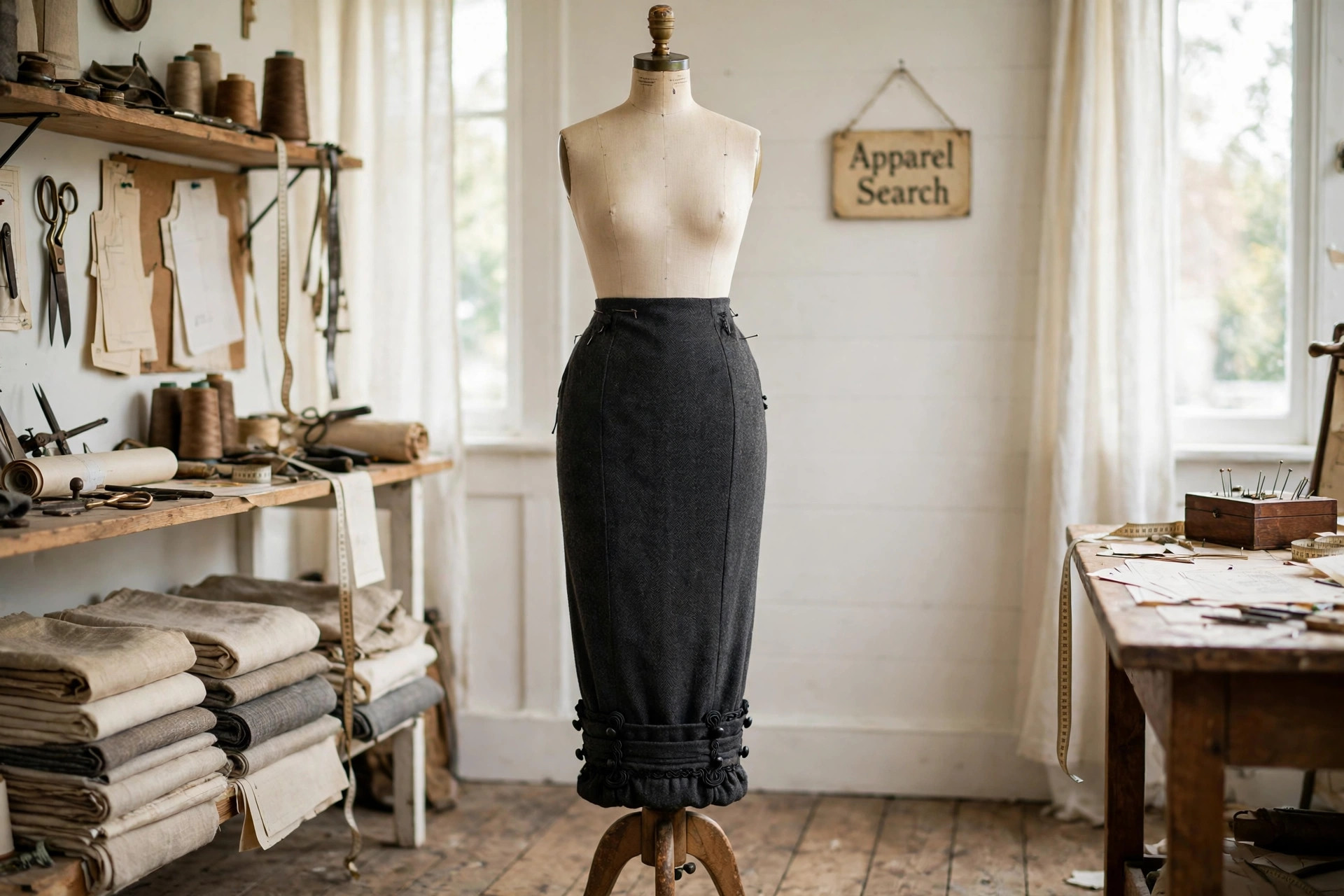
The defining feature is proportion, not decoration. An ordinary skirt allows the legs to separate as far as a walking stride requires; a hobble skirt is cut, or banded, so that below the knee the two legs are effectively held together inside a tube of cloth narrower than a stride. The effect is strongest at the ankle: the hem may be little wider than the wearer's two ankles side by side, sometimes emphasised by a band, a draped fold or a contrasting trim at the narrowest point. Above the restriction the skirt follows the fashionable line of its period — in the 1910s a high waist and a smooth, column-like fall from the hip — so the garment reads as an elegant narrow silhouette whose cost is paid entirely in movement.
That cost is the point of the name and of the definition. A wearer can stand, pose and walk slowly in short steps, but stairs, kerbs and any need to hurry defeat the garment. A hobble skirt is therefore not simply a tight skirt: many close-fitting skirts allow a full stride. It is a skirt whose hem crosses the line from narrow to stride-impeding, and that line — practical, not stylistic — is what the term has always marked.
The 1910s Trend and Paul Poiret
The trend is inseparable from Paul Poiret, the Paris designer who popularised the narrow ankle-length skirt in the years just before the First World War. Poiret is often said to have drawn the idea from Katherine Wright, sister of the Wright brothers, who tied a cord around her skirts below the knee when she flew with her brother Wilbur, to stop the fabric flapping in the wind. Photographs of her bound skirts were widely published, and the tied, narrow shape they showed became a fashionable silhouette in its own right.
For a few seasons the hobble skirt was the identifying silhouette of advanced fashion, drawn, photographed and caricatured everywhere. Its fame outlasted its sales: the shape became so emblematic of the period that the classic contoured glass bottle introduced for Coca-Cola in 1915 was nicknamed the hobble-skirt bottle after it. Restrictive skirts had precedents — they had first appeared in Western fashion in the 1880s — but the 1910s version was the extreme case, narrow at the ankle as a deliberate statement rather than as a by-product of cut.
Why It Faded, and the Pencil Skirt That Followed
The hobble skirt's impracticality was built into its definition, and everyday life withdrew its support. A hem that impedes the stride makes stairs slow, streetcars awkward and boarding the new motor cars — increasingly part of fashionable life — genuinely difficult. The trend faded within a few seasons, overtaken by wartime practicality and by wider, shorter skirts that allowed women to move, work and travel. The silhouette itself, however, never entirely disappeared: long, tight skirts returned through the century in evening dress, where a narrow skirt is worn for a short distance indoors rather than for a day of walking.
The hobble skirt's practical heir solved the mobility problem with one construction change. The pencil skirt — a straight, narrow skirt popularised in the 1950s — keeps the smooth, close line from waist to hem but is shorter, ending at or above the knee, and typically carries a slit or kick pleat at the back that opens as the wearer strides. The slit is the whole difference between the two garments: with it, a narrow skirt is wearable all day; without it, at ankle length, the same line becomes a hobble skirt. The cycle the pair illustrates — narrow hem, fame, impracticality, then a slit or a shorter length as the compromise — is the hobble skirt's lasting story in fashion.
The Hobble Skirt After Fashion
From at least the mid-twentieth century, the hobble skirt took on a second life in fetish fashion, where the restriction that ended its mainstream career is the garment's purpose rather than its flaw. In that context hobble skirts are made in leather, PVC or latex, cut to bind the legs closely, and they were a recurring subject in the 1950s fetish magazine Bizarre. The separate hobble skirt in fetish clothing has its own definition in this guide; the fashion garment and the fetish garment are the same construction — a skirt narrowed until the stride is hobbled — valued for opposite reasons.
Not to Be Confused With
A hobble skirt and a pencil skirt share the same smooth, narrow line, and the pencil skirt descends directly from the hobble skirt — but they part on the one point that defines the older garment. A hobble skirt is ankle-length and has no slit, so its hem genuinely impedes the stride. A pencil skirt ends at or above the knee and almost always has a back slit or kick pleat, so the wearer can walk normally. If the narrow skirt lets you stride, it is a pencil skirt; if it hobbles you, it has crossed into hobble skirt territory.
Common Questions
What is a hobble skirt?
A hobble skirt is a skirt with a hem narrow enough to significantly impede the wearer's stride. The term usually refers to the narrow ankle-length skirts of the early 1910s popularised by designer Paul Poiret.
Why is it called a hobble skirt?
It is named for the gait it imposes: to hobble is to walk with difficulty in short steps, and a hobble is also a device that ties an animal's legs together. The skirt's tight hem holds the wearer's legs together in the same way.
What is the difference between a hobble skirt and a pencil skirt?
A hobble skirt is ankle-length with no slit, so it restricts walking. A pencil skirt keeps the same narrow line but ends at or above the knee and usually has a back slit or kick pleat, so the wearer can take a normal stride.