Fantasywear
Clothing Definitions — definitions of garments and clothing terms from Apparel Search
Search Apparel Search
At a Glance
Definition: Fantasywear is a retail category of clothing, usually including lingerie, built around themed character costumes sold as complete ensembles — such as the French maid outfit — in materials such as PVC, satin or rubber.
Category: Clothing Definitions
Fantasywear is a style of clothing, usually including lingerie, built around themed character costumes. Such costumes are exemplified by the Fembot, French Maid and Fraulein outfit ensembles, and by the use of materials such as PVC, satin or rubber. As a clothing category it sits between lingerie and fancy dress: the garments are costume sets, sold complete with their character accessories. This page explains how the category is defined, the ensembles it standardly includes, and how it differs from both everyday lingerie and general costume.
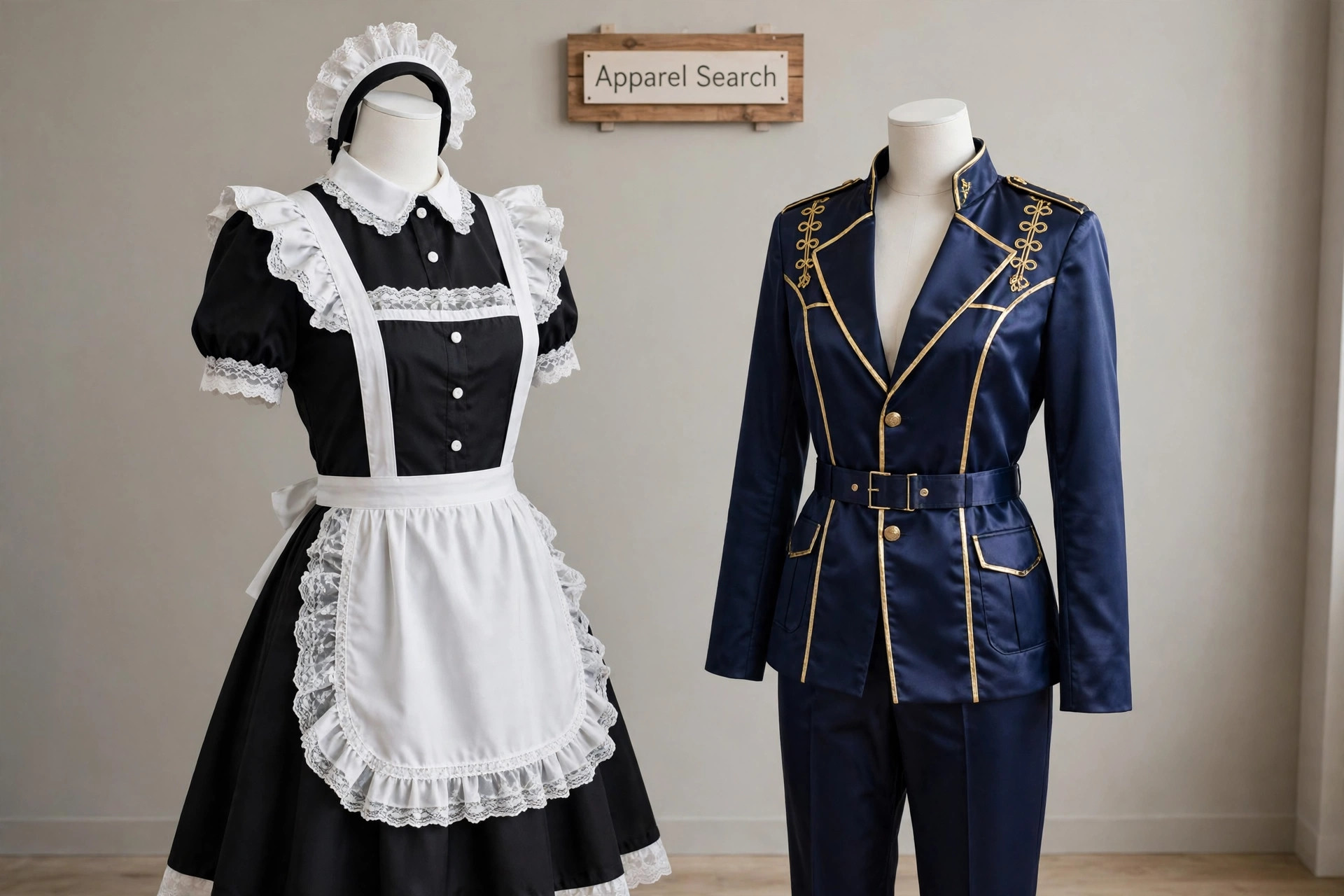
A Costume Category, Organised by Character
Fantasywear is organised differently from the rest of the lingerie trade. Ordinary lingerie is sold by garment type — bras, briefs, slips, nightgowns — while fantasywear is sold by character. Each product is a named ensemble: the maid, the nurse, the uniform and stage-character outfits that costume retailers stock as complete sets, with the dress, apron, cap, cuffs and other identifying pieces boxed together.
That is why the category is catalogued alongside fetish clothing in these definitions: the same retailers stock both, and the same materials — PVC, satin, rubber, lace and sheer synthetics — run through both ranges. A customer shopping the category is not buying a garment type but a character, and the catalogue is arranged to match.
The named ensembles recur across retailers because the characters are stock figures. The original definition's examples — the Fembot, the French Maid and the Fraulein outfits — are typical: each is a recognisable character type with a fixed costume, and a retailer can stock the type without designing anything. New ensembles are added when a new stock character appears in popular culture, and dropped when it fades, which makes a fantasywear catalogue a useful index of which characters were current when it was printed.
Costume Construction
As garments, fantasywear pieces are costume construction rather than everyday clothing construction. Seams, fastenings and fabrics are specified for appearance and short wear rather than for a working life of washing and daily use, sizes are usually simplified to a small range, and the identifying details — white lace trim on a black dress for the maid, for example — matter more than fit refinements.
The materials follow the character. PVC and rubber give a glossy, uniform-like finish; satin gives a softer, formal one; lace and sheer fabrics carry the lingerie side of the category. Because an ensemble must read as its character at a glance, makers keep the colour scheme and accessories standard even when the underlying garment — a dress, a babydoll, a catsuit, a corset — varies in cut.
Because the sets are sold complete, fantasywear is also merchandised differently: one box, one size range, one price for the whole character, where ordinary lingerie is priced piece by piece. The accessory pieces — apron, cap, cuffs, collar — are frequently the cheapest-made parts of the set, in thinner fabric than the main garment, because they are read at a glance and handled little. Replacement accessories are rarely sold separately, so a lost cap usually means a new set: another sign that the product is the character, not the clothing.
Quality in the category is judged by recognition, not by make. A well-made set is one whose character can be named from across a room; a poorly made one is a dress with accessories that suggest nothing in particular. That standard explains the category's conservative designs: makers copy the established ensembles closely, because a variation that weakens recognition weakens the product, where in ordinary fashion a variation is the product.
Between Lingerie and Fancy Dress
The category overlaps fancy dress at one end and lingerie at the other: a comparatively modest themed dress is effectively a costume, while the briefest sets are lingerie with a character theme. Individual garments move between the categories freely — the same French maid outfit is sold as fancy dress for a party and shelved with lingerie by another retailer.
For definition purposes the useful line is intent: fantasywear garments are made to represent a character, and that, rather than any single fabric or garment type, is what the term covers. A plain nightgown is lingerie; a nightgown trimmed and accessorised to represent a named character is fantasywear. The neighbouring terms in this group — the French maid outfit as its best-known ensemble, and the material-led terms such as spandex fetishism — are defined on their own pages.
In these definitions fantasywear is the category page for the themed-costume side of the fetish clothing group, just as fetish clothing is the category page for the material side. Readers looking for a specific ensemble should go to its own page — the French maid outfit above all — while readers looking for a material should go to the material terms. The category exists because retailers, catalogues and buyers all organise this part of the trade by character, and a definitions section that ignored the category would fail to match the words buyers actually use.
Common Questions
What is fantasywear?
Fantasywear is a style of clothing, usually including lingerie, built around themed character costumes, exemplified by outfits such as the French maid ensemble and made in materials such as PVC, satin or rubber.
How does fantasywear differ from lingerie?
Lingerie is underwear and nightwear in general. Fantasywear is themed: each garment set represents a character or uniform and is sold as a complete costume ensemble with matching accessories.
What materials are used in fantasywear?
Fantasywear commonly uses PVC, satin and rubber among its materials, chosen for the look of the character being represented, alongside the lace and sheer fabrics of lingerie.