Catsuit
Clothing Definitions — definitions of garments and clothing terms from Apparel Search
Search Apparel Search
At a Glance
Definition: A catsuit is a close-fitting one-piece garment with sleeves and long legs, sometimes with feet, gloves or a hood, made in leather, rubber, PVC, velour or spandex and used mainly in costume and stage contexts rather than sport.
Category: Clothing Definitions
Word Origin
A compound of cat and suit: a one-piece suit whose sleek, close fit and complete coverage give the wearer a feline silhouette. The same construction in sport and dance is called a unitard; the catsuit name belongs to the costume version of the garment.
A catsuit is a skin-tight one-piece garment with sleeves and long legs, and sometimes with feet or gloves, and sometimes with a hood. Unlike a unitard, its use rarely involves sports, and it may be made of leather, rubber, PVC or velour instead of spandex. It is identical to a unitard in construction, but the term catsuit tends to be preferred in fancy-dress costume contexts. This page explains the catsuit's construction, its materials, and how it differs from the unitard, bodystocking and jumpsuit.
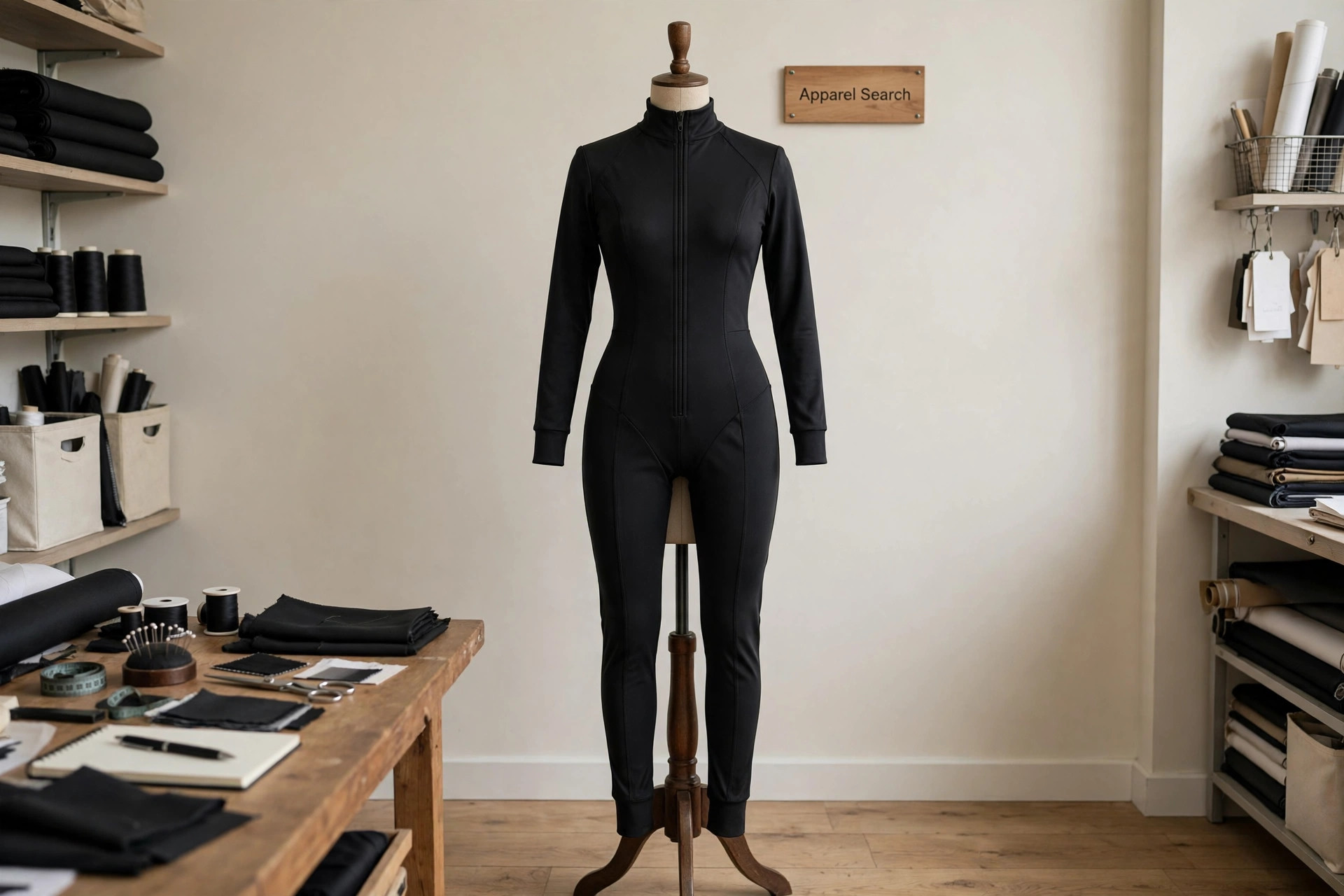
One Piece, Head to Ankle
The catsuit covers the body in a single garment: torso, sleeves and long legs are cut and sewn as one piece, with no waist join and no separate top or trousers. Optional extensions complete the coverage — feet sewn in like socks, gloves attached at the cuff, or a hood at the neck — so that in its fullest form only the face is uncovered. Because there is no waist seam to adjust, the garment is entered through a single opening, usually a long zip at the back or front, and fit is judged first at the torso length: a one-piece that is short in the body cannot be let out at the waist as a two-piece outfit can.
That construction is exactly the unitard's, which is why the two terms describe the same pattern. The difference the names carry is one of setting. A unitard is bought for dance, gymnastics or skating and is expected to stretch, breathe and wash; a catsuit is bought as a costume or stage garment and is expected to look like a second, glossier skin for the length of a performance or an evening.
Variants are named by their extensions. A catsuit with feet, gloves and a hood sewn in leaves only the face open, and in its stretch-fabric form that complete version is the garment also made as the zentai suit defined under spandex fetishism. A catsuit without those extensions is simply a one-piece with sleeves and legs, fastened by its zip. Sleeve and leg lengths are otherwise constant — the pattern does not come in short versions, because a one-piece that ends at the thigh or elbow is a different garment, a leotard or a playsuit, not a catsuit.
Material Decides the Character
In spandex, a catsuit is light, elastic and washable, and serves dancers, performers and costume wear. The stretch of the knit does the fitting: one size covers a range of bodies, seams can be simple, and the zip is a convenience rather than a necessity.
In leather, rubber or PVC the same pattern becomes a heavy, structured garment that must be cut and fitted much more precisely, because those materials stretch little or not at all. Closures — usually long zips — do the work that elasticity does in a knit version, panels must be shaped to the body in the cutting, and a poor fit cannot be pulled into place. Velour gives a softer, matte costume finish, between the two extremes. The material, more than the pattern, is therefore what a buyer is choosing: the pattern is constant across the whole family of one-piece garments.
Fitting is where the two material families diverge most sharply. A spandex catsuit is bought by size and stretches to fit; a leather, rubber or PVC catsuit is commonly made to measure, because a non-stretch one-piece must match the wearer's torso length, waist, hip and limb lengths simultaneously, and an error at any one of them cannot be disguised by the others. That is why the non-stretch versions are specialist, expensive garments while the stretch versions are ordinary costume-shop stock — the pattern is the same, the tolerance is not.
The One-Piece Family
The catsuit belongs to a family of one-piece garments that differ mainly in name, fabric and use. The unitard is the dance and gymnastics version, covering the torso and legs in one piece. The leotard covers the torso only and ends at the hip. The bodystocking is a sheer, stocking-weight version, worn as a layer rather than as an outer garment. The jumpsuit shares the one-piece construction — top and trousers joined — but is cut as ordinary clothing, usually looser, with a front opening, and is worn as daywear or workwear; the difference is set out in Catsuit and Jumpsuit Compared.
The catsuit sits between costume and clothing: the same pattern as a unitard, but made in the heavier or glossier materials of stage and fancy dress, and often finished with feet, gloves or a hood so the covering is complete. In this definitions section it is grouped with the other material-led garments of the fetish clothing pages and with spandex fetishism, the material term for the stretch-fabric version.
Not to Be Confused With
One construction, several names, told apart by use and material. The unitard is the sport and dance version, almost always in a stretch knit. The catsuit is identical in construction but is made in costume materials — leather, rubber, PVC, velour — and the term is preferred in fancy-dress and stage contexts. A bodystocking is the sheer, stocking-weight member of the family, worn as a layer. A jumpsuit shares the one-piece pattern but is cut as ordinary, looser clothing with a front opening.
Common Questions
What is a catsuit?
A catsuit is a close-fitting one-piece garment with sleeves and long legs, and sometimes with feet or gloves, and sometimes with a hood.
How does a catsuit differ from a unitard?
A catsuit is identical to a unitard in construction, but its use rarely involves sports, it may be made of leather, rubber, PVC or velour instead of spandex, and the term is preferred in costume contexts.
What materials are catsuits made from?
Catsuits may be made of leather, rubber, PVC or velour, as well as the stretch fabrics such as spandex that are standard for unitards and other one-piece garments.