The Difference Between a Catsuit and a Jumpsuit
One is a category, the other is its closest-fitting member
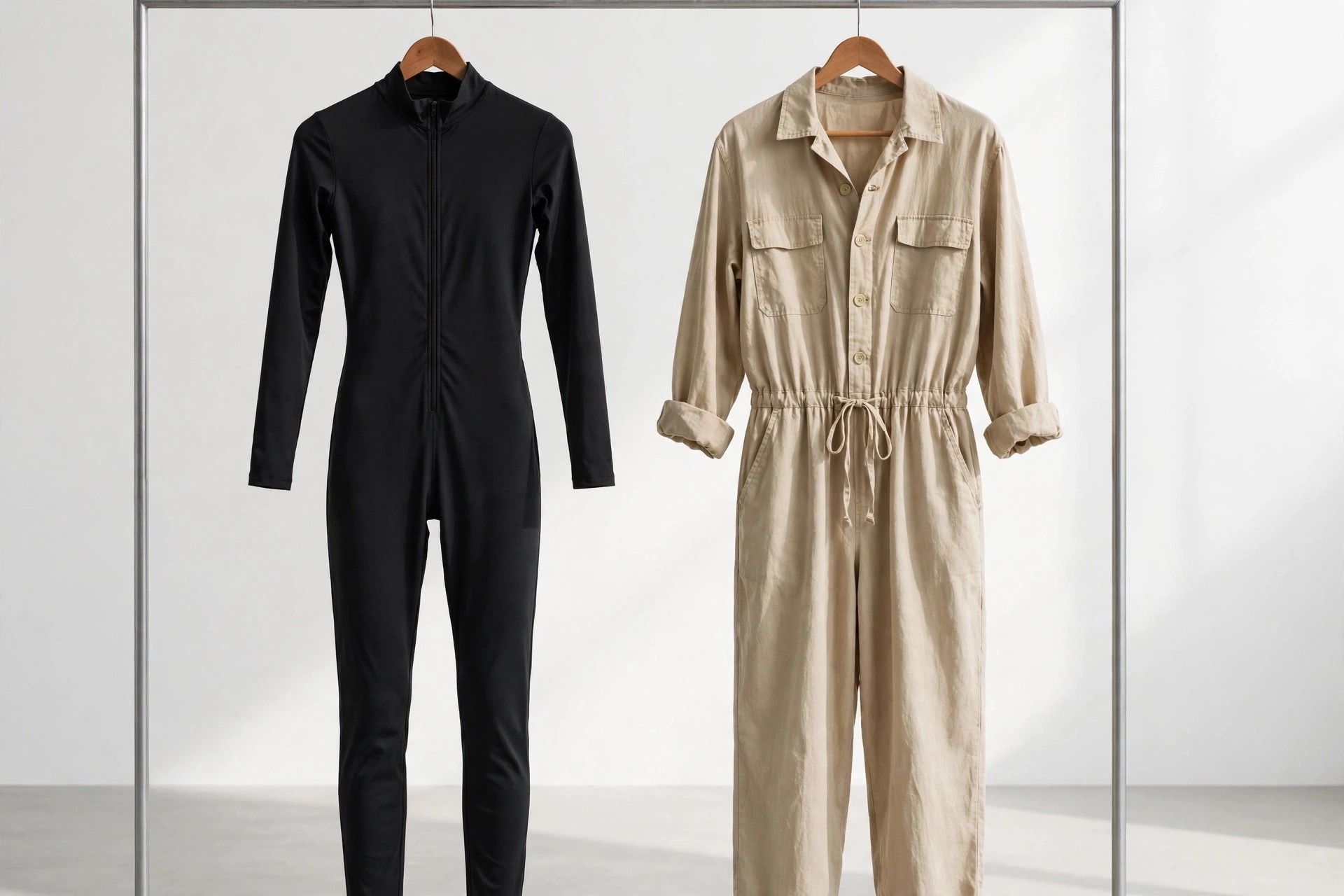
A catsuit is a type of jumpsuit: both are one-piece garments combining a top and trousers, but a catsuit is defined by its close, form-fitting cut, while a jumpsuit is the broader category and can be loose, relaxed, casual or dressy. In short, every catsuit is a jumpsuit, but most jumpsuits are not catsuits.
The practical differences come down to fit, fabric and coverage. Catsuits are usually made from stretchable materials that follow the body closely and frequently close with a zipper at the front or back. Jumpsuits allow a much wider range of fits, fabrics and designs, from functional work and uniform styles to elegant evening versions, and they are generally simpler, lighter and more flexible to wear.
Related Fashion Questions & Guides
What a Catsuit Is
A catsuit is a one-piece form-fitting garment that covers the torso and the legs, and frequently the arms. The close fit is the point of the design: the garment is cut to follow the body's outline rather than hang away from it, which is why stretch is built into the construction. Catsuits are usually made from stretchable materials such as lycra, spandex — in use after 1959 — chiffon, latex or velour, but they can also use less elastic materials such as leather or PVC, as well as fabrics such as lace or jersey.
Catsuits frequently close by means of a zipper at the front or back, since a close-fitting one-piece garment needs a full opening to be put on and taken off. The style was originally called a bodysuit in its early use, and the name catsuit has been around since approximately the mid-1950s. Because the fit is close throughout, a catsuit reads as a single continuous surface from neck to ankle, which distinguishes it visually from looser one-piece styles even at a glance.
What a Jumpsuit Is
A jumpsuit is a one-piece garment, typically with sleeves and legs and typically without integral coverings for the feet, hands or head, although sleeveless designs also exist. Put simply, it is a garment incorporating trousers and a top in one piece. The original jump suit was the functional one-piece garment used by people who parachute, and the form has kept that practical heritage: jumpsuits are worn as fashion items, protective garments and uniforms.
Within that broad definition the range is wide. A jumpsuit can be very basic workwear, can be a comfortable casual outfit, or can be a fashionable garment for a dressy evening out. Fit varies just as widely, from relaxed and flowing to tailored. That breadth is exactly why the catsuit sits inside the category rather than beside it: the catsuit takes the jumpsuit's one-piece structure and fixes the fit at the closest end of the scale. One shared practical note applies to both: unless a garment has an opening at the rear such as a drop seat, it must be removed entirely for bathroom use.
Fit, Fabric and Styling Context
Fit is the clearest way to tell the two apart on a rail. If the garment is cut close throughout, with the fabric held against the body by stretch, it is a catsuit. If there is ease, drape or a defined waist with volume in the leg, it is a jumpsuit in the general sense. Fabric follows fit: catsuits rely on elastic fibres such as lycra and spandex to achieve their fit, while jumpsuits appear in everything from denim and cotton to crepe and satin, with stretch optional rather than essential.
Styling context differs accordingly. Jumpsuits move easily between day and evening, work and leisure, because their looser fits pair naturally with belts, jackets and varied footwear. Catsuits are styled as a single statement layer, often worn under or over other pieces depending on the fabric and occasion, and their continuous close fit is the design feature rather than a backdrop for accessories. Related athletic garments point the same way: athletes in sports such as speed skating, bobsled, winter triathlon, ski racing, cycling, bodyflight and gymnastics wear similar close-fitting one-piece garments called unitards, which are specifically geared to the needs of the sport involved.
Close Relatives: Rompers, Boilersuits and Unitards
Two neighbouring terms complete the picture. A romper suit, usually shortened to romper and also known as a playsuit, is a one-piece or two-piece combination of shorts and a shirt. Its generally short sleeves and pant legs contrast with the long ones of the adult jumpsuit, which makes the romper the warm-weather, shorter member of the family rather than a true full-length jumpsuit.
A boilersuit, also known as coveralls, sits at the opposite, functional end: a loose-fitting garment covering the whole body except for the head, hands and feet, designed for protection during work. Set side by side, the family is easy to remember — coveralls are loose and protective, jumpsuits span the middle in every fit, rompers shorten the leg, unitards adapt the close fit for sport, and the catsuit is the jumpsuit's closest-fitting, stretch-based form.
Photos


Common Questions
Is a catsuit a type of jumpsuit?
Yes. A catsuit is a type of jumpsuit — a one-piece garment combining top and trousers. What sets it apart is fit and fabric: a catsuit is form-fitting, covers the torso and legs and frequently the arms, and is usually made from stretchable material. A general jumpsuit can be loose, relaxed, casual or dressy.
What are catsuits usually made from?
Catsuits are usually made from stretchable materials such as lycra, spandex, chiffon, latex or velour, because stretch is what achieves the close, form-fitting cut. Less elastic materials such as leather or PVC are also used, as are fabrics such as lace and jersey. Most catsuits close with a zipper at the front or back.
What is the difference between a catsuit and a unitard?
They are similar close-fitting one-piece garments, but a unitard is designed for a sport or activity. Athletes in speed skating, bobsled, ski racing, cycling and gymnastics wear unitards geared to the needs of their sport. A catsuit is the general fashion garment, covering the torso and legs and frequently the arms, in a wider range of fabrics.
If You Have More Questions About Fashion
You may want to try these sections here on Apparel Search: