Fetish Clothing
Clothing Definitions — definitions of garments and clothing terms from Apparel Search
Search Apparel Search
At a Glance
Definition: Fetish clothing includes any type of clothing and clothing materials which is commonly fetishised, including underwear, skin-tight clothing and footwear, and materials such as leather, fur, rubber, spandex and PVC.
Category: Clothing Definitions
Fetish clothing includes any type of clothing and clothing materials which is commonly fetishised. It is possible for almost any item of clothing to be the subject of a fetish. Commonly fetishised types of clothing include underwear, skin-tight clothing and footwear, and commonly fetishised materials include leather, fur, rubber, spandex and PVC. This page defines the category, its standard garments, and the line between fetish clothing and the functional clothing made from the same materials.
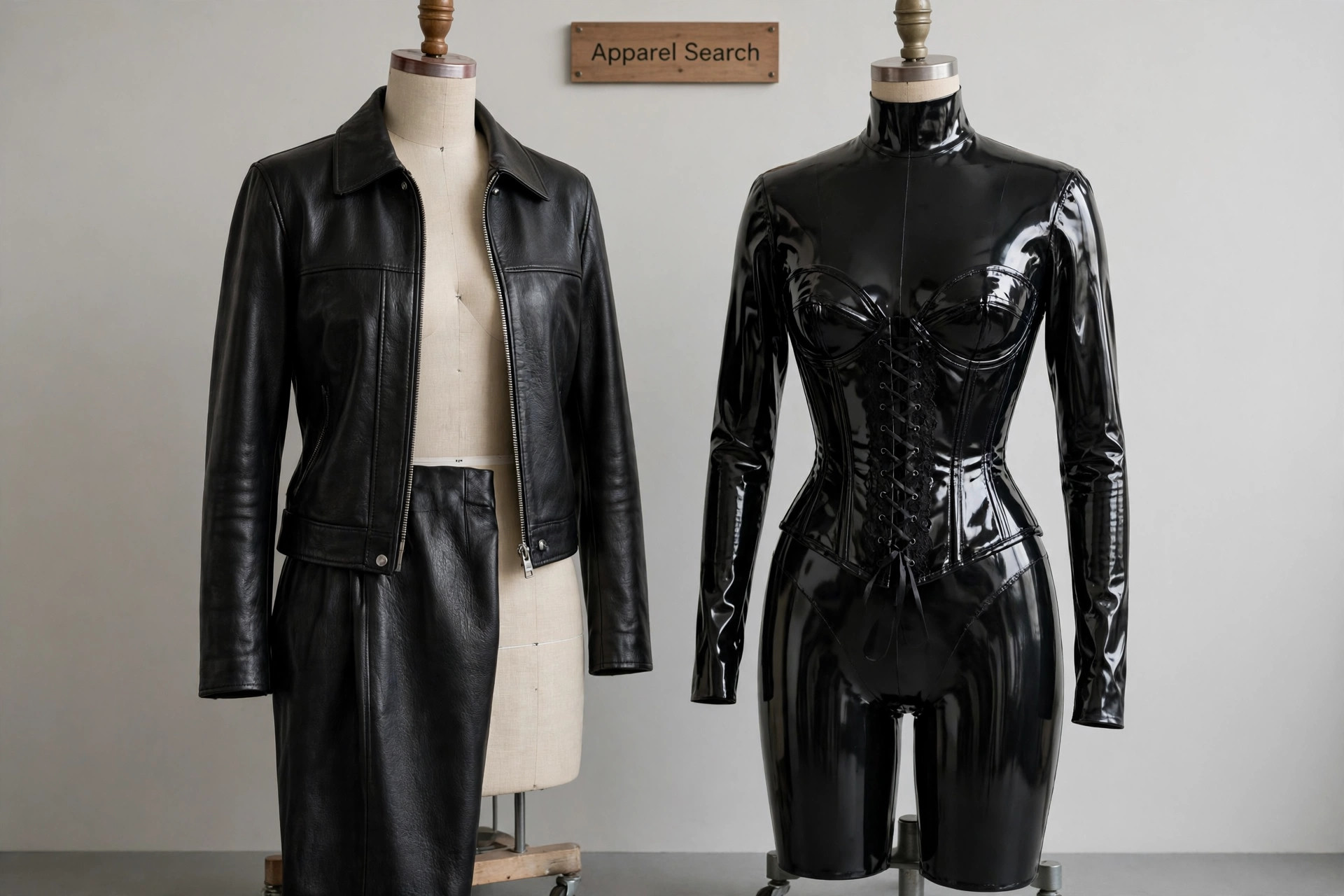
A Category Defined by Materials
The category is defined by materials as much as by garments. Leather, rubber, PVC and spandex share properties that ordinary clothing fabrics do not: shine, tightness, a second-skin fit, and strong associations with specific activities — motorcycling, diving, athletics — whose functional garments were adopted into fetish dress. Fur adds texture rather than shine, and footwear adds form: boots in particular cross constantly between work, riding, fashion and fetish use, which is why the same boot can appear in all four contexts.
Because the material is so often the point, the definitions in this group treat each material and garment on its own terms — spandex fetishism for the stretch fabrics, shoe fetishism for footwear, and garment pages for the catsuit, the corset and the thigh-high boot — under this general heading.
The word 'fetish' in the category name does the classifying; the clothing itself is ordinary clothing, defined elsewhere in this section by garment and material. That is why the group has no single construction, period or price range: a fur coat, a rubber diving suit and a pair of leather boots share nothing as garments. They are grouped because the same response attaches to them, and because retailers of one commonly stock the others — the category is a trade and catalogue category as much as a descriptive one.
Functional Clothing Is Not Necessarily Fetish Clothing
The materials named above are also commonly used in functional clothing, and clothes made of them are not necessarily fetishistic in nature. A leather jacket, a PVC raincoat and a spandex swimsuit are ordinary garments. The traffic also runs the other way: functional clothing has itself been fetishised, including riding boots, diving suits and industrial clothing such as hazmat suits and gas masks, whose protective, enclosing character is the point of interest.
For a definitions glossary the practical rule is that the category is decided by context and intent, not by fabric alone. The same garment can be workwear in one setting, fashion in a second and fetish clothing in a third, and its definition as a garment — its cut, construction and materials — does not change between the three.
The group's own pages illustrate the rule from both directions. The catsuit is an ordinary performer's garment in spandex and a fetish garment in rubber, with no change of pattern between them. The hobble skirt was a fashion garment in 1912 and is a fetish garment now, with no change of cut. Classification follows use and presentation — material, styling, retail setting — and a definition that fixed any of these garments permanently in or out of the category would be wrong within a decade.
Standard Garments and the Mainstream Crossover
Common items of fetish clothing include catsuits, thigh-high boots and leather body harnesses. The wider family defined in this section includes the babydoll and other lingerie, body stockings, stockings, pantyhose, garters and sheer fabrics, leggings, and garments such as the straightjacket that entered the category from other uses.
Fetish clothing has also fed mainstream fashion. Designers have repeatedly adopted its elements — thigh-high boots, leather harnesses, PVC coats, corsets worn as outerwear — and presented them as ordinary fashion, usually one element at a time and softened in material or styling. The traffic runs both ways: stage and screen costumes borrow fetish styling for effect, and high-street versions follow. For a definitions glossary the category matters because its terms are garment terms first: a catsuit or a thigh-high boot must be definable as clothing, whatever context it is worn in.
The pages in this group follow that organisation. Garment pages — the catsuit, corset, babydoll, hobble skirt, French maid outfit, hadaka apron, kinky boots and thigh-high boot — define the item first and record the fetish classification second. Material pages — spandex fetishism, shoe fetishism and clear plastic clothing — define the material or footwear class the interest attaches to. A reader who wants the garment should start from the garment page; this page is the map of the group, and its definitions are the ones the other pages assume.
Common Questions
What counts as fetish clothing?
Fetish clothing includes any type of clothing and clothing materials which is commonly fetishised, including underwear, skin-tight clothing and footwear, and materials such as leather, fur, rubber, spandex and PVC.
Is clothing in leather or PVC always fetish clothing?
No. Those materials are also commonly used in functional clothing, and clothes made of them are not necessarily fetishistic in nature; functional clothing such as riding boots and hazmat suits has itself sometimes been fetishised.
Which garments are common items of fetish clothing?
Common items of fetish clothing include catsuits, thigh-high boots and leather body harnesses, among the garments defined in this section.