Straitjacket
Clothing Definitions — definitions of garments and clothing terms from Apparel Search
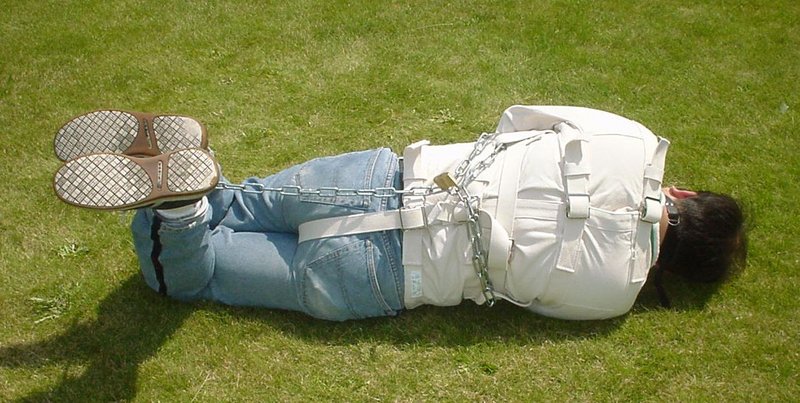
A straitjacket is a garment shaped like a jacket with overlong sleeves. The ends of the sleeves can be tied to the back of the wearer, so the arms are kept close to the chest with possibility of only little movement. Straitjacket is the most common spelling; strait-jacket is also frequent, and strait-waistcoat is an archaic English form. The spellings straightjacket and straight-jacket are valid alternatives, but the term comes from strait, meaning narrow or confined, so straitjacket is the preferable form. Straitjackets are used to restrain people who may otherwise cause harm to themselves or others.
|
If you believe in the Princess of Fashion you may need a straightjacket... Have you heard of the new shocking poll technology by Apparel Search. It was invented by Mr. Santa. |
Have you been sent to this web page because you may be thought of as crazy? Or possibly, you are researching straightjackets for someone else.
A straitjacket is a garment shaped like a jacket with overlong sleeves. The ends of these can be tied to the back of the wearer, so their arms are kept close to their chest with possibility of only little movement.
Although straitjacket is the most common form, strait-jacket is also frequently used, and, in England, strait-waistcoat (archaic). The spellings straightjacket and straight-jacket are now valid alternatives, although the original term came from strait meaning narrow or confined; thus straitjacket is preferable.
Straitjackets are used to restrain people who may otherwise cause harm to themselves and others. Its effectiveness as a restraint makes it of especial interest in escapology. The straitjacket is also a staple prop in stage magic and is sometimes used in bondage games.
The negative connotations straitjackets have as an instrument of torture come from the earlier era of Victorian medicine. Physical restraint was then extensively used both as treatment for mental illness and as a means of pacifying patients in understaffed asylums.
Institutional straitjackets tend to be made of canvas or duck cloth for material strength. Jackets intended as fetish wear or fashion items often use leather or PVC instead.
Security
The security of a straitjacket depends very much on its size, which should be as small as practicable to be secure. A jacket that is tight at the chest and armpits will make it much more difficult for the wearer to pull the arms out of the sleeves.
The sleeves of the jacket are typically sewn shut at the ends
a significant restraint in itself because it retards use of the hands. The
arms are then folded across the front, with the ends of the sleeves wrapping
around to fasten or tie behind the back. On some jackets, the sleeve-ends
are not anchored to the garment to allow the fastening or knot to rotate
away from the wearer's hands as they move their arms, making it more difficult
to undo.
Most jackets feature a crotch-strap to prevent the jacket from simply being lifted over the head. Roller buckles are commonly used to fasten institutional jackets with webbing or cloth straps because they are very difficult to open without a free pair of hands. For this reason, they are rarely used on jackets intended for stage magic.
Escape techniques
To remove a straitjacket with both back and crotch-straps, it is almost always necessary to be able to dislocate one's shoulders in order to gain the slack necessary to pull an arm out of the sleeves. Without this ability, only a very oversized one can be escaped from. Even then, this trick does not work with closed-collar jackets. It is sometimes possible to get more room by pulling at the inside of the arms as they're being strapped or by keeping an elbow held outward to gain slack in the sleeves when the arm is relaxed. Another way to gain slack is to take and hold a deep breath while the jacket is being done up.
It is possible for one person to put a willing volunteer into a straitjacket, but it generally takes at least two people to jacket a struggling person, and yet another to keep an eye out for such tricks.
For a jacket without a front strap, the most common way to escape is to hoist the arms over the head before undoing the crotch strap and at least the strap at the back of the neck. This allows the jacket to simply be peeled off upward over the head. The straitjacket escape was popularized by Houdini, who could dislocate both his shoulders. His magician brother, Hardeen, who also did the escape, could only dislocate one shoulder. Houdini first did it behind a curtain, forcing the audience to listen to thumps while watching a billowing curtain for many minutes. He found the trick went over better when the audience could see his struggles. In one of his later and more popular acts, he would perform the straitjacket escape while hung upside down from a skyscraper.
Precautions
Wearing an institutional straitjacket for long periods of time can be quite painful. Blood tends to pool in the elbows, where swelling may then occur. The hands may become numb from lack of proper circulation, and due to bone and muscle stiffness the upper arms and shoulders may experience excruciating pain. Thrashing around while in a straitjacket is a common, but mostly ineffective, method of attempting to move and stretch the arms.
Some jackets intended for fetish use include additional restraining features like wrist straps, lockable fastenings or opt to cross the arms behind the back. Again, these should be used cautiously and never for long periods, as they can interfere with circulation or make the jacket difficult to release in the event of emergency.
Don't be crazy.
| The above article is licensed under the GNU Free Documentation License. From Wikipedia, the free encyclopedia (https://en.wikipedia.org/wiki/straitjacket). 1/6/06 Modified by Apparel Search. |
Construction of a Restraint Garment
A straitjacket is built like workwear, not like dress clothing, because it has to withstand force. Heavy canvas or duck cloth forms the body, seams are placed and reinforced to resist tearing, and the closure is a series of straps and buckles up the back, where the wearer cannot reach them. The sleeves extend well past the hands and end in straps or loops; crossed over the chest and tied or buckled behind, they convert the wearer's own arms into the restraint. Extra straps at the crotch and collar on institutional designs stop the jacket being worked up or down the body. Every detail follows from the single purpose: a soft garment, with no rigid parts, that limits arm movement completely.
From Institution to Stage
The straitjacket belongs to the history of institutional care, where it was used to restrain people judged a danger to themselves or others, and modern practice has largely replaced such garments with other methods of care and de-escalation. Its cultural afterlife is larger than its current use: the jacket became a stage property of escapology, most famously in the escapes of Harry Houdini, and from there a general metaphor in everyday speech for anything rigidly confining, a set of rules, a contract, a routine. The metaphor only works because the garment itself is so well understood: everyone knows what the crossed, tied sleeves mean. As a clothing definition, the straitjacket is the limiting case of a jacket, a familiar garment form turned entirely to function.
Common Questions
Why is it spelled straitjacket rather than straightjacket?
The first element is strait, meaning narrow or confined, not straight. Straitjacket and strait-jacket are the historically grounded spellings, and strait-waistcoat is an archaic English variant. The straight- spellings are now accepted alternatives, but straitjacket remains preferable.
How does a straitjacket restrain the wearer?
The garment is shaped like a jacket but its sleeves are overlong. The ends of the sleeves are tied to the back of the wearer, which keeps the arms folded close to the chest with only a little movement possible.
Why are straitjackets used in escapology?
Because the garment's effectiveness as a restraint is precisely what makes escaping from it a test of skill. Its restraint value gives it especial interest in escapology, where performers are secured in the jacket and escape in view of an audience.
More to Explore
- Princess of Fashion
- new shocking poll technology
- Mr. Santa
- garment
- jacket
- canvas
- leather
- PVC
- Coats
- Fetish Clothing
- Ski Jacket
- Clothing Definitions
- Safari Jackets
- Trench Coat
- Parka Definition
- Anorak
- Overcoat
- Poncho
- Petticoat
- Frock Coat
- Morning Coat
- Bekishe
- Waistcoat
- Blazer
- GNU Free Documentation License
- https://en.wikipedia.org/wiki/straitjacket