Thigh-High Boots
Clothing Definitions — definitions of garments and clothing terms from Apparel Search
Search Apparel Search
At a Glance
Definition: Thigh-high boots are boots rising along the legs up to and above the knees, to the thigh; they are often considered to be kinky boots, used as fetish clothing in shoe fetishism, but the height is also a recurring mainstream fashion style.
Category: Clothing Definitions
Thigh-high boots are boots rising along the legs up to and above the knees. They are often considered to be kinky boots, used as fetish clothing in shoe fetishism, but the height is also a recurring mainstream fashion style and descends from functional riding and military boots. This page explains the boot's defining measurement — a shaft that reaches the thigh — its materials and heel forms, and how it differs from the go-go boot and the riding boot.
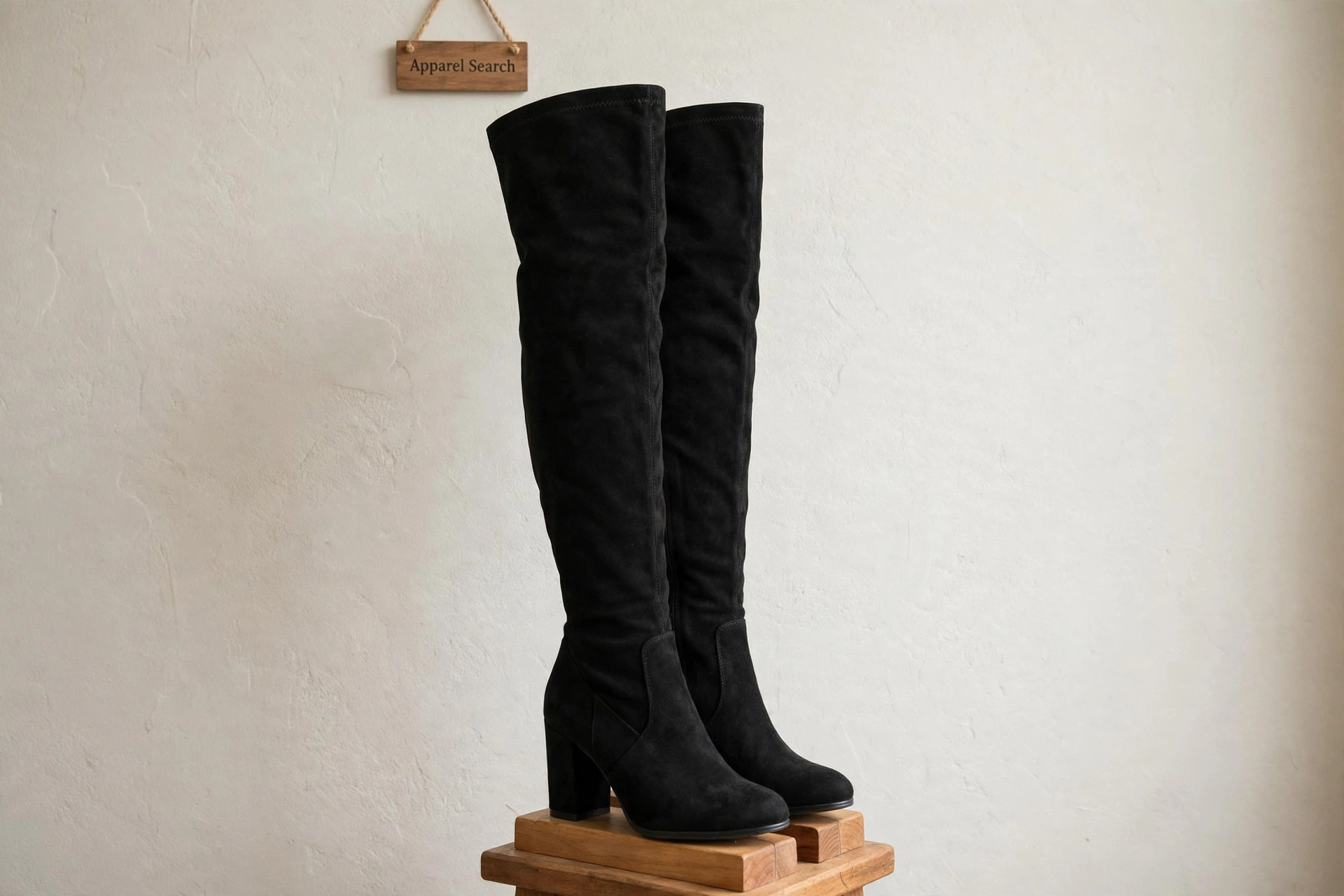
Height Is the Definition
Boot names are mostly height names. Ankle boots, knee boots and over-the-knee boots mark points on the leg, and thigh-high is the top of that scale: the shaft continues past the knee to mid-thigh or higher. The name is a measurement, and everything else about the boot — material, heel, fastening — can vary without changing the term.
That extra length changes the boot's construction. A knee boot can stand in firm leather; a thigh-high shaft in soft material collapses unless it is closely fitted, made in a stretch fabric, held by the leg's shape, or supported by straps or garters. Fashion versions solve the problem with stretch suede and synthetic panels; fetish versions with tight leather or PVC; stage versions with zips and elastic gussets. Keeping the shaft up is the style's defining engineering problem, and each market answers it differently.
Fastenings are dictated by the shaft. A pull-on thigh-high boot must stretch at the top or be cut wide enough to pass the knee, which works against the close fit the style wants; most therefore close with a long inside zip, and leather versions may lace or buckle at the thigh to adjust the top. Elastic gussets at the back of the shaft are the fashion compromise — invisible from the front, they let a non-stretch material flex at the knee and grip above it.
From Riding Boots to Fashion Cycles
The style's history runs through riding boots and cavalry boots, where a high shaft protected the leg against the saddle, the horse and the ground, into twentieth-century fashion, where the height became the point. The functional boot supplied the pattern; fashion supplied the reasons to wear it without a horse.
In the 1960s the go-go boot stopped at or below the knee; thigh-high fashion boots appeared at the decade's end and have returned in cycles since, usually with short hemlines, since the boot's effect depends on the shaft being seen. Within the footwear definitions, thigh-high boots sit alongside riding boots as the functional ancestor and kinky boots as the fetish category they are most often placed in.
The fashion revivals follow a pattern of their own. The boot returns when hemlines are short and legs are the focus of a silhouette, is worn first by performers and in editorial fashion, reaches ordinary retail in softened materials and lower heels, and recedes when hemlines lengthen. Through every cycle the construction problems and their solutions — stretch panels, zips, gussets, close fitting — remain the ones set out above, because the measurement that defines the boot does not change.
Materials, Heels and the Fetish Category
Thigh-high boots are made with the standard heel forms, including stiletto heels, platform soles and block heels, and with the full range of high-heeled and flat constructions, in materials from leather to stretch synthetics that hold the shaft up. Heel height is independent of shaft height: the tallest boot can be flat, and the fetish versions are not defined by their heels but by their fit and finish.
They are often considered to be kinky boots, used as fetish clothing in shoe fetishism, and boots made for that market are typically cut higher, tighter and glossier than fashion versions of the same height. The definition, however, stays with the measurement: a thigh-high boot is a boot that reaches the thigh, in whatever material, heel or context, and it is catalogued in this group because the fetish classification is the one under which the style is most consistently sold and searched for.
Styling follows the measurement. Because the boot covers most of the leg, it is worn where the leg is otherwise bare or in close trousers or leggings, and hemlines in its fashion revivals are set to meet or clear the shaft top. Worn under a long skirt the boot is indistinguishable from a knee boot, which is why the style's revivals are always short-skirt revivals too. As a definition, thigh-high remains the clearest of the boot-height terms: it is the only one that names a point above the knee joint itself rather than at or below it.
Not to Be Confused With
Adjacent heights on the same scale. An over-the-knee boot stops just above the knee. A thigh-high boot continues well past it, to mid-thigh or higher — that extra shaft length is the definition, and it is what creates the style's construction problem of keeping the shaft up. The thigh-high boot is also the boot most often meant by kinky boots, but the two terms are not interchangeable: thigh-high names a measurement, kinky boots an association.
Common Questions
What are thigh-high boots?
Thigh-high boots are boots rising along the legs up to and above the knees. They are often considered to be kinky boots, used as fetish clothing in shoe fetishism.
How do thigh-high boots differ from go-go boots?
Go-go boots are the fashionable, usually white, low-heeled boots of the 1960s, typically reaching the knee or below. Thigh-high boots are defined by greater height, rising above the knee to the thigh.
What heel forms do thigh-high boots use?
Thigh-high boots are made with the standard heel forms, including stiletto heels, platform soles and block heels, in materials from leather to stretch synthetics that hold the shaft up.