Kinky Boots
Clothing Definitions — definitions of garments and clothing terms from Apparel Search
Search Apparel Search
At a Glance
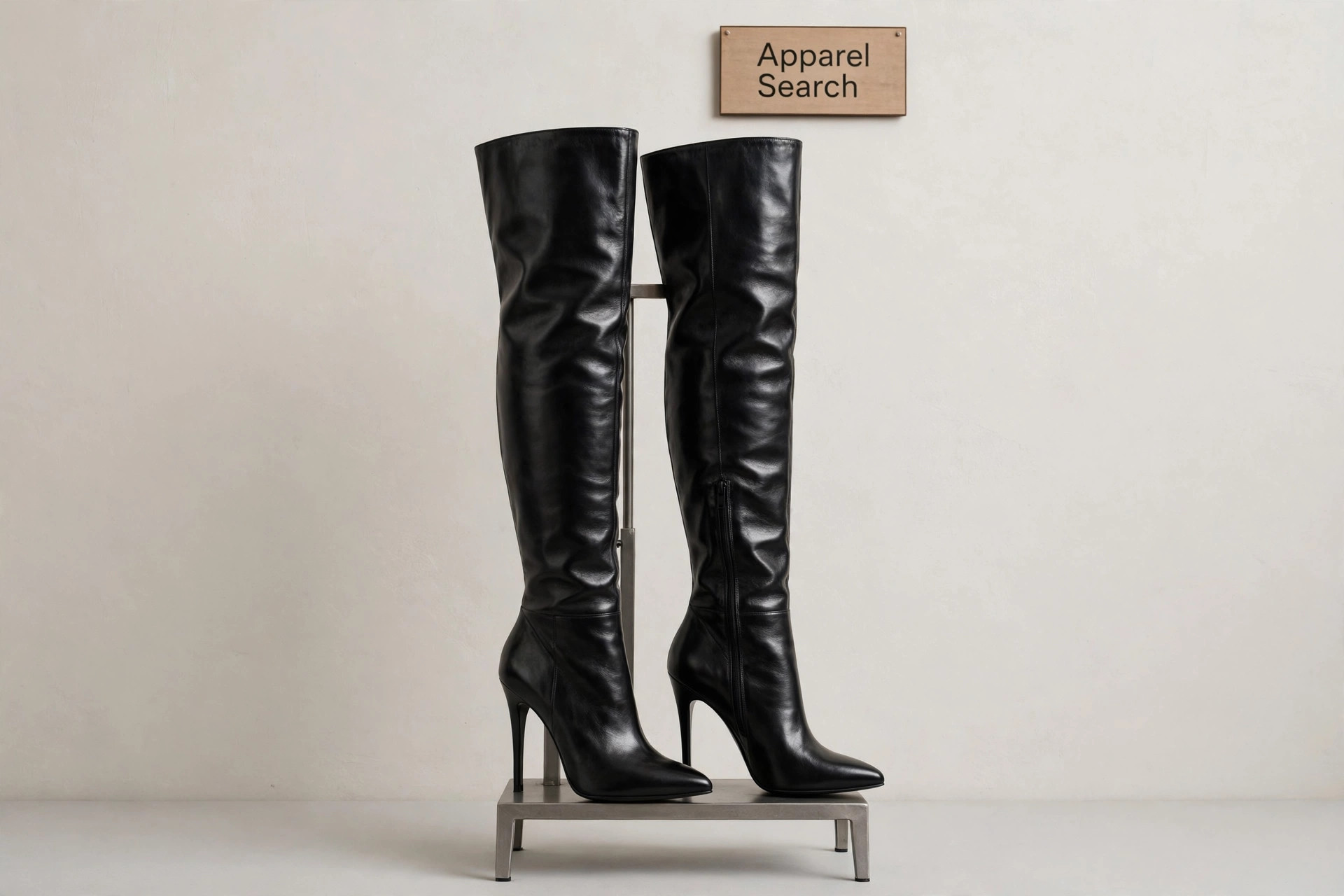
Definition: Kinky boots are boots that are intended for, or by some people connected to, shoe fetishism, and thus a form of fetish clothing; the term most often refers to thigh-high boots.
Category: Clothing Definitions
Kinky boots are boots which are intended for, or by some people are connected to, shoe fetishism, and thus a form of fetish clothing. The term is ambiguous, since what can be considered kinky by some can be seen as elegant and trendy by others. It is most connected with the thigh-high boot, as worn by Julia Roberts in the film Pretty Woman and by Madonna on her Re-Invention world tour in 2004. This page explains the term and the boot styles it overlaps — thigh-high boots, go-go boots and riding boots.
An Ambiguous Term
Kinky boots is a context term, not a construction term. No measurement, material or heel height defines it: the same boot can be read as elegant and trendy in a fashion editorial and as fetish clothing in another setting, and the original definition is explicit that the term is ambiguous for exactly that reason. What the word records is an association in the reader's mind, not a feature the maker built in.
Two appearances fixed the association for the general public. Julia Roberts wore thigh-high boots as her character's signature footwear in the film Pretty Woman, and Madonna wore the style on her Re-Invention world tour in 2004. In both cases the boots were presented as bold, glamorous styling — which is the ambiguity in action: the garments most connected with the term are also mainstream fashion images.
In retail use the term is a search and shelving word. Buyers look for it, so sellers title high leather boots with it even when the same boots are also listed as fashion footwear, and a single product can carry both descriptions in different listings. That dual listing is the ambiguity operating commercially: the word does not change the boot, it changes the audience the boot is offered to.
The Thigh-High Boot at the Centre
The thigh-high boot is the garment at the centre of this term, and it has never belonged to one world. As footwear it is a practical height — over-the-knee boots began as riding and military boots, where the high shaft protected the leg — and as fashion it returns in cycles, worn with short skirts in the 1960s, in film costume, and on pop tours, each time as a bold but mainstream style.
The other reading is the fetish one. Within shoe fetishism, high boots — especially in leather, with high heels — are a standard focus, and boots made for that market are cut higher, tighter and glossier than fashion versions. The construction questions are the same in both worlds — shaft height, heel, material, fastening — while the category question is one of intent and styling, which is why this definitions section treats kinky boots under both footwear and fetish clothing.
Boots sold under the kinky boots name share the thigh-high pattern's construction features, whatever their styling: a shaft cut to stay up on the thigh by fit, stretch or fastening, a zip or lace closure long enough to admit the foot into so tall a boot, and heel forms borrowed from fashion footwear, from flat to stiletto. The fetish versions differ from fashion versions in degree rather than in kind — a higher shaft, a tighter leg, a glossier leather, a higher heel — which is why no catalogue can draw a clean line between the two, and why the term remains a label of association rather than of specification.
Related Boot Styles
The related terms follow the same split between fashion and function. Go-go boots are the white, low-heeled fashion boot of the 1960s dance floor — a named style with a fixed period and look. Riding boots are the functional boot from which many high boot styles derive, built for the saddle rather than for appearance. Thigh-high boots are the height category itself, defined on their own page.
Kinky boots, by contrast, names none of these precisely. It is best understood as the label applied, from outside, to whichever of these boots is being worn or sold in a fetish context — most often the thigh-high boot in leather with a high heel. Retailers use the term because buyers search for it; definers keep it because the association it names is a real part of how the footwear is classified and sold.
The term's history in popular culture runs through music and film as much as through retail: the boots were a recurring visual shorthand for bold, theatrical femininity in 1960s entertainment, long before the Pretty Woman and Madonna appearances the original definition cites. Each revival of the thigh-high boot in fashion revives the word with it, because the association the word names is re-made every time the boot is worn as a statement rather than as weather protection.
Not to Be Confused With
A height term and a context term for the same boot. Thigh-high boots are named by measurement — the shaft rises above the knee to the thigh — whatever the setting. Kinky boots are named by association: boots intended for, or connected with, shoe fetishism. A thigh-high fashion boot worn on the street is not necessarily a kinky boot, and the boots sold as kinky boots are almost always thigh-high in cut, higher, tighter and glossier than the fashion version.
Common Questions
What are kinky boots?
Kinky boots are boots intended for, or connected by some people to, shoe fetishism, and thus a form of fetish clothing. The term most often refers to thigh-high boots.
Why is the term kinky boots ambiguous?
The term is ambiguous since what can be considered kinky by some can be seen as elegant and trendy by others; the same thigh-high boot appears in mainstream fashion, film costume and fetish clothing.
Which boot styles are related to kinky boots?
Related styles are the thigh-high boot, which the term most often describes, and the go-go boot, the fashionable boot of the 1960s; riding boots are the functional boot from which many styles derive.