Hazmat Suit
Clothing Definitions — definitions of garments and clothing terms from Apparel Search
Search Apparel Search
At a Glance
Definition: A hazmat suit is an overall garment worn to protect the wearer from hazardous materials or substances, made from heavy PVC or rubber or from Tyvek-type material treated to repel hazardous chemical, biological or radioactive material, and worn with or without its own oxygen supply.
Category: Clothing Definitions
Word Origin
Hazmat is a contraction of hazardous materials — the chemicals, biological agents and radioactive substances the suit is worn against. The clipped name comes from the emergency-services and transport world, where hazardous materials are placarded, classified and handled as "hazmat" for short.
A hazmat suit is an overall garment worn by people to protect themselves from hazardous materials or substances. The materials that make up the garment include heavy PVC or rubber and Tyvek, a paper-like material that has been treated to repel hazardous chemical, biological or radioactive materials. These suits may or may not include accompanying oxygen supplies to aid the wearer with breathing under adverse conditions. The suit is the outermost layer of a protective system: what level of suit a job requires depends on whether the hazard is a splash, a vapour, or an atmosphere that cannot be breathed at all. Of the environmental suits, it is the member most often seen by the public.
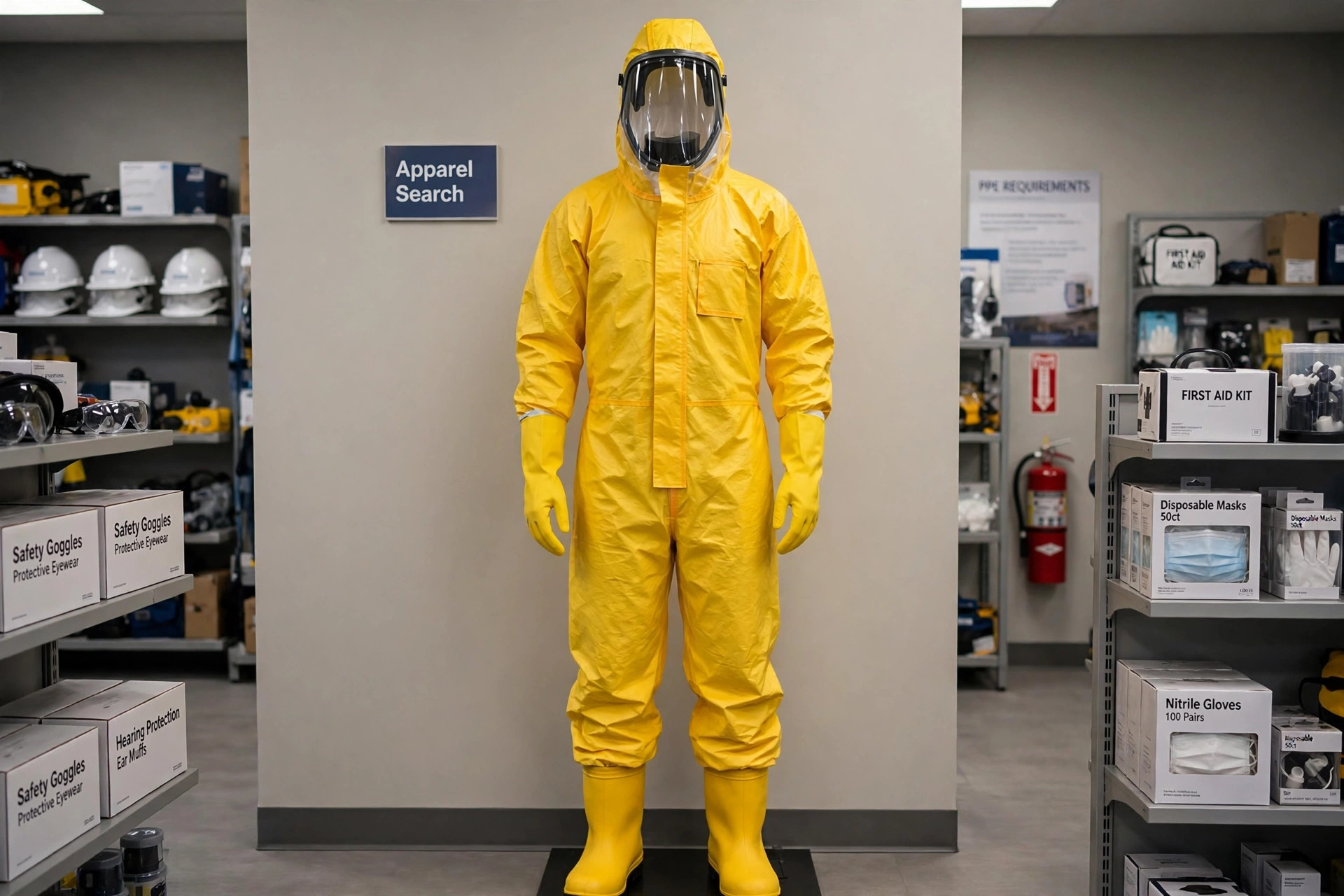
A Barrier Against Hazardous Materials
The hazmat suit's job is absolute separation: the hazardous material must not touch skin, lungs or eyes at all. Heavy PVC or rubber gives chemical resistance and survives repeated decontamination, so suits of those materials are inspected and reused. Tyvek-type spunbonded fabrics — paper-like sheets treated to repel hazardous chemical, biological and radioactive material — serve for lighter, often disposable suits, which are cut off after one use and discarded as hazardous waste. Seams are sealed or taped, since a stitched seam is a line of holes through the barrier, and closures, gloves and boots are integrated or sealed to the suit so the whole system has no gap.
Whether the suit carries its own air depends on the hazard. Where the air itself is dangerous or unknown, the suit is worn with an accompanying oxygen supply or a self-contained breathing apparatus, and the highest-protection suits are fully encapsulated, with the breathing set inside the suit. Where the hazard is only contact with liquids or particles, a suit without its own air supply, worn with a respirator, can be enough — and is far less burdensome to work in.
The three hazard families in the definition — chemical, biological and radioactive — stress the barrier differently. Chemicals attack materials, so suit fabrics are chosen for resistance to the specific substances expected. Biological hazards are particles and organisms, stopped by an intact, sealed surface. Radioactive contamination is likewise a particle problem: the suit keeps contaminated dust off the skin and is itself treated as contaminated when it comes off. One garment form serves all three because the underlying requirement is the same: nothing crosses.
Levels of Protection
In the widely used American system, protection is graded in levels. Level A is the highest: a fully encapsulated, vapour-tight suit with breathing apparatus inside, for atmospheres immediately dangerous to life. Level B gives the same breathing protection with a less gas-tight suit, for splash hazards. Level C uses air-purifying respirators where the hazard and its concentration are known. Level D is ordinary work clothing with minimal protection.
The level is chosen from the hazard assessment before anyone enters the site — the suit is selected by the job, never by habit. That grading is what makes the hazmat suit a system rather than a garment: the same wearer, at the same spill, may correctly work in a disposable coverall or in a fully encapsulated suit, depending entirely on what the assessment says about the material and the air.
The deciding questions are the ones in the definition of the suit itself: is the hazard a splash, a vapour, or an atmosphere that cannot be breathed at all? A splash hazard can be met by a chemical-resistant suit and a respirator. A vapour hazard demands a gas-tight barrier. An atmosphere that cannot be breathed demands that the suit bring its own air — and at that point the hazmat suit has converged with the space suit and the atmospheric diving suit: a sealed, self-contained environment worn on the body.
One Part of a System
A hazmat suit never works alone. Around it sit the procedures that make it effective: hazard assessment to choose the suit level, inspection before use, supervised dressing that checks every seal, a buddy system while working, time limits set by heat stress inside an impermeable suit, and decontamination on exit, where the suit is washed down and removed in a sequence that keeps its contaminated outside away from the wearer's skin. The suit's weakness is the wearer: inside a sealed, impermeable garment the body cannot shed heat, so work periods are short and monitored, whatever the suit itself could withstand.
Chemical plants and refineries keep suits for leaks and maintenance on hazardous lines. Fire services and dedicated hazmat teams respond to transport accidents and spills. Laboratories and hospitals use lighter suits and coveralls against biological hazards, and nuclear sites use related suits against radioactive contamination. The hazmat suit belongs to the environmental suit family, but it is the member most often seen by the public, in news pictures of spill responses, precisely because its bright, sealed, whole-body form signals that the material being handled must not touch skin, lungs or eyes at all.
Common Questions
What is a hazmat suit made of?
Heavy PVC or rubber for chemical resistance and repeated decontamination, and Tyvek-type spunbonded fabrics, paper-like sheets treated to repel hazardous chemical, biological and radioactive material, for lighter, often disposable suits. Seams are sealed or taped, since a stitched seam is a line of holes through the barrier, and closures, gloves and boots are integrated or sealed to the suit so the whole system has no gap.
Does a hazmat suit include breathing equipment?
It may or may not. Where the air itself is dangerous or unknown, the suit is worn with an accompanying oxygen supply or a self-contained breathing apparatus, and the highest-protection suits are fully encapsulated, with the breathing set inside the suit. Where the hazard is only contact with liquids or particles, a suit without its own air supply, worn with a respirator, can be enough, and it is far less burdensome to work in.
What are the levels of hazmat protection?
In the widely used American system, Level A is the highest: a fully encapsulated, vapour-tight suit with breathing apparatus inside, for atmospheres immediately dangerous to life. Level B gives the same breathing protection with a less gas-tight suit, for splash hazards. Level C uses air-purifying respirators where the hazard and its concentration are known. Level D is ordinary work clothing with minimal protection. The level is chosen from the hazard assessment before anyone enters the site.