Space Suit
Clothing Definitions — definitions of garments and clothing terms from Apparel Search
Search Apparel Search
At a Glance
Definition: A space suit is a complex system of garments, equipment and environmental systems designed to keep a person alive and comfortable in the harsh environment of outer space, providing stable internal pressure, breathable oxygen, temperature regulation, radiation shielding, micrometeoroid protection, mobility and communications.
Category: Clothing Definitions
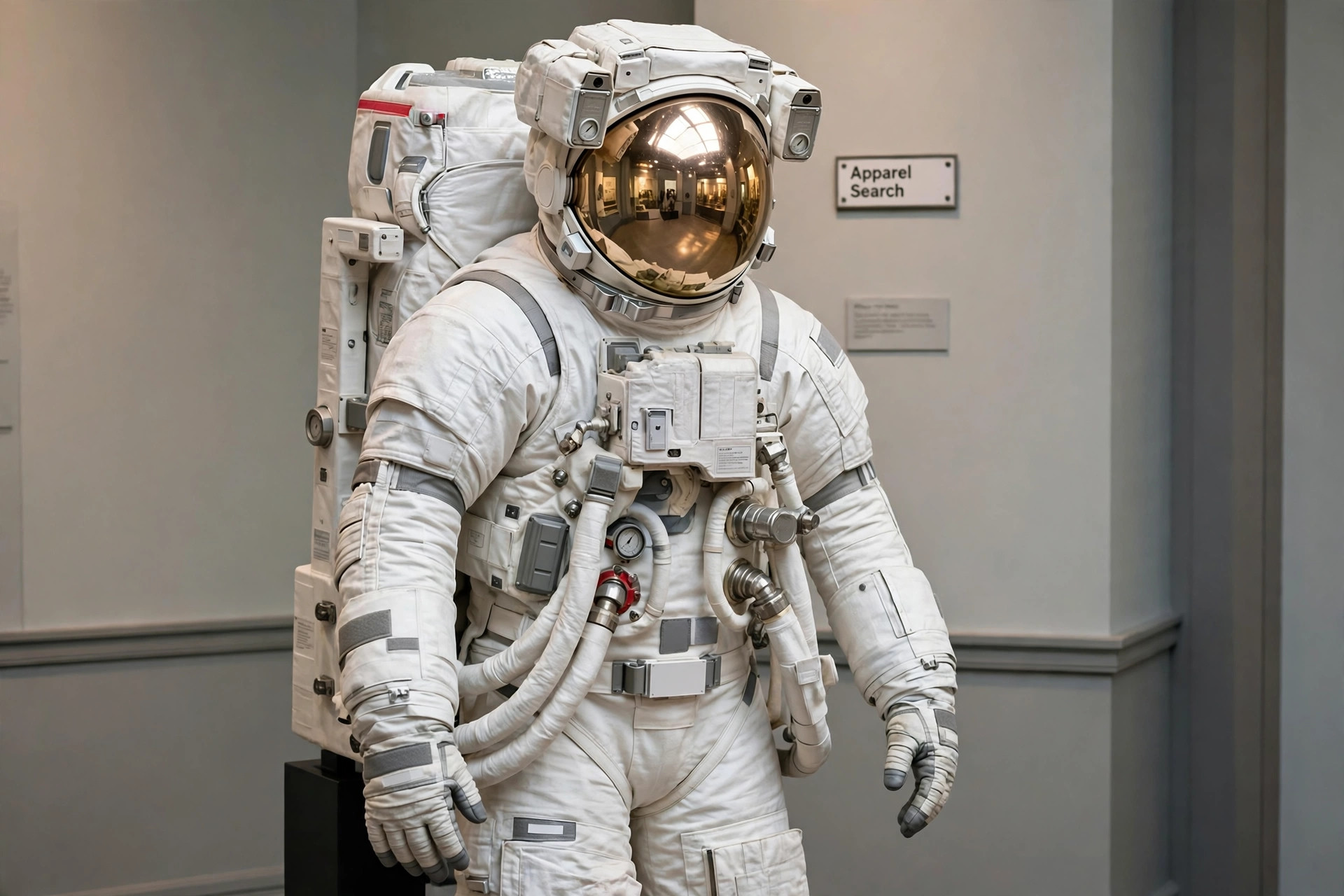
A space suit is a complex system of garments and equipment and environmental systems designed to keep a person alive and comfortable in the harsh environment of outer space. It applies to extra-vehicular activity outside spacecraft orbiting Earth, and has applied to walking, and riding the Lunar Rover, on the Moon. Some of its requirements also apply to pressure suits worn by people such as high-altitude fighter pilots, who may fly so high that breathing pure oxygen at surrounding pressure would not provide enough oxygen for them to function. The space suit is the most complete environmental suit ever made — and, for all its engineering, it remains a garment: cut, layered, jointed and worn.
On This Page
Spacesuit Requirements
Several things are needed for the spacesuit to function properly in space. It must provide a stable internal pressure — this can be less than Earth's atmosphere, as there is usually no need for the spacesuit to carry nitrogen. It must provide breathable oxygen, usually with a rebreather used along with a supply of fresh oxygen. It must provide temperature regulation: heat can only be lost in space by thermal radiation, or conduction with objects in physical contact with the suit, and since heat is lost very slowly by radiation, a space suit almost always has only a cooling system, with heavy insulation on the hands and possibly the feet.
It must also provide electromagnetic radiation shielding and micrometeoroid protection; mobility; a communication system; means to recharge and discharge gases and liquids; and a means to manoeuvre, dock, release and tether on spacecraft. Read as a list, it is the specification of a small spacecraft. Read as clothing, it is a list of everything a garment has ever been asked to do, extended until the garment becomes the wearer's whole environment — the endpoint of the line that begins with the diving suit.
The Constant-Volume Problem
A space suit should allow its user natural and unencumbered movement, and the only way this is possible is for the suit to maintain a constant volume no matter what position the wearer is in. Mechanical work is needed to change the volume of a constant-pressure system: if moving an arm or hand changes the volume of the suit, the astronaut has to do extra work every time that joint bends, and has to maintain a force to keep the joint bent. Even if this force is very small, it can be seriously fatiguing to constantly fight against your suit, and it makes delicate movements very difficult.
The most common solution is to form the suit out of multiple layers. The bladder layer is a rubbery, airtight layer, much like a balloon. The restraint layer goes outside the bladder and provides a specific shape for the suit: since the bladder layer is larger than the restraint layer, the restraint takes all the stresses caused by the pressure of the suit, and since the bladder is not under structural stress, it will not "pop" like a balloon even if punctured. The restraint layer is shaped so that bending a joint causes pockets of fabric, called gores, to open up on the outside of the joint — making up for the volume lost on the inside, and keeping the suit at a constant volume. Once the gores are opened all the way, however, the joint cannot be bent any more without a considerable amount of work. In some Russian spacesuits, strips of cloth were wrapped tightly round the spaceman's arms and legs outside the suit to stop it ballooning in space. One inconvenience with some spacesuits is the head being fixed facing forwards, unable to turn to look sideways: astronauts call this effect "alligator head".
Four Design Approaches
There are three classical theoretical approaches, and a fourth that abandons gas pressure altogether. Flexible pressure suits are the kind most in use: they combine heavy weight, the need for a cooling suit, and difficult motion because the suit wants to blow up like a balloon — their one saving grace is that they do not limit the range of motion. Hard-shell suits are usually made of metal or composite materials; while they resemble suits of armour, they are also designed to maintain a constant volume, but they tend to be difficult to move, as they rely on bearings instead of bellows over the joints, and often end up in odd positions that must be manipulated to regain mobility.
Mixed suits have hard-shell parts and fabric parts: NASA's Extravehicular Mobility Unit uses a hard-shell torso and fabric limbs, putting the shell where the body bends least and fabric where it bends most. Skintight suits, or mechanical counterpressure suits, use a heavy elastic body stocking to compress the body: the head is encompassed in a pressurised helmet, but the rest of the body is pressurised only by the elastic effect of the suit, which eliminates the constant-volume problem and reduces the possibility of depressurisation — though these suits are very difficult to put on and face problems providing constant pressure everywhere. Most proposals use the body's natural sweat to keep cool. See space activity suit for more information.
From High-Altitude Suits to the Moon
Related preceding technologies include the gas mask used in the Second World War, the oxygen mask used by pilots of high-flying bombers, the high-altitude or vacuum suit required by pilots of the Lockheed U-2 and SR-71 Blackbird, the diving suit, the rebreather, scuba diving gear and many others. The development of the spheroidal dome helmet was key in balancing the need for field of view, pressure compensation and low weight. Wiley Post experimented with a number of hard-shell designs for record-breaking flights, at the head of the line of flown suits: the Russian suits of Yuri Gagarin's era, the Orlan suits for extra-vehicular activity and the Sokol suits worn by Soyuz crew members during lift-off and re-entry; then the Mercury high-altitude/vacuum suit, the Gemini spacewalk suits, the Apollo lunar surface suits, Skylab, and the Space Shuttle suits.
Fiction imagined suits long before engineers built them, and may have influenced real design somewhat — at least in getting real spacesuits to use a hard helmet rather than a soft pressurised hood. In H. G. Wells's The First Men in the Moon (1901), standard diving dresses are fitted with a big backpack cylinder each and used as spacesuits; the Dan Dare series, from April 1950, gave its Spacefleet a corselet like standard diving dress; skintight spacesuits appear in the original Buck Rogers comics, familiar enough to give us the expression "Buck Rogers outfit" for real protective suits; and Robert Heinlein's Have Space Suit, Will Travel drew on his experience designing pressure suits during the Second World War. After NASA started, fictional spacesuits often followed real design — above all in the large rectangular backpack that became the suit's silhouette.
Space Suits Today
The design questions have not changed — pressure, mobility, cooling, protection — but a new generation of suits is being built for a return to the Moon and for commercial spaceflight. The SpaceX flight suit carries the flight-suit line into commercial crew flight, a pressurised suit worn inside the spacecraft for launch and landing. For work on the lunar surface, the Prada × Axiom moon suit applies fashion-house construction to the extra-vehicular problem — a reminder that a space suit is still, in the end, a made garment, and that who makes it, and how it is cut and joined, still decides how well it works. Our spacesuit guide follows the modern suits in full.
Not to Be Confused With
The space suit is the pressure suit carried to completion. A pressure suit maintains pressure for breathing where the atmosphere is thin but still present, and may be a partial, emergency garment. A space suit must work in complete vacuum, where there is no atmosphere at all — so on top of pressure it must supply all breathing gas, temperature regulation, radiation shielding, micrometeoroid protection, mobility and communications as a self-contained system. Every space suit is a pressure suit; a pressure suit becomes a space suit only when it can replace an entire environment.
Common Questions
What must a space suit provide?
A space suit must provide a stable internal pressure, breathable oxygen, temperature regulation, electromagnetic radiation shielding, micrometeoroid protection, mobility, a communication system, and means to recharge and discharge gases and liquids and to maneuver, dock, release and tether on spacecraft.
Why are space suits built in layers?
The common construction uses a rubbery, airtight bladder layer, much like a balloon, inside a restraint layer that gives the suit its shape and takes the stresses of pressure. The restraint is shaped so that bending a joint opens fabric pockets called gores on the outside of the joint, making up the volume lost inside and keeping the suit at constant volume.
What are the main space suit design approaches?
Flexible pressure suits, the kind most in use; hard-shell suits of metal or composite, which rely on bearings at the joints; mixed suits with a hard-shell torso and fabric limbs, such as NASA's Extravehicular Mobility Unit; and skintight mechanical counterpressure suits, which use a heavy elastic body stocking to compress the body.