Atmospheric Diving Suit
Clothing Definitions — definitions of garments and clothing terms from Apparel Search
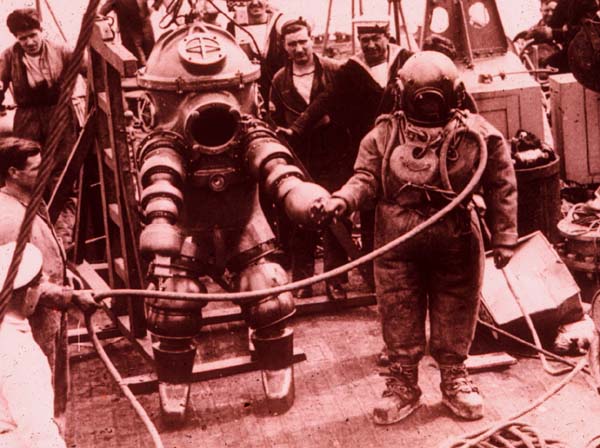
An atmospheric diving suit, or ADS, is a small one-person, human-shaped articulated submersible that provides the diver with an environment at one atmosphere of pressure at any depth. It can be used for very deep dives, to 600 metres or 2,000 feet, for many hours, without the normal hazards of depth such as decompression sickness and nitrogen narcosis. It solves most of the problems encountered by ambient pressure divers using breathing apparatus, and it is used only in professional diving. The suits look like suits of armour, with elaborate pressure joints that allow articulation while resisting the large difference between inside and outside pressure.
They look like suits of armour, with elaborate pressure joints to allow articulation while resisting the large difference between the inside and outside pressure. They are often made from aluminium, weigh around 250 kg/500 pounds, and have propellers so they can move in water. They are often lowered from a support vessel, which supplies breathing gas, electric power and communications to the suit through an umbilical cable. The suit may have its own rebreather-type breathing system in case the umbilical supply fails.
| The above article is licensed under the GNU Free Documentation License. From Wikipedia, the free encyclopedia ( https://en.wikipedia.org/wiki/atmospheric_diving_suit ). Apparel Industry definition modified by Apparel Search 8/2/05 |
 |
Armour That Dives
The ADS is best understood as armour engineered against pressure rather than weapons. Water pressure rises by about one atmosphere every ten metres, so at working depth the pressure difference across the suit's shell can reach tens of atmospheres, trying to crush every joint seal. The elaborate pressure joints are the heart of the design: rotary joints at the shoulders, elbows, hips and knees that rotate freely for the wearer while their seals hold the difference. The occupant works the suit's arms from inside, and manipulators or gloved hands at the arm ends do the work on the seabed, inspecting, sampling and repairing structures such as pipelines and oil platforms.
Life Support Through the Umbilical
Like the standard diving dress of the helmet era, the modern ADS usually works tethered. The support vessel above supplies breathing gas, power and communications down the umbilical, and handles launching and recovery, since a suit weighing about 250 kilograms is not something a diver climbs into from a beach. The onboard rebreather is the safety net: if the umbilical supply fails, the suit's own breathing system keeps the occupant alive while the suit is recovered. Endurance is the payoff for all this engineering, many hours at depths no ambient pressure diver could work at, with no decompression time owed on the way up. Among special suits the ADS is the extreme case of the environmental suit idea: a complete wearable environment, closer to a space suit in its life-support demands than to any garment, built for the most hostile workplace on Earth that humans regularly visit.
Common Questions
How does an atmospheric diving suit protect the diver?
By keeping the inside of the suit at one atmosphere, the pressure at the surface, regardless of the water pressure outside. Because the occupant never breathes gas at depth pressure, there is no nitrogen build-up in the body, so decompression sickness and nitrogen narcosis, the two great hazards of deep ambient pressure diving, do not arise, and the diver can be brought straight back to the surface.
What is an atmospheric diving suit made of and how does it move?
The suits are often made from aluminium, weigh around 250 kilograms or 500 pounds, and have propellers, or thrusters, so they can move in the water. They are usually lowered from a support vessel, which supplies breathing gas, electric power and communications through an umbilical cable, and the suit may carry its own rebreather-type breathing system in case the umbilical supply fails.
How is an ADS different from a wetsuit or drysuit?
Completely different in principle. Wetsuits and drysuits are ambient pressure suits: the diver inside them is at the pressure of the surrounding water and breathes compressed gas, with all the limits that imposes. An ADS is a hard, atmospheric pressure suit, effectively a one-person submersible shaped like a person, with articulated limbs instead of a diver's own movement through the water.