Union Suit
Clothing Definitions — definitions of garments and clothing terms from Apparel Search
Search Apparel Search
At a Glance
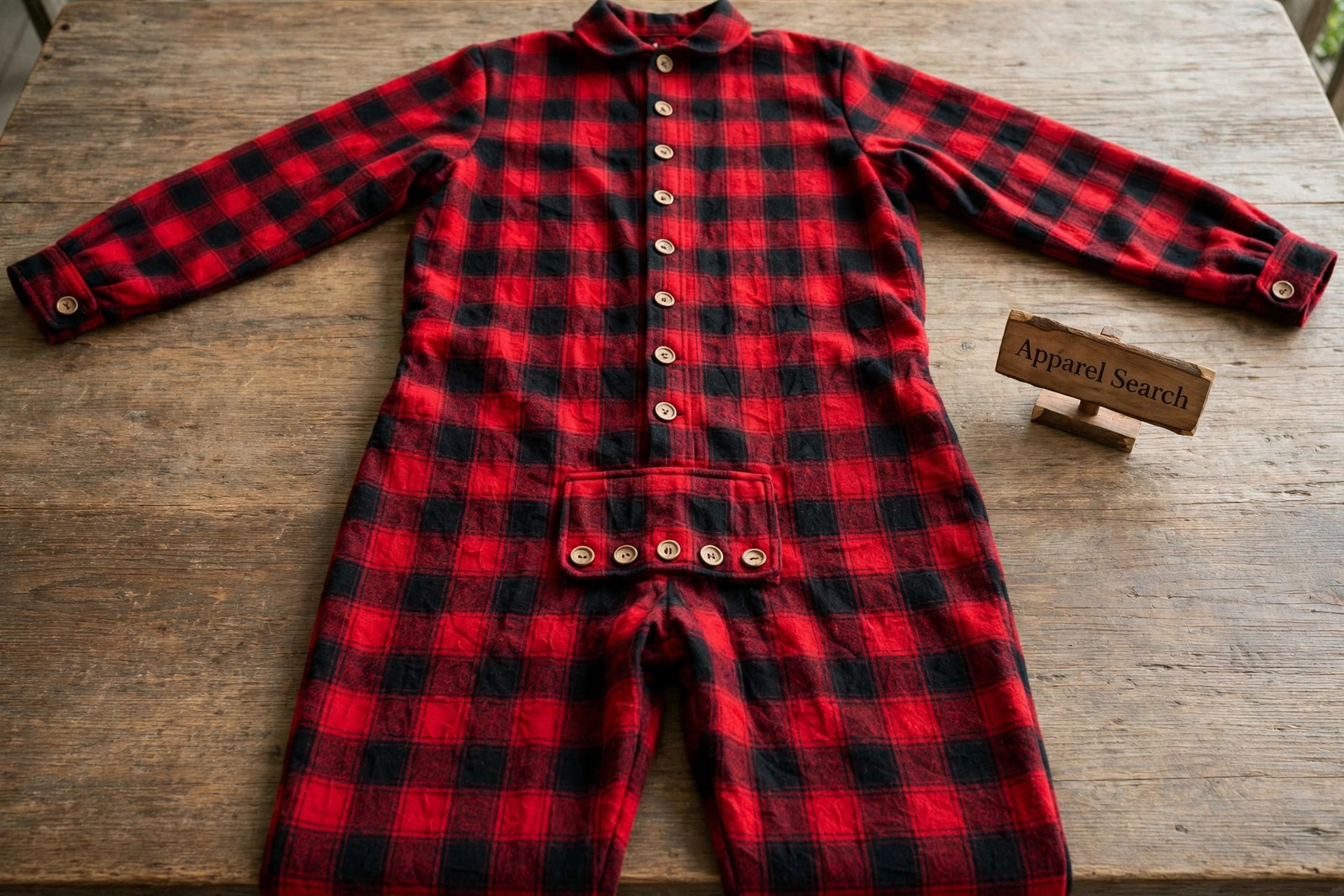
Definition: A union suit is a one-piece form of long underwear with long sleeves and long legs, traditionally made of red flannel, buttoning up the front and fitted with a button-up rear access hatch.
Category: Clothing Definitions
Word Origin
The name records the construction: the suit united what had been two separate undergarments — the shirt above and the drawers below — into a single garment, eliminating the gap at the waist.
A union suit is a type of one-piece long underwear long favoured by men in North America until recent times. Traditionally made of red flannel with long arms and long legs, it buttoned up the front and had a button-up rear access hatch. It was cold-climate engineering in a single garment: covering torso, arms and legs with no gap at the waist where cold air could enter — the weak point of every two-piece outfit. Normally no other underwear was worn with it.
One Garment for the Whole Winter
The union suit's design solved the practical problems of dressing in a cold house. The front buttons let the wearer get in and out of it, and the rear access hatch solved the problem of the privy without undressing in an unheated room. In a house heated by one stove, worn under work clothes through a week of farm or logging labour, it was less a fashion choice than part of the heating system.
It was not uncommon up until the mid-1900s for rural men to wear the same union suit continuously all week, or even all winter. That reputation is really a comment on laundry: heating the water and washing a heavy flannel suit by hand was a major task. One of the major events of the spring was the time when the union suits were finally removed, washed, and put away for the summer — a small seasonal ceremony that marked the end of winter as surely as any calendar.
The red flannel version became the visual shorthand for the garment: warm, hard-wearing, and cheerful in colour. Red flannel was the traditional cloth, but the form mattered more than the colour — a single knitted or woven suit, close enough to hold warm air against the body, substantial enough to stand between the wearer and a draughty farmhouse.
Construction and Cloth
The construction was dictated by the job. A union suit had to go on once and stay comfortable under a full set of work clothes for a long day, so the cut was plain: a knitted or woven body with long sleeves and long legs, a full row of buttons up the front, and the button-up hatch at the rear. There were no separate waistbands to dig in and no shirt tail to come untucked — the two failure points of two-piece underwear under physical labour simply did not exist.
The traditional cloth was red flannel, a soft, napped fabric that traps warm air against the skin and stands up to hard wear and hard washing. Flannel's warmth-to-weight made it the cold-country underwear cloth of its era, and the red dye hid the grime of a working week better than undyed cloth would have. A garment expected to be worn continuously, in some cases all winter, had to be chosen for exactly those virtues: warmth, toughness, and indifference to dirt.
Why Two Pieces Won
Central heating, indoor plumbing and the washing machine removed the conditions that made the union suit necessary. Today, most people — both men and women — favour two-piece long underwear, also known as "long johns". The two-piece form washes and dries faster, lets the wearer size top and bottom separately, allows just the top to be worn on a milder day, and is far easier for children and older wearers to manage than a one-piece suit with a full row of buttons.
The union suit survives as a novelty, a costume reference, and in modern one-piece base layers made for extreme cold, where its original advantage — no gap at the waist — still counts. But its working life as everyday North American underwear ended with the world that required it: the unheated house, the outdoor privy, and the weekly wash.
Not to Be Confused With
One piece or two? The union suit is a single garment — top and legs united, buttoning up the front, with a button-up rear access hatch. Long johns are the two-piece form of long underwear — a separate top and a separate pair of long drawers, worn together. The union suit came first as everyday wear; the two-piece long johns are what most people buy today.
Common Questions
What is a union suit?
A union suit is a type of one-piece long underwear with long arms and long legs. It was long favoured by men in North America, traditionally made of red flannel, buttoning up the front with a button-up rear access hatch.
What replaced the union suit?
Most people today — both men and women — favour two-piece long underwear, also known as long johns. The two-piece form is easier to wash, size and adjust than the one-piece suit.
How was the union suit traditionally worn?
Normally no other underwear was worn with it, and up until the mid-1900s it was not uncommon for rural men to wear the same union suit continuously all week, or even all winter, with the spring removal and washing of the suits a major seasonal event.