Environmental Suit
Clothing Definitions — definitions of garments and clothing terms from Apparel Search
Search Apparel Search
At a Glance
Definition: An environmental suit is a suit designed specifically for a particular environment, usually one otherwise hostile to humans — typically a one-piece, often completely sealed garment, with a helmet or other head covering, of which diving suits, pressure suits, space suits and hazmat suits are all members.
Also known as: Environment suit
Category: Clothing Definitions
An environmental suit is a suit designed specifically for a particular environment, usually one otherwise hostile to humans. An environment suit is typically a one-piece garment, and many types also feature a helmet or other covering for the head. Where the surrounding environment is especially dangerous, the suit is completely sealed. The first environmental suits were diving suits, designed to protect a diver from the surrounding water. Later developments protected the wearer from cold, in wetsuits and other ambient pressure suits, from undersea high pressure and decompression sickness, in atmospheric diving suits, and from contamination, in hazmat suits. This page is the general definition behind the whole special suits family.
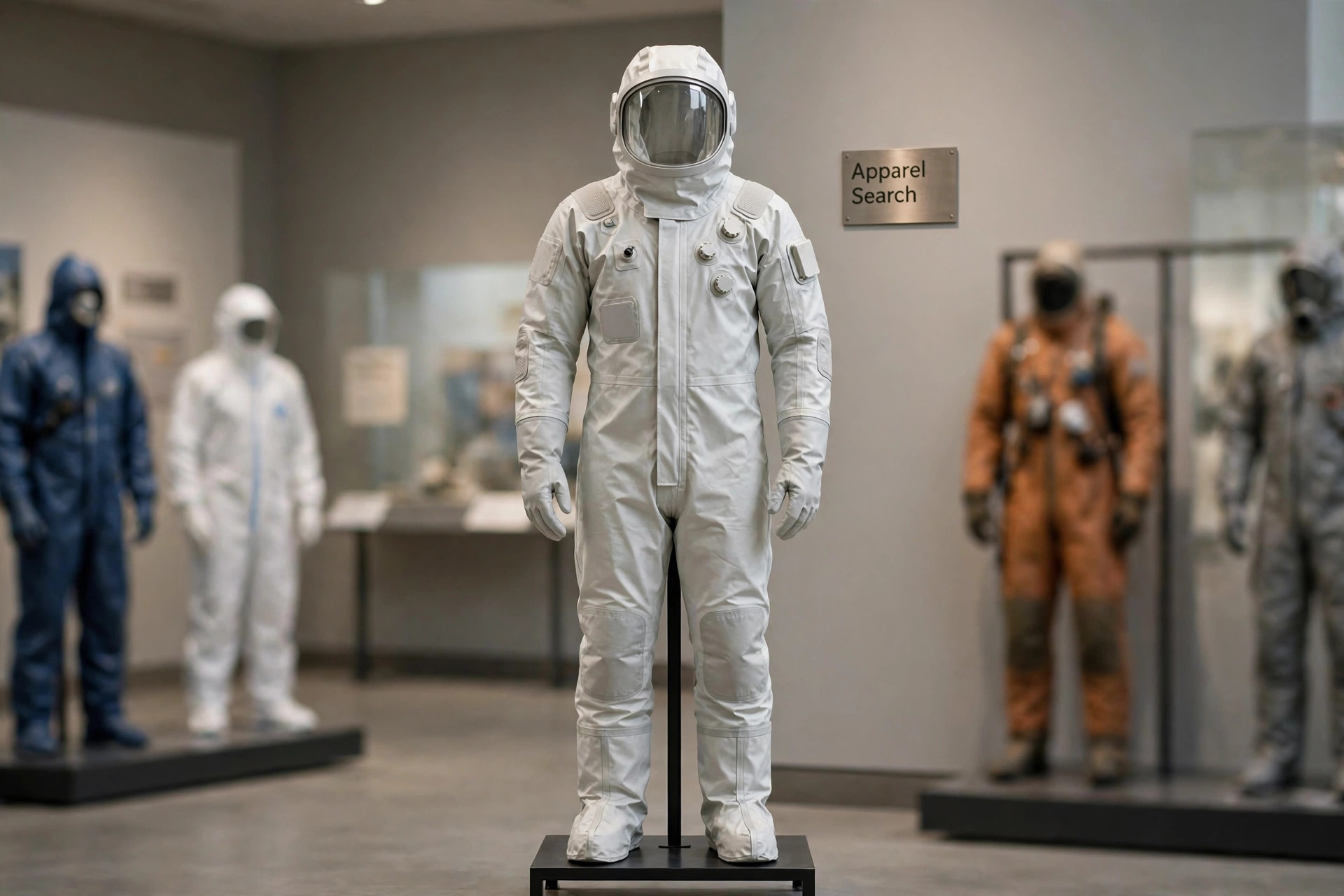
One Idea, Every Hostile Place
The environmental suit is the general category behind a shelf of specialised garments, and the special suits section of this glossary is its catalogue. The organising principle is the hazard. Water brings cold and pressure, answered by wetsuits, drysuits and atmospheric diving suits. Altitude brings thin air, answered by the pressure suit, and acceleration, answered by the g-suit. Protecting the wearer from cold is also a feature of ski suits, the most familiar environmental suit in ordinary life.
Vacuum combines every hazard at once. The most extreme environmental suits are used by astronauts to protect them during ascent and while in the vacuum of space: space suits and space activity suits. Such suits are self-supporting, and include a supply of oxygen for the wearer — a wearable environment in the fullest sense, carrying everything the wearer needs because the surroundings provide nothing at all.
Read as a catalogue, the family covers nearly every way an environment can attack a body. Cold is met by insulation, as in the ski suit and the wetsuit. Pressure — too much of it underwater, too little of it at altitude — is met by shells and by pressurised garments. Acceleration is met by the g-suit's squeeze. Contamination is met by sealed barriers. Each member suit is defined on its own page in this section; this page is the definition they all share, the genus of which they are the species.
Why One Piece, and Why Sealed
The typical environmental suit is one piece because a gap is a failure point. A one-piece garment has no waist opening where water, cold air, chemicals or vacuum can reach the body, and where the environment is especially dangerous the suit is completely sealed, with its own supply of breathing gas. The helmet or other head covering follows the same logic: the head is the part of the body least tolerant of cold, pressure change and contamination, and the part through which the wearer breathes.
The line of development runs from the sea upward. The first environmental suits were diving suits, protecting the diver from the surrounding water; later suits protected against cold, against high pressure and decompression sickness, against hypoxia at altitude and against acceleration. In real engineering the barrier keeps improving in the same directions — lighter materials, better joints and seals, longer life support — but the definition does not change: a suit designed for a particular environment that would otherwise harm or kill the person inside it.
That is also what separates an environmental suit from ordinary protective clothing. A raincoat or a pair of work gloves defends against a discomfort; an environmental suit defends against an environment — a whole set of conditions, pressure, temperature, atmosphere and contamination together, that the unaided body cannot survive for long. The suit is therefore designed as a system around the body rather than as an item of dress, and its specification starts from the environment's terms, not the wearer's.
Contamination in Both Directions
Environmental suits are also used to protect the wearer from contamination — the hazmat suit is the standard example — or, conversely, to protect the environment from contamination by the wearer, as cleanroom suits do in semiconductor production. The same garment idea serves both directions; only the side of the barrier that matters is reversed.
The concept is strong enough to have entered fiction and public memory beyond engineering: the "boy in the bubble" trope, drawn from David Vetter and Ted DeVita, who lived in sterile isolation and at some point used such suits, made the environmental suit a symbol of a person kept alive by a barrier against the world. The wider clothing family it belongs to is covered at extreme environment clothing.
For the clothing industry, the environmental suit is the point where apparel becomes equipment. These are garments specified the way machines are specified — by the hazard they defeat, the pressure they hold, the hours they sustain — and judged by test results rather than by fit or fashion. Yet they remain garments: worn on the body, closed around it, and shaped, in the end, like the person they protect.
Common Questions
What counts as an environmental suit?
Any suit built for one specific hostile environment. The family includes diving suits for water, ski suits for cold, pressure suits against hypoxia at altitude, g-suits against acceleration, space suits and space activity suits for vacuum, hazmat suits against contamination, and cleanroom suits, which run the protection in reverse, shielding the environment from contamination by the wearer.
Why are environmental suits usually one-piece and sealed?
Because a gap is a failure point. A one-piece garment has no waist opening where water, cold air, chemicals or vacuum can reach the body, and where the environment is especially dangerous the suit is completely sealed, with its own supply of breathing gas or oxygen, as in a space suit, which is fully self-supporting.
What is the most extreme environmental suit?
The space suit. Suits worn during ascent and in the vacuum of space must supply oxygen, hold pressure against nothing, control temperature in extremes of sun and shadow, and protect against micrometeorites, all while letting the astronaut work. They are the endpoint of the line that begins with the diving suit.