Clean Room Suit
Clothing Definitions — definitions of garments and clothing terms from Apparel Search
A clean room suit, cleanroom suit or bunny suit is an overall garment worn in a clean room. One common type is an all-in-one coverall worn by semiconductor and nanotechnology line production workers, technicians and process and equipment engineers. The suit covers the wearer to prevent skin and hair being shed into the clean room environment. The suit may be in one piece or consist of several separate garments worn tightly together, and it incorporates both boots and a hood, as well as a properly fitted bouffant cap. More advanced designs with face covers were introduced in the 1990s. Similar suits are worn in the contaminated areas of nuclear power plants, with taped wrists and ankles.
The suit covers the wearer to prevent skin and hair being shed into a clean room environment. The suit may be in one piece or consist of several separate garments worn tightly together. The suit incorporates both boots and hood. It must also incorporate a properly fitted bouffant cap.
More advanced designs with face covers were introduced in the 1990s (like the Intel fab worker-style suits seen on the Pentium processor product advertisements).
Since everyone looks alike in cleanroom suits, each person has their own set of suits, purchased to measure with a name tag or some other integral identification label.
Suits are usually deposited in a store after being contaminated for dry cleaning and/or repair.
Similar suits are worn in the contaminated areas of nuclear power plants. These suits consist of the main garment, hood, thin cotton gloves, rubber gloves, plastic bags over normal work shoes, and rubber booties. The wrists and ankles are taped down with masking tape. Occasionally a plastic raincoat is also worn. Removal of the garments (into several barrels) is a complicated process which must be performed in an exact sequence. Often a health physicist is present in the work area to observe good anti-contamination practices.
| The above article is licensed under the GNU Free Documentation License. From Wikipedia, the free encyclopedia ( https://en.wikipedia.org/wiki/cleanroom_suit ). Apparel Industry definition modified by Apparel Search 1/31/06 |
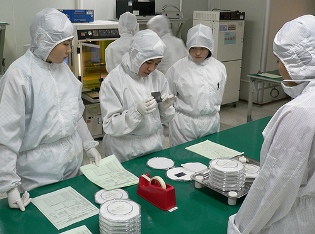
Photo by
Steve Jurvetson
from
Flickr
Group
inspecting an optical circuit after the wafer dicing saw. |
The Person Is the Contamination
Every other protective suit on this site guards the wearer against the workplace. The clean room suit inverts the problem: in a semiconductor fab, the workplace, a wafer worth more than a car, must be guarded against the wearer. A human sheds skin flakes and hair continuously, along with fibres from ordinary clothing, and a single particle can ruin a chip at modern feature sizes. The bunny suit is therefore a filter worn on the body: non-shedding synthetic fabric, full coverage including boots and hood, a bouffant cap under the hood, and no exposed skin beyond what the design allows. Gowning, putting the suit on in a set order in a gowning room so outside contamination is never carried through, is a trained procedure, and workers are certified in it.
Materials and Laundering
Cleanroom garments are made from tightly woven synthetic fabrics that do not release fibres and can survive repeated industrial laundering, which is itself done in cleanroom laundries with filtered water and particle-counted drying, since a suit returned with laundry lint on it defeats its own purpose. Suits are inspected and retired on schedule, because worn fabric sheds more. The face-cover designs introduced in the 1990s, familiar from processor advertisements showing fab workers in full white suits, closed the last gap, the breath and skin around the eyes and mouth. The same family of garments serves pharmaceutical and biotechnology production, where sterile products need protection from people, and hospital isolation work, where the protection runs in both directions at once.
Common Questions
Why is it called a bunny suit?
The hooded white coverall, with its full coverage and rounded silhouette, reminded wearers of a rabbit costume, and bunny suit became the universal nickname on production lines. The formal names are clean room suit and cleanroom suit. The resemblance aside, the suit is precision protective equipment, and the nickname is used by the engineers who wear it daily.
Why does each worker have their own set of suits?
Because everyone looks alike in cleanroom suits, each person has their own set, purchased to measure, with a name tag or other integral identification label. Suits are deposited in a store after use for dry cleaning and repair, and the personal set guarantees fit, which matters because a loose suit sheds more particles and a tight one tears.
How do nuclear plant suits differ from semiconductor bunny suits?
The purpose is reversed in emphasis: cleanroom suits protect the product from the person, while nuclear contamination-area suits protect the person from the environment, though both control contamination. The nuclear version consists of the main garment, hood, thin cotton gloves, rubber gloves, plastic bags over normal work shoes and rubber booties, with wrists and ankles taped down with masking tape, and removal follows an exact sequence into separate barrels under supervision.