Fashion in the 1890s
Fashion Definitions — fashion history, brands and industry terms from Apparel Search
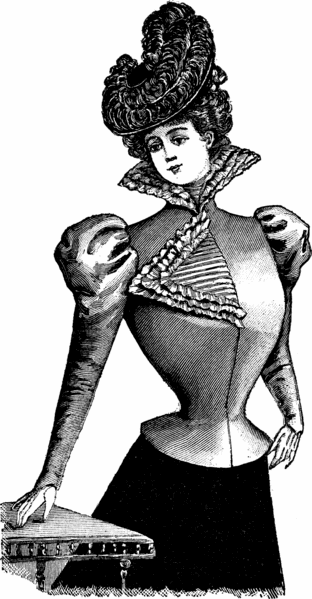
During the 1890s, fashionable women's clothing shed some of the extravagances of previous decades, so skirts were neither crinolined as in the 1850s, nor protrudingly bustled as in the late 1860s and mid-1880s, nor tight as in the late 1870s, but corseting continued unmitigated, or even slightly increased in severity. Early 1890s dresses consisted of a tight bodice with the skirt gathered at the waist and falling more naturally over the hips.
Influence of aesthetic dress
The 1890s in both Europe and America saw growing acceptance of artistic or aesthetic dress as mainstream fashion, especially in the adoption of the uncorseted tea gown for at-home wear. In America in this period, Dress, the Jenness Miller Magazine (1887-1898), reported that tea gowns were being worn outside the home for the first time in fashionable summer resorts.
The above article is licensed under the GNU Free Documentation License. From Wikipedia, the free encyclopedia https://en.wikipedia.org/wiki/1890s_in_fashion Retrieved and modified by Apparel Search 1/13/06
Designer Definition (from U.S Department of Labor)
Learn about another era in fashion:
1980's Fashion History / 1980's Fashion Term (terms section)
Clothing & Fashion Industry Definitions
fabric & Textile Industry Definitions
Fashion Terms / Fashion History / Fashion Designers / Fashion Brands etc.
Embroidery & Embroidery Industry Terms
fibers & fiber Industry Definitions
yarns & yarn Industry Definitions
Footwear & Shoe Industry Definitions
Shipping Industry Freight Definitions
Miscellaneous Apparel Industry Terms
A Plainer Skirt, an Unrelenting Corset
The 1890s are defined by a paradox. Judged by the skirt alone, dress became simpler: in the early years of the decade the skirt was gathered at the waist and fell more naturally over the hips and undergarments than it had for a generation, freed from crinoline, bustle and the skin-tight fit of the late 1870s in turn. Judged by the body inside it, nothing relaxed at all. Corseting continued unmitigated, or even slightly increased in severity, and the tight bodice remained the fixed point of the outfit. Fashion had removed the machinery around the body while keeping, and tightening, the machinery on it. That distinction explains the decade's look: a comparatively natural skirt supporting a highly artificial torso, the hourglass figure that Charles Dana Gibson's drawings made into a cultural ideal.
The Great Sleeve of the Mid-1890s
Into this relative calm, the mid-1890s introduced the decade's one extravagance. Leg-of-mutton sleeves returned — as they had been in the 1830s — and grew in size each year, balancing the A-line, almost bell-like skirt that developed in the same years. For a brief moment the fashionable outline was wide at both shoulder and hem, with the corseted waist pinched between them. Then, in about 1896, the great sleeves disappeared, and the late 1890s reversed course completely: sleeves became tight again, finished with only small puffs or ruffles capping the shoulder and fitted close to the wrist. Skirts likewise changed shape, taking on a trumpet form that fitted closely over the hip and flared just above the knee, a smoother, more column-like line that led directly toward the new century.
Sport, the Tea Gown and the S-Curve
The most forward-looking changes of the 1890s were social. Changing attitudes about what activities were acceptable for women made sportswear genuinely popular, and the bicycling dress and tennis dress were designed for movement in a way fashionable dress had never needed to be — the bicycle in particular demanded a practical answer to the problem of skirts and wheels. At home, aesthetic dress moved into the mainstream through the uncorseted tea gown, accepted for at-home wear and, according to Dress, the Jenness Miller Magazine, worn outside the home for the first time at fashionable American summer resorts. A fashionable woman could thus be uncorseted at tea and tightly corseted at dinner in the same day.
The corset had one more transformation to make. In the very late 1890s it elongated, pushing the body into a slight S-curve silhouette that would remain popular well into the Edwardian era. The skirt had shed its extravagances, the sleeve had shrunk, but the shaped torso carried the 19th-century ideal forward into the 20th century almost intact.
Common Questions
What happened to sleeves in the 1890s?
The mid-1890s introduced leg-of-mutton sleeves, which grew in size each year until they disappeared in about 1896. The late 1890s then returned to tighter sleeves, often with small puffs or ruffles capping the shoulder but fitted to the wrist, reversing the mid-decade expansion.
How did the corset create the 1890s hourglass and S-curve?
Corsets in the 1890s helped define the hourglass figure immortalised by artist Charles Dana Gibson. In the very late 1890s the corset elongated, giving women a slight S-curve silhouette that would remain popular well into the Edwardian era, even as skirts themselves grew less extreme.
What sportswear became popular for women in the 1890s?
Changing attitudes about acceptable activities for women made sportswear popular, with notable examples including the bicycling dress and the tennis dress. At the same time aesthetic dress gained acceptance, especially the uncorseted tea gown, worn for at-home wear and, in America, increasingly outside the home at summer resorts.
More to Explore
- 1850s
- 1860s
- 1870s
- corseting
- bodice
- skirt
- undergarments
- sleeves
- Edwardian
- artistic or aesthetic dress
- tea gown
- GNU Free Documentation License
- Designer Definition
- Clothing Definitions
- Fashion Accessories
- Style
- Catwalk
- 1550-1600 Fashion History
- 1600-1650 Fashion History
- 1700-1750 Fashion History
- 1750-1795 Fashion History
- 1820' Fashion History
- 1830's-1840's Fashion History
- 1920's Fashion History
- 1930's Fashion History
- 1940's Fashion History
- 1950's Fashion History
- 1960's Fashion History
- 1970's Fashion History
- 1980's Fashion History
- 1980's Fashion Term
- 1990's Fashion History
- 2000's Fashion History
- Victorian Fashion
- History of Western Fashion
- Elizabethan Fashion