History of Western Fashion
Fashion Definitions — fashion history and style definitions from Apparel Search
Search Apparel Search
At a Glance
Definition: The history of Western fashion is the story of the changing fashions in clothing for men and women in Western Europe and other countries under its influence in the period 1500 to the present, organised era by era.
Category: Fashion Definitions
The history of Western fashion is the story of the changing fashions in clothing for men and women in Western Europe and other countries under its influence in the period 1500 to the present. Fashion is a popular aesthetic expression in a certain time and context, especially in clothing, footwear, lifestyle, accessories, makeup, and hairstyle — which is why a period history covers silhouettes and garments together with the accessories and grooming that completed a look. This page is the map: it names the eras, chains the period pages in order, and explains how to read them.
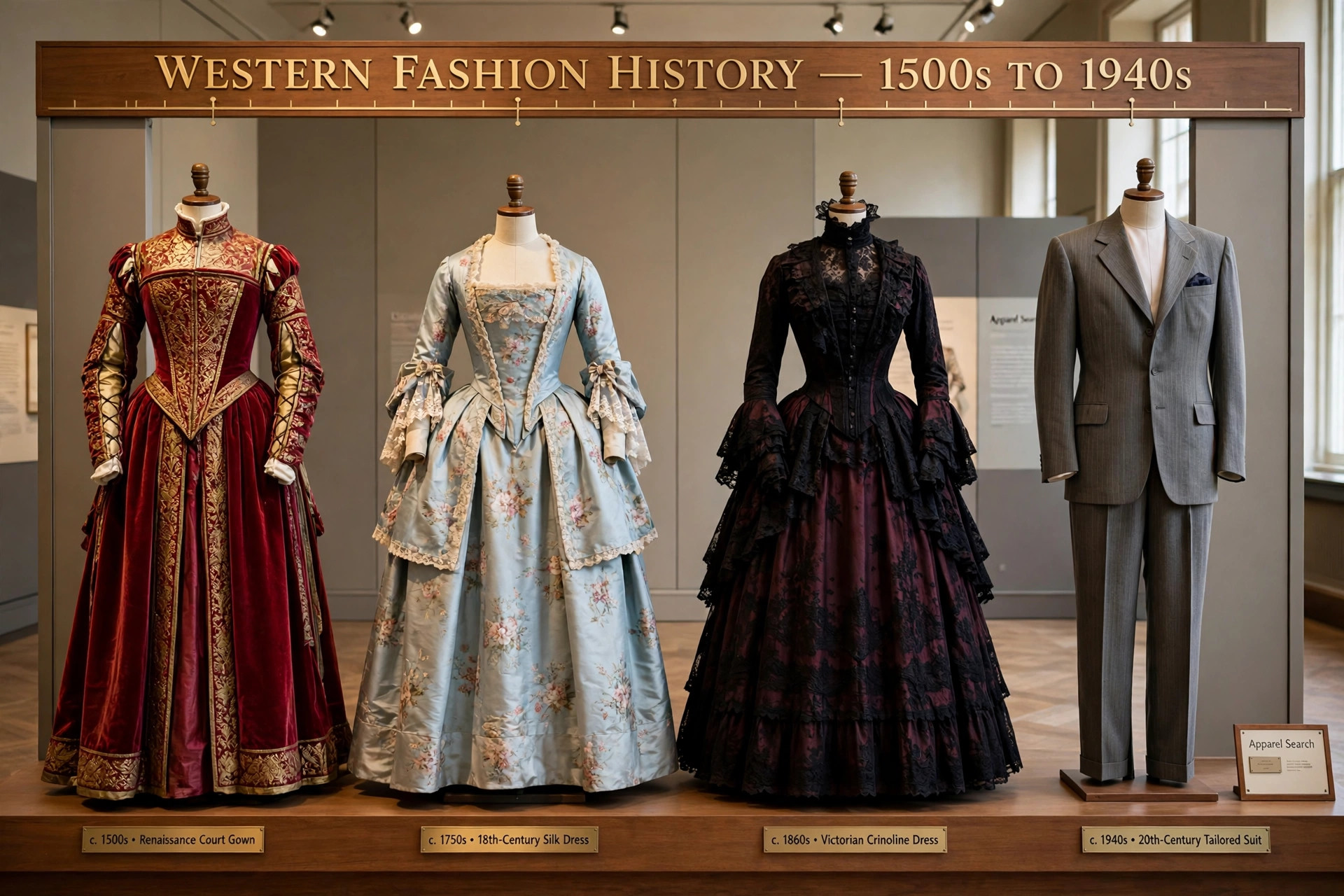
Eras Named for Monarchs
Three eras serve as entry points, each named for the monarch whose long reign gave the period a stable court, economy and set of manners against which clothing changed. Elizabethan fashion takes its name from Elizabeth I, Queen of England and Ireland from 17 November 1558 until her death on 24 March 1603. Victorian fashion takes its name from Queen Victoria, who reigned from 1837 to 1901. Edwardian fashion takes its name from King Edward VII, who reigned from 1901 to 1910.
Monarch-named eras survive because courts were once fashion's engine. A long reign provided a fixed centre of wealth and ceremony, a known set of occasions for which clothes were required, and a royal image that portraits carried across Europe. Elizabethan, Victorian and Edwardian are therefore not just date labels: each implies a court culture, a level of industrial development and a set of rules about display. The Victorian span is so long that fashion inside it changed several times over, from early full skirts through crinolines and bustles to the narrower shapes of the 1890s — itself a lesson that an era name is a container, not a single style.
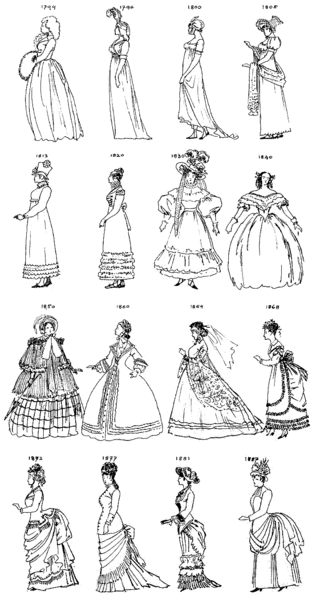
The Periods, 1500 to 1900
The 1500s open with 1550–1600 fashion history, a world of court display and expensive cloth that includes the Elizabethan decades. The 1600s continue with 1600–1650 fashion history; the years 1650–1700 have no period page of their own here. The 1700s are covered by 1700–1750 in fashion and 1750–1795 fashion history, and the years 1795–1820 — which bracket a political and industrial transformation that simplified men's dress and changed women's silhouettes — lead into the nineteenth century.
The 1800s proceed decade by decade: 1820s fashion history, 1830s–1840s fashion history, 1850s fashion history, 1860s fashion history, 1870s fashion history, and 1890s fashion history. These entries sit inside industrial production, imperial trade and the department store, and the later ones fall within the Victorian era named above.
The Twentieth Century and After
The twentieth-century decades accelerate. The period labels run 1900–1915, 1915–1930 and 1930–1945 before the century settles into single decades: 1930s fashion history, 1940s fashion history and 1950s fashion history carry their own pages, as do 1960s in fashion, 1970s in fashion, the 1980s in fashion and 1990s fashion history. The 2000s close the sequence the original survey set out, each decade increasingly shaped by mass media, youth culture and global manufacturing.
The acceleration is itself a finding of the history. Fashion's cycle shortened as making and distribution sped up, until change by decade gave way to change by season, and then to the continuous change of fast fashion. Readers who want the wider frame can learn more about fashion and the fashion industry beyond the period pages.
Why Western Fashion History Is Told by Periods
Clothing changes continuously, but it does not change evenly. A period structure, decade by decade and century by century, exists because certain stretches of time share a silhouette, a technology and a social order that make their clothes recognisably related, while the boundaries between stretches mark real breaks. The 1500-to-present span contains several such breaks. Court dress gave way to a commercial fashion system. Hand sewing gave way to the sewing machine and then to factory production. Clothing made for an individual gave way, for most people, to clothing bought ready made in standard sizes. A period-by-period history lets a reader see each break arrive: what the dominant shape was before it, what caused it to change, and what survived from the older order into the new one.
What Changes, and What Drives the Change
Across five centuries the recurring drivers are consistent enough to use as a checklist for any period. Materials come first: new fibres, new weaves and new dyes widen what a garment can look like, and trade routes decide which luxuries a country's dress can use. Making comes second: tailors, seamstresses, mills, sewing machines and factories each set a different limit on fit, trim and price. Distribution comes third: a fashion known only at court moves differently from one printed in a magazine, photographed, shown in a department store or sold online. Social rules run through all three, deciding who may wear what, on which occasions, and what a garment says about rank, profession, age and respectability.
Reading a single period with those four drivers in mind makes the period lists useful rather than decorative. The 1550 to 1600 entries describe a world of court display and expensive cloth. The 1750 to 1795 and 1795 to 1820 entries bracket a political and industrial transformation that simplified men's dress and changed women's silhouettes. The entries for the 1850s through the 1890s sit inside industrial production, imperial trade and the department store. The twentieth-century decades accelerate, each increasingly shaped by mass media, youth culture and global manufacturing.
Using the Period Pages
The practical way to use a period history is to start from a garment or a picture and work outward. Identify the silhouette first, since shape dates clothing more reliably than colour or fabric. Then check the construction and materials against what the period could produce. Then place the look socially: court, town, country, work or ceremony each carried its own version of the same decade's fashion.
The named-era pages for Elizabethan, Victorian and Edwardian fashion, and the related pages on the Artistic Dress Movement and Victorian dress reform, supply the counterpoint every period needs, because reform movements show what contemporaries themselves found uncomfortable, unhealthy or absurd in the fashion of their own time. A history that includes its critics is harder to romanticise, and more useful for understanding why the next period dressed differently.
Common Questions
What period does the history of Western fashion cover?
It covers the changing fashions in clothing for men and women in Western Europe and other countries under its influence from 1500 to the present. It is organised by period, from the 1500s through each century to the 2000s.
Why are eras named after monarchs?
Long reigns give a period a stable court, economy and set of manners against which clothing changed. Elizabethan fashion takes its name from Elizabeth I, who reigned from 1558 to 1603; Victorian fashion from Queen Victoria, 1837 to 1901; and Edwardian fashion from Edward VII, 1901 to 1910.
How is fashion defined for this history?
Fashion is a popular aesthetic expression in a certain time and context, especially in clothing, footwear, lifestyle, accessories, makeup and hairstyle. That breadth is why a period history covers silhouettes and garments together with the accessories and grooming that completed a look.