Fashion in the 1820s
Fashion Definitions — fashion history, brands and industry terms from Apparel Search
During the 1820s, fashionable women's clothing transitioned away from the classically influenced Empire and Regency styles of about 1795-1820 and re-adopted elements characteristic of the 18th century, such as full skirts and clearly visible corseting of the natural waist. In the first half of the decade the changes were gradual, with the waistline trending successively lower.
During the first half of the 1820s, there were slight gradual modifications of Regency styles, with the position of the waistline trending successively lower than the high waistline of the Regency (just below the breasts), and also further development of the trends of the late 1810s towards giving skirts a somewhat conical silhouette (as opposed to earlier more clinging and free-flowing styles), and in having various types of decoration (sometimes large and ornate) applied horizontally around the dress near the hem. However, there was still no radical break with the Empire/regency aesthetic.
During the second half of the 1820s, this neo-classical aesthetic was decisively repudiated, preparing the way for the main fashion features of the next ten to fifteen years (large sleeves, somewhat strict corseting of the natural waist, full skirts, elaborate large-circumference hats, and visual emphasis on wide sloping shoulders). Around 1826, fabrics with large bold checkerboard or plaid patterns were seen on various fashion plates (another contrast with the previous fashion period, which had favored small delicate pastel prints). A bustle was sometimes also worn.
This illustration gives examples of late 1820s fashions; the rightmost outfit, with its skimpier sleeves, non-whitish color scheme, and slightly lower neckline, is the evening dress.
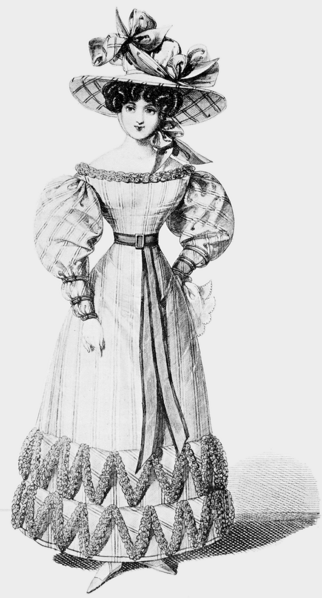
Image: 1826 fashion plate from Wiener Moden, Vienna. Shows how the cutting-edge high styles of the mid-1820's took a sharp turn from the legacy of the classically-influenced "Empire"/"Regency" styles of the late 1790's to early 1820's, preparing the way for the main fashion features of the next ten to fifteen years (large sleeves, somewhat strict corseting of the natural waist, full skirts, large-circumference hats, and visual emphasis on wide sloping shoulders).
The above article is licensed under the GNU Free Documentation License. From Wikipedia, the free encyclopedia https://en.wikipedia.org/wiki/1820s_in_fashion 1/13/06
Learn about another era in fashion:
1980's Fashion History / 1980's Fashion Term (terms section)
Designer Definition (from U.S Department of Labor)
Clothing & Fashion Industry Definitions
fabric & Textile Industry Definitions
Fashion Terms / Fashion History / Fashion Designers / Fashion Brands etc.
Embroidery & Embroidery Industry Terms
fibers & fiber Industry Definitions
yarns & yarn Industry Definitions
Footwear & Shoe Industry Definitions
Shipping Industry Freight Definitions
Miscellaneous Apparel Industry Terms
A Decade in Two Halves
The 1820s reward being read as two distinct halves. In the first half, Regency fashion was modified rather than abandoned: the waistline inched down season by season from its high position just below the breasts, skirts took on a more conical outline, and heavy horizontal decoration gathered near the hem. None of this was yet a radical break with the Empire aesthetic, and a dress of 1823 would still have been recognisable to a wearer of 1815. In the second half the neo-classical aesthetic was decisively repudiated. What replaced it — large sleeves, stricter corseting at the natural waist, full skirts, elaborate hats of large circumference and a visual emphasis on wide, sloping shoulders — became the defining features of the next ten to fifteen years. The mid-1820s fashion plate is therefore a hinge document: it shows a silhouette turning away from classical drapery and toward structure.
That structure meant a return, in new form, to ideas that had governed most of the 18th century. Full skirts need support and emphasis; a natural waist needs corseting to be clearly visible under fashionable dress. The 1820s did not simply copy the 1700s, but they restored the principle that the waist should be defined and the skirt should stand away from the body, after a generation in which the high waist and falling cloth had done the opposite.
Pattern Grows Bolder
Fabric tells the same story of growing emphasis. The late 1810s and the Empire period generally favoured small, delicate pastel prints — patterns that suited light, clinging dresses. Around 1826, fashion plates began showing large, bold checkerboard and plaid patterns, designs with real visual weight that needed a fuller, more structured dress to carry them. Bold pattern and bold silhouette advanced together: as sleeves, skirts and hats all grew larger, decoration grew larger to match, including the ornate horizontal bands near the hem that weighted the bottom of the conical skirt and balanced the widening shoulders above.
Day Dress and Evening Dress
Even within the new fashion, occasion still governed detail. Late 1820s illustration contrasts day and evening wear clearly: the evening dress could show skimpier sleeves, a slightly lower neckline and a non-whitish colour scheme, while day dress remained more covered. That distinction — greater exposure and richer colour reserved for evening — would persist through the following decades, with sleeve size, neckline and glove length all adjusting to the hour. For a visitor comparing the 1820s with what came next, the key point is direction: every element that would dominate the 1830s, from the gigot sleeve to the wide hat, is already present in embryo by 1826, waiting only to be enlarged and emphasised in the fashionable dress that followed it.
Common Questions
How did the waistline change during the 1820s?
In the first half of the 1820s the waistline trended successively lower than the high Regency waistline just below the breasts, moving toward the natural waist. That shift brought back clearly visible corseting of the natural waist and ended the relatively unconfining Empire silhouette.
How did skirts change in the 1820s?
Skirts developed a somewhat conical silhouette, in contrast to the earlier clinging, free-flowing styles, and various types of decoration, sometimes large and ornate, were applied horizontally around the dress near the hem. A bustle was sometimes also worn to support the new shape.
What was new in fabrics around 1826?
Around 1826 fabrics with large, bold checkerboard or plaid patterns were seen on various fashion plates. That was a sharp contrast with the previous period, which had favoured small, delicate pastel prints, and it signalled the more emphatic decoration of the coming decade.
More to Explore
- empire silhouette
- bustle
- fashion plate
- GNU Free Documentation License
- https://en.wikipedia.org/wiki/1820s_in_fashion
- 1550-1600 Fashion History
- 1600-1650 Fashion History
- 1700-1750 Fashion History
- 1750-1795 Fashion History
- 1830's-1840's Fashion History
- 1850's Fashion History
- 1860's Fashion History
- 1870's Fashion History
- 1890's Fashion History
- 1920's Fashion History
- 1930's Fashion History
- 1940's Fashion History
- 1950's Fashion History
- 1960's Fashion History
- 1970's Fashion History
- 1980's Fashion History
- 1980's Fashion Term
- 1990's Fashion History
- 2000's Fashion History
- Artistic Dress Movement
- Victorian Fashion
- History of Western Fashion
- Elizabethan Fashion
- Edwardian Fashion History
- Designer Definition
- Clothing Definitions
- Fashion Accessories
- Style
- Catwalk
- Designer Definition Guide
- Clothing Brand Names