Fashion Plates
Apparel Search fashion summary — a short guide to fashion plates.
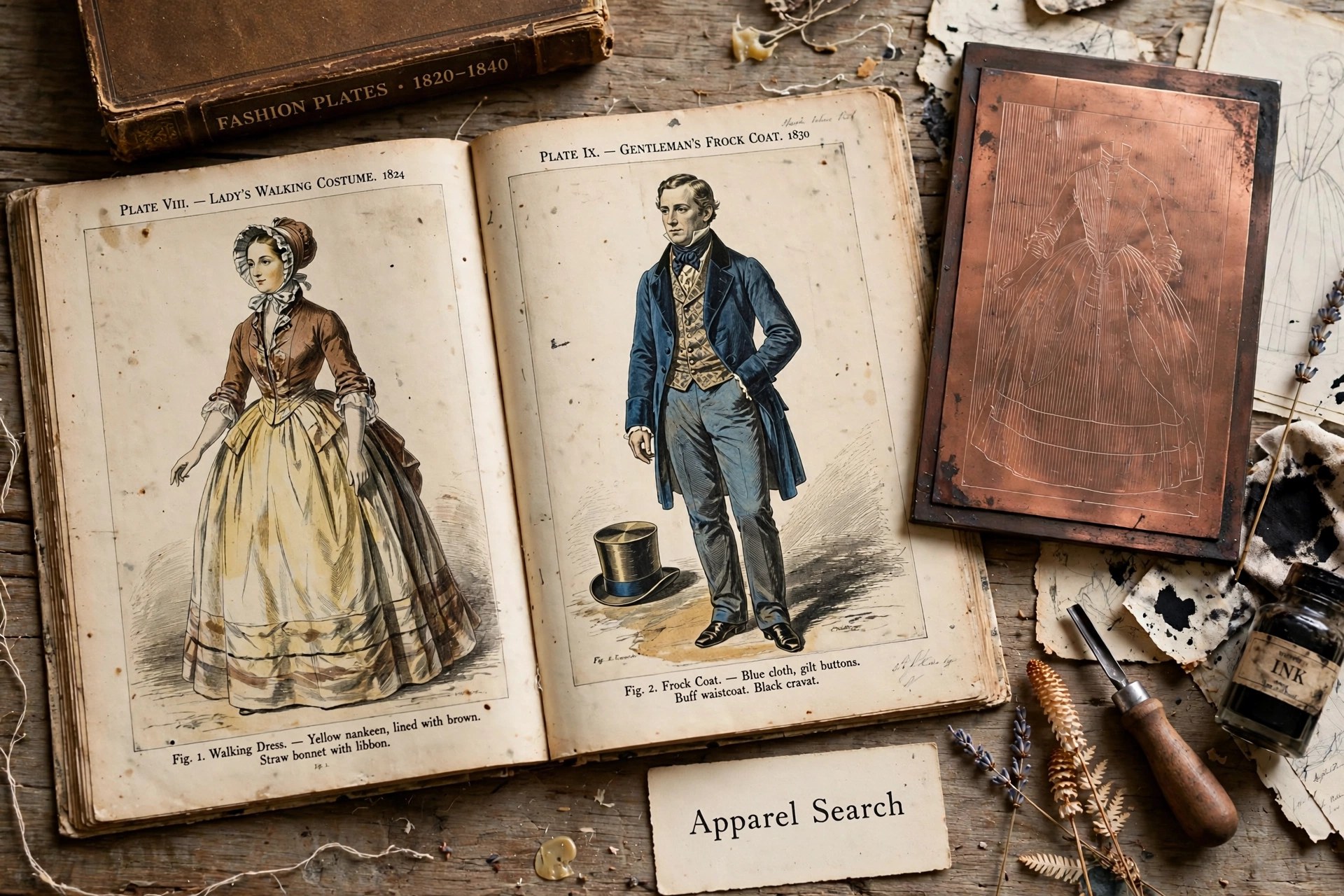
A fashion plate is an illustration demonstrating the highlights of fashionable styles of clothing — traditionally rendered through etching, line engraving or lithography and then coloured by hand. It is not the kind of plate used to serve food. Fashion plates are frequently used as primary source material for the study of historical fashions, because for over a century they were how fashion travelled.
Fashion Plates — Explore & Resources
What Fashion Plates Showed
Fashion plates do not usually depict specific people. They take the form of generalised portraits that dictate the style of clothes a tailor, dressmaker or store could make or sell, or demonstrate how different materials could be made up into clothes. The majority appeared in ladies' fashion magazines, which began to appear during the last decades of the 18th century. Used figuratively, the term fashion plate came to mean a person whose dress conforms to the latest fashions.
Before the French Revolution fashion plates were few and far between, although their origins date back to the 16th century. The method of disseminating fashionable styles this way was mostly popular during the 19th and early 20th centuries. By the 1830s, United States magazines began including their own fashion plates, often derived from imported French originals; Godey's Lady's Book and its competitors Graham's Magazine and Peterson's Magazine boasted about the quality of theirs.
Why Photography Ended Them
The increasing popularity of photography in the early 20th century spelled the end for fashion plates, because photographs offered a realistic portrayal of fashionable styles that no engraving could match. The fashion photography summary linked from this page tells that successor's story, and the fashion illustration summary linked alongside covers the drawn image's other surviving branch.
What the plates left behind is an archive. Because they were dated, published and preserved in magazine runs, historians can reconstruct what was worn, season by season, across more than a century — which is why the fashion history and history of the fashion industry pages linked here lean on them so heavily. A fashion plate was advertising in its own day; it is evidence in ours, and the hand colouring that once sold a dress now documents it.
Reading a Fashion Plate Closely
Historians read plates the way tailors once did: for construction. A plate records silhouette, trimming, fabric suggestion and accessories together, and its magazine's date fixes the ensemble in a season. Comparing successive years of plates reveals fashion's speed before photography — hemlines, sleeves and waist positions shifting measurably year by year. The plates also quietly document retail: the same issue that carried a plate often carried the names of the shops and dressmakers who could supply the style, making each magazine a catalogue as well as a chronicle.
Common Questions
What is a fashion plate?
An illustration showing the highlights of fashionable clothing, traditionally etched, engraved or lithographed and coloured by hand, published mainly in ladies' fashion magazines from the late 18th century onward.
Do fashion plates show real people?
Usually not. They are generalised portraits showing styles a tailor, dressmaker or store could make or sell, rather than portraits of specific individuals.
Why did fashion plates disappear?
Photography replaced them in the early 20th century, because photographs portrayed fashionable styles more realistically than engravings could.