Paisley Design
Miscellaneous Definitions — accessories, trims, tools and general fashion terms from Apparel Search
Paisley is a droplet-shaped vegetal motif, similar to half of the Tai Chi symbol, the Indian bodhi tree leaf, or the mango tree. The design originated in India and spread to Scotland when British soldiers brought home cashmere shawls, and from roughly 1800 to 1850 the women of the town of Paisley, Scotland adapted the design and wove woolen shawls on Jacquard looms, so the design is popularly known as the Paisley pattern.
 Paisley is a droplet-shaped vegetal
motif, similar to half of the T'ai Chi symbol,
the Indian bodhi tree leaf, or the mango
tree. The design originated in
India and
spread to Scotland when British soldiers
brought home
cashmere
shawls. From roughly 1800 to 1850, using
Jacquard looms,
the women of the town of Paisley, Scotland
adapted the design and wove woolen shawls,
hence the design is popularly known as the
Paisley pattern. Changes in fashion
led to the demise of the shawl bringing
hardship to the
weavers in Scotland and the originators
in Kashmir.
The shape has been widely adopted since then. Although the influence is not clear, the Turkish tughra calligraphic seal strongly resembles the paisley shape. Some design scholars call the distinct shape boteh and believe it is the convergence of a stylized floral spray and a cypress tree -- a Zoroastrian symbol of death and eternity.
Paisley is a lovely print pattern.
| The above article is licensed under the GNU Free Documentation License. From Wikipedia, the free encyclopedia https://en.wikipedia.org/wiki/paisley_(design). 11/02/04 |
|
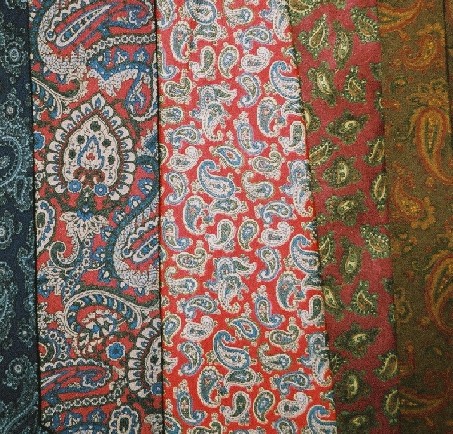
Below is an image of Paisley fabric |
| Fashion Industry |
A Droplet That Traveled From India to ScotlandThe paisley motif is instantly recognizable even to people who cannot name it: a rounded droplet with a curved, hooked tip, its interior filled with fine vegetal detail. Comparisons reach for natural forms because the shape sits between them — similar to half of the Tai Chi symbol, to the Indian bodhi tree leaf, and to the mango tree. That in-between quality is part of its endurance. It reads at once as leaf, fruit and flame-like drop, so it can carry floral ornament without depicting any single flower, and it can repeat across a cloth in rows, in mirrored pairs or in dense all-over fields without losing its identity. A single boteh can stand alone as a focal motif on a shawl end or a tie, or hundreds can interlock into a pattern where the eye travels from tip to tip. Few motifs in textile history have proved so adaptable to scale, which is one reason the shape has been widely adopted since its early spread. The journey behind the name is a story of trade, imitation and craft skill. The design originated in India, and it spread to Scotland when British soldiers brought home cashmere shawls — luxurious woven goods whose patterned ends carried the droplet motif in fine wool. Demand for such shawls in Britain outran what imports could supply at prices buyers could pay, so Scottish weavers set out to make their own versions. From roughly 1800 to 1850, using Jacquard looms, the women of the town of Paisley adapted the design and wove woolen shawls. The Jacquard loom mattered because its punched-card control let a weaver reproduce intricate, curving pattern repeats that would have been painstaking on simpler equipment. Paisley shawls became the town's signature product, and the association was so strong that the design itself took the town's name in popular use, even though the motif was far older than the Scottish industry that made it famous in the West. Boteh, Shawls and the Meaning of the ShapeDesign scholars often step back from the town name and call the distinct shape boteh. They believe it is the convergence of a stylized floral spray and a cypress tree — a Zoroastrian symbol of death and eternity. That reading gives the motif a double nature: the spray speaks of growth, flowering and renewal, while the cypress speaks of endurance beyond a single lifetime. Whether or not every weaver who wove the shape intended that symbolism, the pairing helps explain why the motif suited ceremonial and treasured cloth. A shawl is an heirloom object, worn for years and handed down, and a pattern that quietly joins a flower to a symbol of eternity fits such an object well. Another resemblance has also been noted, although the influence is not clear: the Turkish tughra, a calligraphic seal, strongly resembles the paisley shape, with the same swelling body and curving stroke. The similarity is a reminder that curving droplet forms arose in several artistic traditions of the region, and that motifs traveling along trade routes rarely keep a single, tidy line of descent. The shawl trade that carried paisley to fame also carried its fragility. Changes in fashion led to the demise of the shawl, bringing hardship to the weavers in Scotland and to the originators in Kashmir. When the wide, patterned shawl ceased to be an essential part of fashionable dress, the looms that existed to weave it lost their market, and skilled workers in both places felt the loss — a pattern of boom and hardship familiar throughout textile history, where a town's craft can rise and fall with one garment type. The motif itself, however, outlived the garment that named it. Detached from the shawl, paisley moved onto other cloth and other goods: dress fabrics, neckties, scarves, upholstery and printed cottons, where the droplet could be drawn at any size and in any colorway. Weavers and printers learned to nest the shapes so their curved tips fill the spaces between bodies, producing the dense, flowing fields most people now picture when they hear the word. The name remained Scottish, the shape remained far older and wider-traveled, and the result is one of the rare patterns that a shopper can find on both a formal silk tie and a casual cotton shirt in the same store — a lovely print pattern whose history joins Indian origins, Kashmiri weaving, Scottish Jacquard looms and worldwide adoption into a single, instantly recognizable, endlessly repeatable droplet of cloth ornament. Common QuestionsWhat is the paisley design?Paisley is a droplet-shaped vegetal motif, similar to half of the Tai Chi symbol, the Indian bodhi tree leaf, or the mango tree. The shape has been widely adopted since its early spread. Where did the paisley pattern get its name?The design originated in India and spread to Scotland when British soldiers brought home cashmere shawls. The women of the town of Paisley, Scotland adapted the design and wove woolen shawls, so the design is popularly known as the Paisley pattern. What is the shape also called by design scholars?Some design scholars call the distinct shape boteh and believe it is the convergence of a stylized floral spray and a cypress tree, a Zoroastrian symbol of death and eternity. More to ExploreMore from Apparel Search: Miscellaneous Definitions | Clothing Industry Glossary | Fashion Terms | Apparel Search Home
|