Stays
Clothing Definitions — definitions of garments and clothing terms from Apparel Search
Search Apparel Search
At a Glance
Definition: Stays are a stiffened, laced foundation bodice worn as women's underwear from roughly the seventeenth century to the mid-nineteenth, shaping the torso, supporting the bust and ending above the hip — the handmade predecessor of the corset.
Category: Clothing Definitions
Word Origin
The name is generally explained as the plural of stay in its old sense of a prop or support: the garment was named for the stiff supports — the boning — that stayed, or held up, the body and the dress above it. The record is not exact enough to state the derivation more firmly than that.
Stays are the foundation garment of women's dress for roughly two centuries before factory-made clothing: a stiffened bodice, laced closed, that shaped the torso to the silhouette of the period, supported the bust and gave dresses a smooth base to hang from. They are an older form of the garment later standardised as the corset, and the differences between the two — length, construction and manufacture — are exactly what define stays. This page describes how stays were made, how they were worn, and the line of development that runs from stays through the corset to the brassiere.
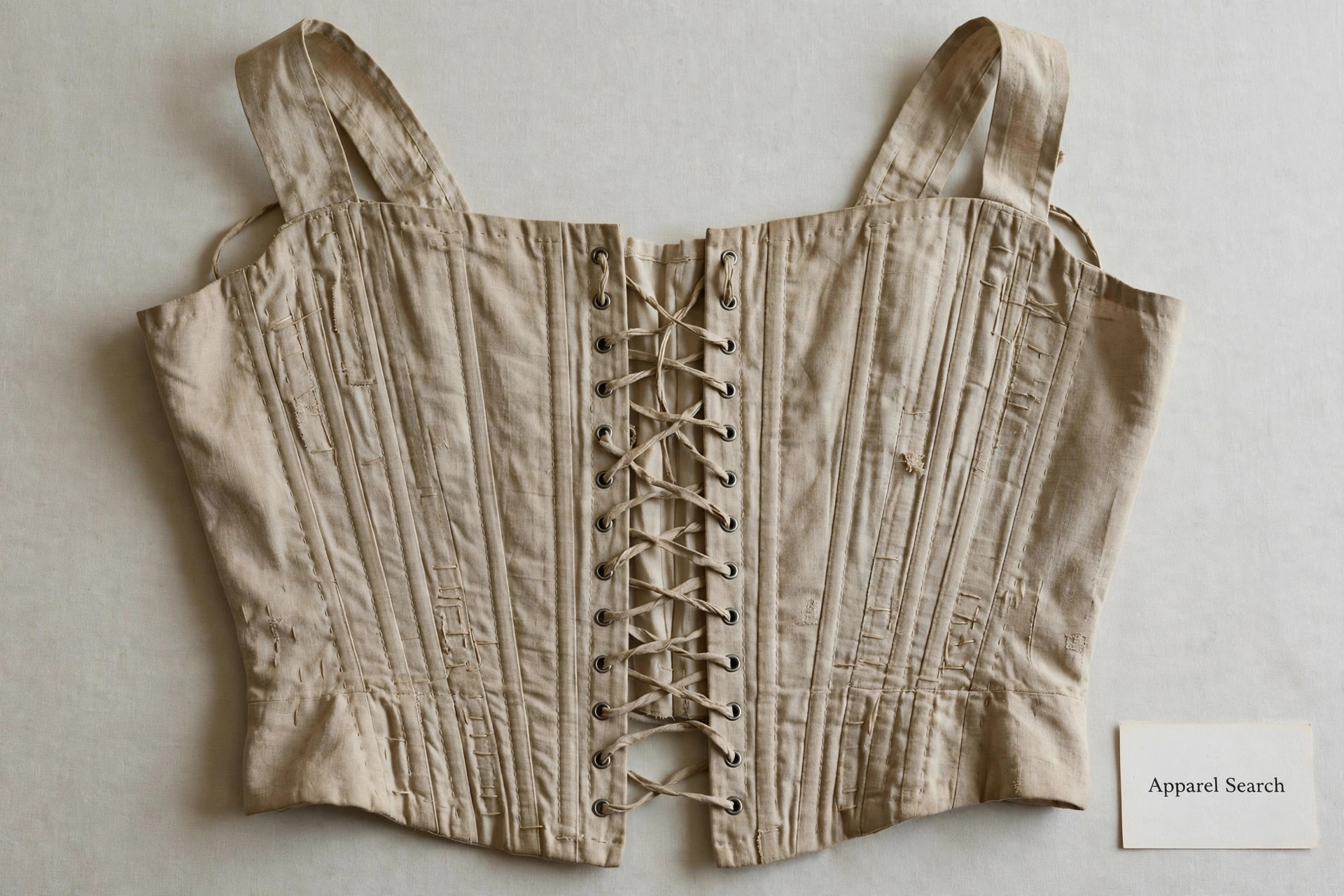
Construction: Boning, Lacing and Straps
A pair of stays is built around stiffening. Boning — whalebone, cane or a similar flexible stiffener — runs in stitched channels through a strong linen or cotton body, turning a fabric bodice into a shaped structure. Lacing, usually up the back, sets the tension and closes the garment. Shoulder straps keep the stays from slipping and spread their pull across the shoulders, a practical feature that shorter later garments gave up.
The lower edge carries as much of the definition as the boning. Stays end above the hip, and the edge flares out over the dress or skirt below. That is the opposite arrangement from the later corset, which lengthened to cover the hip. Ending higher left the hips freer, and it is the quickest visual test when telling the two garments apart.
Stays were worn as the first structured layer of dress, under the gown or skirt whose line they created. The silhouette they produced changed with fashion — the long, conical torso of one period giving way to other shapes in the next — but the method stayed the same: a boned, laced structure imposed the period's outline on the body, supported the bust without any separate garment, and presented a firm, smooth surface that outer dress could be fitted and pinned to. Dresses of the period cannot be understood, or accurately reproduced, without the stays underneath them.
Handmade and Fitted to the Wearer
A pair of stays was typically made by hand, fitted to the individual wearer, and surviving examples are older than about 1860, or about 1870 in some regions. Because each pair was made for one body by one maker, no two surviving pairs are quite alike: the boning channels, stitching and materials record both the maker's hand and the client's shape. Costume historians therefore treat stays as documents — evidence of how ordinary structured clothing was actually made before ready-made sizes existed.
For collectors and costume makers, identification runs on the points above. Handmade construction, shoulder straps, an edge that clears the hip and a date before roughly 1860 to 1870 point to stays. A longer, hip-covering line, machine stitching and steel boning point to the later corset.
The trade word is worth noting: stays are almost always spoken of as a pair of stays, like a pair of trousers — a survival from garments made in two joined halves. A pair was an investment piece, expected to serve for years, repaired and re-covered as fabrics wore. That longevity, combined with hand making, is why museum collections hold stays in numbers out of proportion to most underwear of the period, and why they carry so much evidence about the bodies and budgets of ordinary wearers.
From Stays to Corset to Brassiere
The vocabulary shifted as the garment changed. Stays is the older word; corset became the standard term as manufactured, steel-boned garments replaced handmade ones during the nineteenth century and the fashionable line lengthened over the hip. Then the direction reversed: fashionable support shortened decade by decade, from the full torso to the waist — the territory of the girdle — and from the waist to the bust alone, until the brassiere separated bust support from torso shaping entirely.
Read that way, stays are the first point on a single line of structured underwear, and each later garment is stays with a different length, a different material or a different job. The terminology of the whole family is gathered under clothing terminology.
Stays also mark the boundary between two eras of making. Everything about them — hand stitching, individual fitting, natural stiffeners — belongs to the workshop; everything about the later corset — standard sizes, machine stitching, steel — belongs to the factory. The change of name from stays to corset is the wardrobe's record of the industrial revolution arriving at underwear.
Not to Be Confused With
Two foundation garments from two different centuries of making. Stays are the earlier, handmade form: a stiffened, laced bodice with shoulder straps, ending above the hip so the lower edge flares over the skirt. A corset is the later, manufactured form: machine-made, usually steel-boned, and longer, covering the hip. A waist cincher is shorter than either — a wide band gripping the waist alone, with no straps and no bust support — and is the point where the stays line of development gives way to garments that shape one zone at a time.
Common Questions
How do stays differ from a corset?
Stays end at a lower edge that hangs over the dress or skirt, while a corset covers the hip. Stays also normally have shoulder straps, which distinguishes them from a waist cincher. Surviving stays are typically handmade pieces from before about 1860, or 1870 in some regions.
What happened to stays over time?
Stays became shorter and shorter as fashions changed, covering less of the torso. That shortening is the path that eventually leads to the brassiere, which supports the bust alone instead of shaping the whole torso.
Were stays handmade?
Yes. A pair of stays was typically made by hand, fitted to the individual wearer. Handmade construction is one reason surviving examples are individual historical garments rather than standardized manufactured products.