Girdle
Clothing Definitions — definitions of garments and clothing terms from Apparel Search
A girdle is a women's undergarment constructed of elasticized fabric and usually fastened with hook and eye closures, designed to shape and smooth the figure and produce a smoother silhouette under clothing. A girdle can extend as high as the neck line, incorporating a brassiere, and as low as the thighs, and it may also include garters to hold up stockings. This page explains how the girdle replaced the corset in popularity and usage, why elasticized fabric was an improvement over lacing and rigid boning, and why girdles were worn so much more in the 1950s and 1960s than they are today.
A girdle is a piece of women's
underwear that replaced
the
corset in popularity and
usage. Constructed of
elasticized fabric and
usually fastened with
hook and eye closures, it is designed to shape and smooth
a woman's figure, thereby producing a more aesthetically
pleasing and attractive
silhouette. A girdle can extend as high as the neck
line (incorporating a
brassiere) and as low as
the thighs. A girdle may also include
garters to hold up
stockings.
While such a piece of clothing may seem uncomfortable and
unnecessary now, when it was first designed it was a significant
improvement compared to wearing a corset, which would have
to be laced up and included rigid
boning. Girdles are still
worn today, but much more rarely than during the 1950s and
1960s. In that period, the advent of the
Dior New Look gave
rise to women's
fashion featuring a narrow,
nipped-in waistline, also known as "the
wasp".
See also
| The above article is licensed under the GNU Free Documentation License. From Wikipedia, the free encyclopedia ( https://en.wikipedia.org/wiki/girdle ). 1/17/06 |
Bone (for corsetry)
Photos
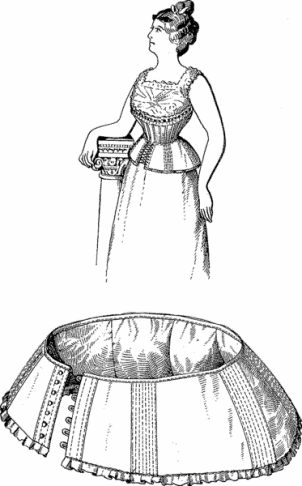
Construction: Elastic Panels Instead of Boning
The girdle's defining material is elasticized fabric. Where the corset shaped the body with lacing tension over rigid boning, a girdle shapes by stretch: woven or knitted elastic panels pull in at the waist and smooth over the hips, and the garment is put on and taken off through its hook and eye closures rather than by unlacing. Lengths varied with the clothing they were worn under. A short girdle covered the waist and hips; longer styles reached to the thighs; and the longest forms extended as high as the neck line by incorporating a brassiere into the same garment, making a single foundation piece for the whole torso.
The garter attachments explain the girdle's period. Before pantyhose became standard, stockings had to be held up, and a girdle's garters — short elastic straps with clips at the hem — did that job while the girdle itself shaped the figure, so the two functions were combined in one undergarment. The firmness grading of elastic panels also let manufacturers offer light smoothing for everyday dresses through to firm control for close-fitting evening wear, all on the same basic pattern of an elastic tube with closures. Modern shapewear is the direct continuation of the girdle idea: elasticized fabric, closures or pull-on construction, and lengths from waist to thigh, produced with newer elastics and seamless knitting. The girdle sits in the foundation-garment family alongside the corset it replaced and the brassiere it was often combined with, and its related hardware — the bone used in corsetry, the busk fastening and the stays — belongs to the older corset construction that elastic fabric made unnecessary for most wearers.
Common Questions
What is a girdle?
A girdle is a piece of women's underwear that replaced the corset in popularity and usage. Constructed of elasticized fabric and usually fastened with hook and eye closures, it is designed to shape and smooth a woman's figure, producing a smoother silhouette.
How does a girdle differ from a corset?
A corset had to be laced up and included rigid boning. A girdle is made of elasticized fabric with hook and eye closures, which was a significant improvement in comfort and ease of wear compared to the corset.
Why were girdles so common in the 1950s and 1960s?
In that period, the advent of the Dior New Look gave rise to women's fashion featuring a narrow, nipped-in waistline, also known as the wasp, and girdles were worn to shape the figure under that silhouette. They are still worn today, but much more rarely.