Wetsuit
Clothing Definitions — definitions of garments and clothing terms from Apparel Search
Search Apparel Search
At a Glance
Definition: A wetsuit is a protective garment for watersports such as scuba diving, surfing, windsurfing and triathlon, mostly made from thin neoprene lined with nylon, which lets in a thin layer of water that body heat warms and the neoprene then insulates against the cold water outside.
Category: Clothing Definitions
Word Origin
The name states the mechanism. Unlike a drysuit, which keeps water out entirely, a wetsuit is designed to get wet inside: it admits a thin layer of water against the skin, traps it there, and lets body heat warm it. The suit is named for the water it works with, not the water it excludes.
A wetsuit is a protective garment used for watersports such as scuba diving, surfing, windsurfing and triathlon. A modern wetsuit is mostly made from thin neoprene, which provides limited thermal protection for activities in cold water, usually lined with nylon fabric for strength and easier dressing. A wetsuit allows water inside, but the water is trapped as a thin layer between the skin and the neoprene and body heat warms it; the neoprene then insulates that warm layer against the surrounding cold water. A close fit and flexible seals at the cuffs make the system work. It is the most familiar of the ambient pressure diving suits — the one that turned cold water from a barrier into a playground.
On This Page
How a Wetsuit Warms
The wetsuit's insight is counterintuitive: it does not try to keep the wearer dry. A wetsuit allows water inside the suit, but the water is trapped as a thin layer between the skin and the neoprene, and body heat warms it. The neoprene — a foam full of closed gas cells — insulates that warm water layer against the surrounding cold water. The wearer is, in effect, carrying a personal layer of warmed sea.
Everything about the suit's fit follows from that mechanism. The wetsuit must be a close fit to work efficiently: too loose a fit will simply allow the warmed water to be flushed through and replaced by cold water, and the insulation collapses. Flexible seals at the suit cuffs — and at neck and ankles — aid in retaining the layer. Fit is not a comfort preference in a wetsuit; fit is the heating system.
Materials and Thickness
Neoprene does the insulating, but plain neoprene has faults: it resists stretching and tends to shrink with age. The nylon lining strengthens the suit and makes it easier to put on and take off. Some newer wetsuits, usually marketed as "superflex", contain spandex in addition to neoprene to allow the suit to stretch — the panels of a wetsuit of this type typically contain 15–20% spandex. This counteracts neoprene's tendency to shrink with age, and also allows for some changes in the wearer's size without making the suit uncomfortable.
Wetsuits come in different thicknesses depending on the conditions for which they are intended. The thicker the suit, the warmer it will keep the wearer — and a thick suit is stiff, so mobility is restricted. A wetsuit is normally described in terms of its thickness: a wetsuit with a torso thickness of 5 mm and a limb thickness of 3 mm will be described as a "5/3", putting warmth where the body needs it and flexibility where the arms and legs bend. Some suits have extra layers added for key areas such as the lower back.
Thickness is a bargain the wearer strikes with the water. Every added millimetre of neoprene is added insulation and added stiffness at once, and the right answer depends on the sport as much as the temperature: a diver descends and hovers, a surfer paddles and pops up, a triathlete swims for distance. That is why the thickness code puts the bigger number on the torso — the core, where warmth is life — and the smaller number on the limbs, where movement is the sport. The "5/3" formula is the wetsuit's whole design philosophy written in two figures.
Shapes for Different Water
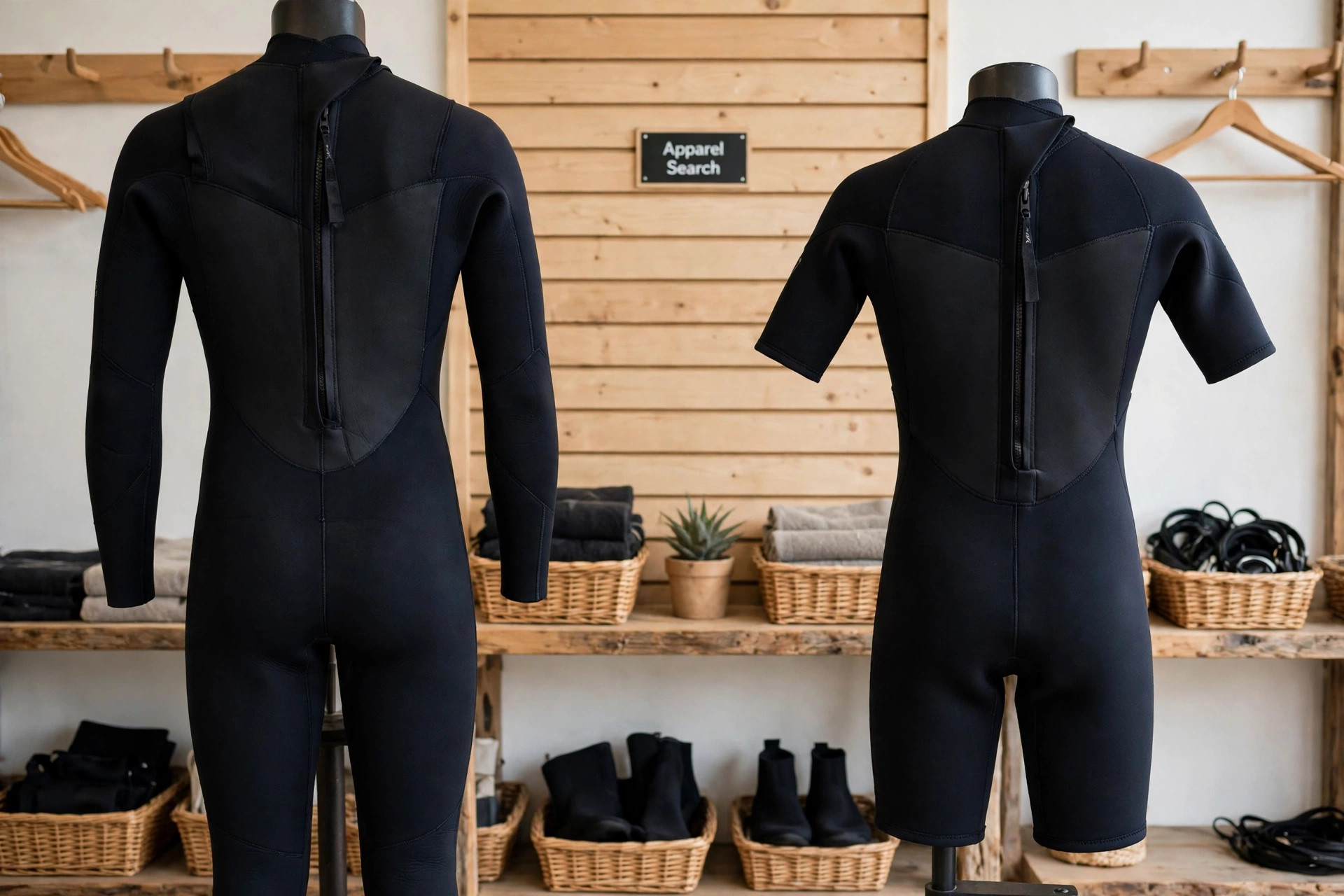
Different shapes of wetsuit are available, cut to the amount of protection a sport needs. The "shorty" covers the torso and has short arms and short legs, for warm water and summer surfing. The "jacket" covers the torso and arms; the "long johns" cover the torso and legs only; and the "full suit" or "steamer" covers the torso and the full length of the arms and legs, and is the standard cold-water form. Some suits are arranged in two parts: the jacket and long johns can be worn separately in mild conditions, or worn together to provide two layers of insulation around the torso in cold conditions.
A specialised kind of wetsuit, with a very smooth — and somewhat delicate — outer surface, is used for long-distance swimming and triathlon. These are designed to maximise the mobility of the limbs while providing both warmth and buoyancy. Between the shorty and the racing suit, the wetsuit covers nearly every temperature of water a person would voluntarily enter, which is why it escaped diving into general watersport: the same garment serves the scuba diver, the surfer, the windsurfer and the triathlete, differing only in cut and thickness.
The two-part arrangement deserves a note, because it is the wetsuit thinking like clothing rather than equipment. Jacket and long johns worn separately cover mild conditions with half a suit; worn together they double the insulation exactly where doubling matters, around the torso, while the limbs keep single-layer flexibility. It is layering — the oldest strategy in cold-weather dress — applied inside a single garment family, and it lets one purchase cover a range of water that would otherwise need two suits.
Who Invented the Wetsuit?
It is difficult to credit a single individual for the creation of the modern wetsuit. In 1951, while working for the US Navy, Hugh Bradner had the insight that a thin layer of trapped water could act as an insulator. It was a colleague of Bradner's who suggested neoprene as a feasible material. However, Bradner was not overly interested in profiting from his design and never marketed a version to the public, nor did he patent his design. The first written documentation of Bradner's invention was in a letter dated June 21, 1951.
Traditionally, most say it was Jack O'Neill who invented the wetsuit and started using neoprene, which he found lining the floor of an airliner. However, this is disputed by some aviation experts, because neoprene and other rubbers are not fire retardant and therefore would not be found on any passenger aircraft. O'Neill went on to found the successful wetsuit manufacturer O'Neill. But Bob and Bill Meistrell, from Manhattan Beach, California, claim to have started experimenting with neoprene around 1953. Their company would later be named Body Glove. The honest summary is that the wetsuit had an inventor of the idea, an inventor of the legend, and inventors of the business — and the garment outgrew all three.
The three claims are not really rivals; they describe the three stages every equipment garment passes through. Bradner, working for the US Navy, supplied the principle and wrote it down, in the letter of June 21, 1951 — and then, characteristically for a researcher, neither patented it nor sold it. The Meistrell brothers supplied the experiment, working with neoprene from about 1953 in Manhattan Beach. O'Neill supplied the market, building the company that put wetsuits on surfers everywhere. What none of them could have supplied alone was the material itself: neoprene, a foam rubber whose closed cells made the trapped-water idea practical, waiting for someone to cut a suit out of it.
Not to Be Confused With
Wet versus dry is a difference of principle, not degree. A wetsuit lets a thin layer of water in and insulates the warmed layer with neoprene; the wearer is wet, and warm enough, in water typically between 10 and 25 °C. A drysuit — covered in full at Diving Suits — seals water out entirely at neck and wrists, traps air over an insulating undersuit, and serves in colder water, typically 0 to 15 °C. Between them sits the semi-dry suit: a thick wetsuit with much better seals.
Common Questions
How does a wetsuit keep a swimmer warm?
A wetsuit lets in a thin layer of water, which the body warms. The neoprene insulates that warmed layer against the cold water outside. The suit must fit closely: a loose fit lets the warmed water flush through and be replaced by cold water, which destroys the effect.
What does a wetsuit thickness such as 5/3 mean?
Wetsuits are described by neoprene thickness. A 5/3 suit has 5 mm of neoprene at the torso and 3 mm at the limbs, putting warmth where the body needs it and flexibility where the arms and legs bend. The thicker the suit, the warmer and stiffer it is.
Who invented the wetsuit?
Credit is disputed. Hugh Bradner had the trapped-water insight in 1951 while working for the US Navy and documented it in a letter dated June 21, 1951, but never patented or marketed it. Jack O'Neill is traditionally credited and founded the O'Neill company, while Bob and Bill Meistrell of Manhattan Beach, California, later of Body Glove, claim experiments with neoprene from about 1953.