Coverall
Clothing Definitions — definitions of garments and clothing terms from Apparel Search
Search Apparel Search
At a Glance
Definition: A coverall is a loose one-piece protective garment with full-length sleeves and legs, worn over ordinary clothes, called a boiler suit in Britain.
Also known as: Boiler suit (British); overall (British use for the one-piece garment)
Category: Clothing Definitions
Word Origin
Coverall is a plain compound of cover and all — the garment covers all of the clothes beneath it. The British name boiler suit records where the one-piece garment was first standardised: the boiler rooms and engine spaces of steam-age industry, where loose jacket tails near machinery and fire were a danger the one-piece suit removed.
A coverall is a one-piece garment with full-length sleeves and legs, worn loose over ordinary clothes as protection while working. In American English the word is almost always plural — coveralls — and in British English the same garment is a boiler suit. Its defining feature is continuity: there is no gap between jacket and trousers and no loose jacket tail to catch, flap or let dirt in, so the wearer is covered, as the name says, all over. This page explains the coverall’s construction and fastenings, its use as issued workwear and uniform, and how it differs from the bib overalls it is so often confused with.
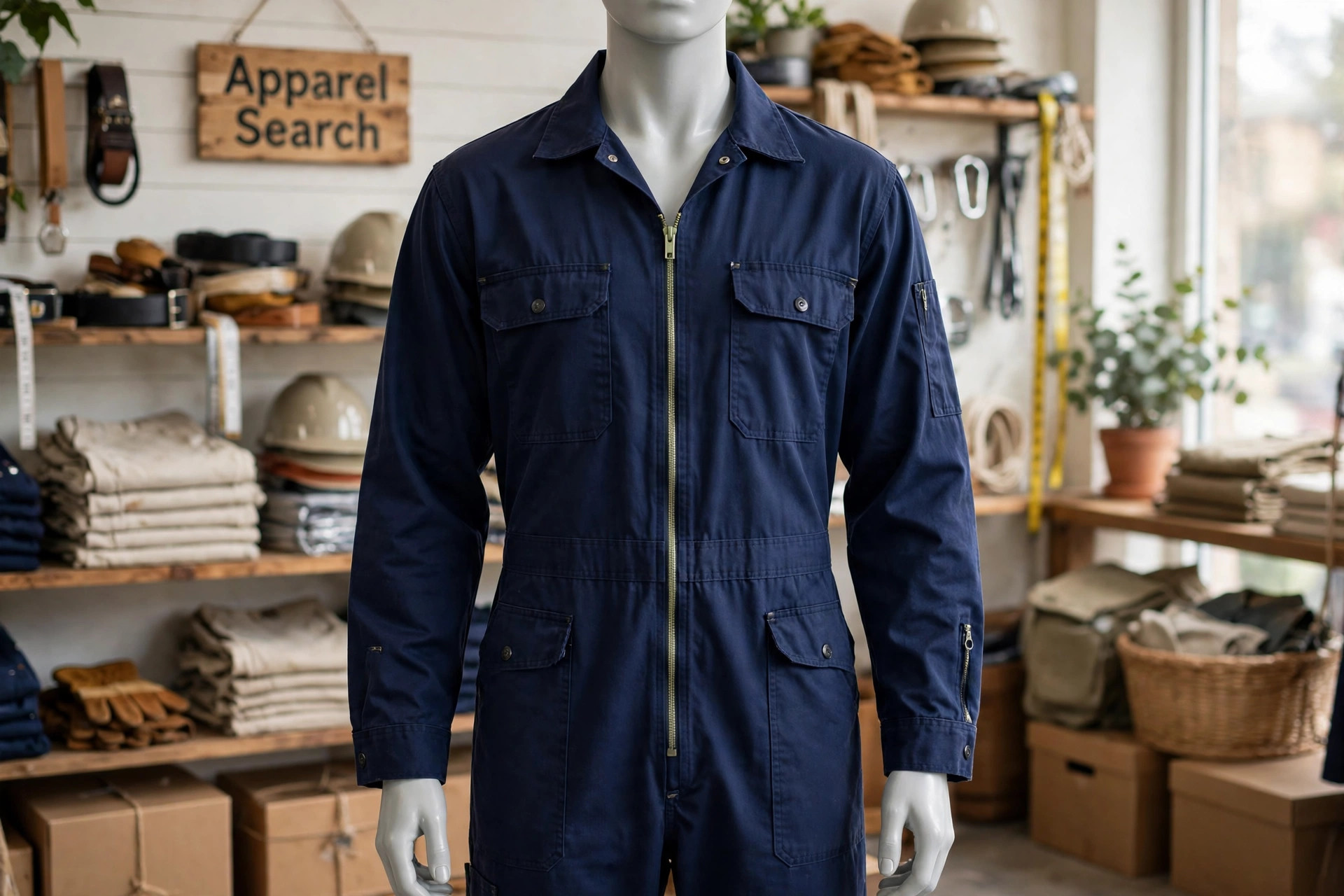
Construction of a Coverall
A coverall is cut generously, because it must go on over a full set of street clothes and still allow bending, reaching and climbing. The body, sleeves and legs are made as one garment, usually in a hard-wearing cotton, cotton-polyester twill or, for hazardous work, flame-resistant or chemical-resistant fabric. A long, narrow pocket down the outside of the right thigh is a traditional detail, sized for the long tools of a mechanic or engineer, and chest and hip pockets carry the smaller ones. Elastic or gathered cuffs, an action back with pleats across the shoulders, and a two-way front closure are the refinements that separate a good working coverall from a merely adequate one.
The front fastening runs the whole length of the body, from ankle-level rise to the throat, and there are no lapels — nothing ornamental interrupts the protective surface. The fastening itself varies by trade and era: buttons on older garments, a zipper on most modern ones, hook-and-loop (Velcro) where a snag-free, quickly opened closure matters — the British Royal Air Force uses it — and snap fasteners or press-studs where the garment must pull open in an emergency. A covered placket over the closure keeps sparks, swarf and dirt away from the fastening and from the clothes beneath.

Issued Workwear and Uniforms
Because one garment protects a whole outfit, coveralls became standard issue wherever work is dirty, hot or hazardous. Factories issue them to their workers, often with the firm’s badge on the chest; garages, farms, ships’ engine rooms and flight lines all dress the same way. As formal uniforms, a dark blue coverall is the working dress of the US Navy, with the wearer’s name and “U.S. Navy” on the chest and rank insignia on the collar points, and police and military units in several countries use boiler suits as working uniforms in the same spirit. Purpose-built variants add the protection the base garment lacks: insulated coveralls for cold stores and winter work, high-visibility coveralls for road and rail crews, and disposable coveralls for painting, asbestos and clean-room work.
The Other Overall: Bib-and-Brace
The confusion around this page’s title comes from the second garment that shares the name. Bib-and-brace overalls are trousers with an attached bib covering the chest and braces over the shoulders — dungarees in British English. They are traditionally made of blue denim with riveted pockets like blue jeans, and they have been work dress for farmers and railroad workers for well over a century, worn over long johns or a union suit in cold weather or a T-shirt in warm. Since the 1960s they have also cycled through fashion, worn by young people of both sexes, often with one strap left loose. A third, older military sense survives in mess dress, where “overalls” are the tight, high-waisted wool trousers worn with braces as part of officers’ formal dress — a reminder that the word once meant any close over-garment before it settled on workwear.
Choosing and Caring for Coveralls
Fit a coverall over the clothes it will protect: the torso length is the critical measurement, since a short rise makes bending miserable, and sleeves and legs should reach the wrists and ankles without pulling. Working coveralls are washed hard and often, so colourfast, pre-shrunk fabric and bar-tacked stress points matter more than finish. Check that the closure still runs freely after washing, that knee and elbow fabric is not thinning, and that reflective or protective treatments, where fitted, are renewed to their maker’s schedule — a coverall’s value is entirely in the protection it still gives. The fashion relatives of the garment — the jumpsuit above all — borrow its one-piece ease but are cut to be seen rather than to protect, and current workwear and fashion versions are surveyed in our guide to coveralls.
Not to Be Confused With
The words divide differently on each side of the Atlantic. In American use, coveralls are the one-piece garment described here, while overalls are bib-and-brace trousers with a chest bib and shoulder straps, worn over a shirt. In British use, overall can mean the one-piece garment itself, and the bib garment is usually called dungarees. Our questions section works through the same distinction: the difference between a coverall and overalls.
Common Questions
What is the difference between bib overalls and coveralls?
Bib-and-brace overalls are trousers with an attached patch covering the chest and braces over the shoulders, worn over a shirt. Coveralls — the boiler suit — are a one-piece garment with full-length sleeves and legs, worn over street clothes, with no gap between jacket and trousers and no loose jacket tails.
How do coveralls fasten?
A coverall usually has a front fastening extending the whole length of the front of the body up to the throat, with no lapels. The fastening can be buttons, a zipper, hook-and-loop (Velcro, as in the British Royal Air Force), or snap fasteners and press-studs.
Who is issued coveralls as a uniform?
Factories often issue coveralls to their workers, with the firm's badge on the garment. A dark blue coverall is the working uniform of the US Navy, with the wearer's name and US Navy on the chest and rank insignia on the collar points, and uniformed services in several countries use boiler suits in the same way.