Jerkin
Clothing Definitions — definitions of garments and clothing terms from Apparel Search
A jerkin is a man's short close-fitting jacket, made usually of light-colored leather, and without sleeves, worn over the doublet in the sixteenth and seventeenth centuries. The stock phrase buff jerkin refers to an oiled oxhide jerkin, as worn by soldiers. Leather jerkins of the sixteenth century were often slashed and punched, both for decoration and to improve the fit. Jerkins were worn closed at the neck and hanging open over the peascod-bellied fashion of doublet, and at the turn of the seventeenth century buttoned at the waist and open above. This page explains the jerkin's wearing through those changes of silhouette, and the unknown origin of its name.
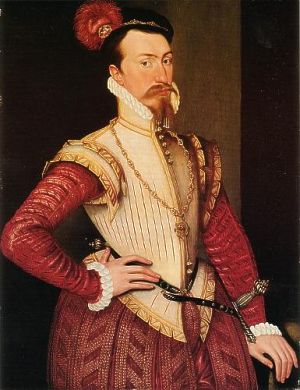
Robert Dudley, Earl of Leicester, in a buff
jerkin,
by Steven van der Muelen, c. 1560s.
(Yale Center for British Art)
A jerkin is a man's short close-fitting jacket, made usually of light-colored leather, and without sleeves, worn over the doublet in the sixteenth and seventeenth centuries.
The stock phrase buff jerkin refers to an oiled oxhide jerkin, as worn by soldiers.
Leather jerkins of the sixteenth century were often slashed and punched, both for decoration and to improve the fit.
Jerkins were worn closed at the neck and hanging open over the peascod-bellied fashion of doublet (as worn by Martin Frobisher). At the turn of the seventeenth century, the fashion was to wear the jerkin buttoned at the waist and open above to reflect the fashionable narrow-waisted silhouette (as worn by Sir Walter Raleigh, 1602).
By the mid-seventeenth century, jerkins were high-waisted and long-skirted like doublets of the period.
The origin of the word is unknown. The Dutch wordjurk, a child's frock, often taken as the source, is modern, and represents neither the sound nor the sense of the English word.
| The above article is licensed under the GNU Free Documentation License. From Wikipedia, the free encyclopedia (https://en.wikipedia.org/wiki/jerkin_%28garment%29). 1/6/06 |
Following the Doublet's Silhouette
Because the jerkin was worn over the doublet, its history is the doublet's history seen from outside. In the 1560s, as in the portrait of Robert Dudley, Earl of Leicester, in a buff jerkin, the jerkin was worn closed at the neck and hanging open over the peascod-bellied doublet, the padded, protruding front fashionable at the time, as worn by Martin Frobisher. At the turn of the seventeenth century the fashionable silhouette narrowed at the waist, and the jerkin changed with it: buttoned at the waist and open above, reflecting the narrow waist, as worn by Sir Walter Raleigh in 1602. By the mid-seventeenth century jerkins were high-waisted and long-skirted like the doublets of the period, so at every stage the sleeveless leather layer took its shape from the garment beneath it.
The word itself resists explanation. The origin of the word jerkin is unknown: the Dutch word jurk, a child's frock, often taken as the source, is modern, and represents neither the sound nor the sense of the English word. What is certain is the garment's place in the jacket family. It is the jacket reduced to a body layer — no sleeves, close fit, leather for durability — worn by gentlemen as fashion and by soldiers as the practical buff jerkin, and its two fashion periods, 1550-1600 and 1600-1650, are the ones under which its portraits and survivors are catalogued.
Common Questions
What is a jerkin?
A jerkin is a man's short close-fitting jacket, made usually of light-colored leather, and without sleeves, worn over the doublet in the sixteenth and seventeenth centuries.
What is a buff jerkin?
The stock phrase buff jerkin refers to an oiled oxhide jerkin, as worn by soldiers.
Why were leather jerkins slashed and punched?
Leather jerkins of the sixteenth century were often slashed and punched, both for decoration and to improve the fit.
More to Explore
- jacket
- leather
- sleeves
- doublet
- 1550-1600 in fashion
- 1600-1650 in fashion
- Coat
- Ski Jacket
- Clothing Definitions
- Safari Jackets
- Trench Coat
- Parka Definition
- Anorak
- Overcoat
- Poncho
- Petticoat
- Frock Coat
- Morning Coat
- Bekishe
- Waistcoat
- Blazer
- Strightjacket
- GNU Free Documentation License
- https://en.wikipedia.org/wiki/jerkin_%28garment%29