Tailor
Miscellaneous Definitions — the maker of custom-fit suits, coats and trousers, and the craft of tailoring, from Apparel Search
Search Apparel Search
At a Glance
Definition: A tailor is a person whose occupation is to sew clothes custom-fit to individuals and to repair clothes, making men's and women's suits, coats, trousers and similar garments, usually of wool, linen or silk.
Category: Miscellaneous Definitions
A tailor is a person whose occupation is to sew clothes custom-fit to individuals, and to repair clothes. Although the term dates to the thirteenth century, tailor took on its modern sense in the late eighteenth century, and it now refers to makers of men's and women's suits, coats, trousers and similar garments, usually of wool, linen or silk. Traditional made-to-measure tailoring is called bespoke tailoring in the United Kingdom, where the heart of the trade is in London's Savile Row, and custom tailoring in the United States and Hong Kong. This page covers the occupation itself, the bespoke and custom names for it, the tailor-made and tailored styles that carry the tailor's manner into general clothing language, and the rodeo tailor at the trade's most decorated extreme.
Custom Fit as an Occupation
The tailor's occupation rests on one commitment: clothes made for an individual body rather than for an average size. A tailor sews clothes custom-fit to individuals, and also repairs clothes, so the same hands that construct a garment can extend its life by mending and adjustment. In some documents tailor also means adjust, and tailoring means adjust or mend, which captures the second half of the trade exactly.
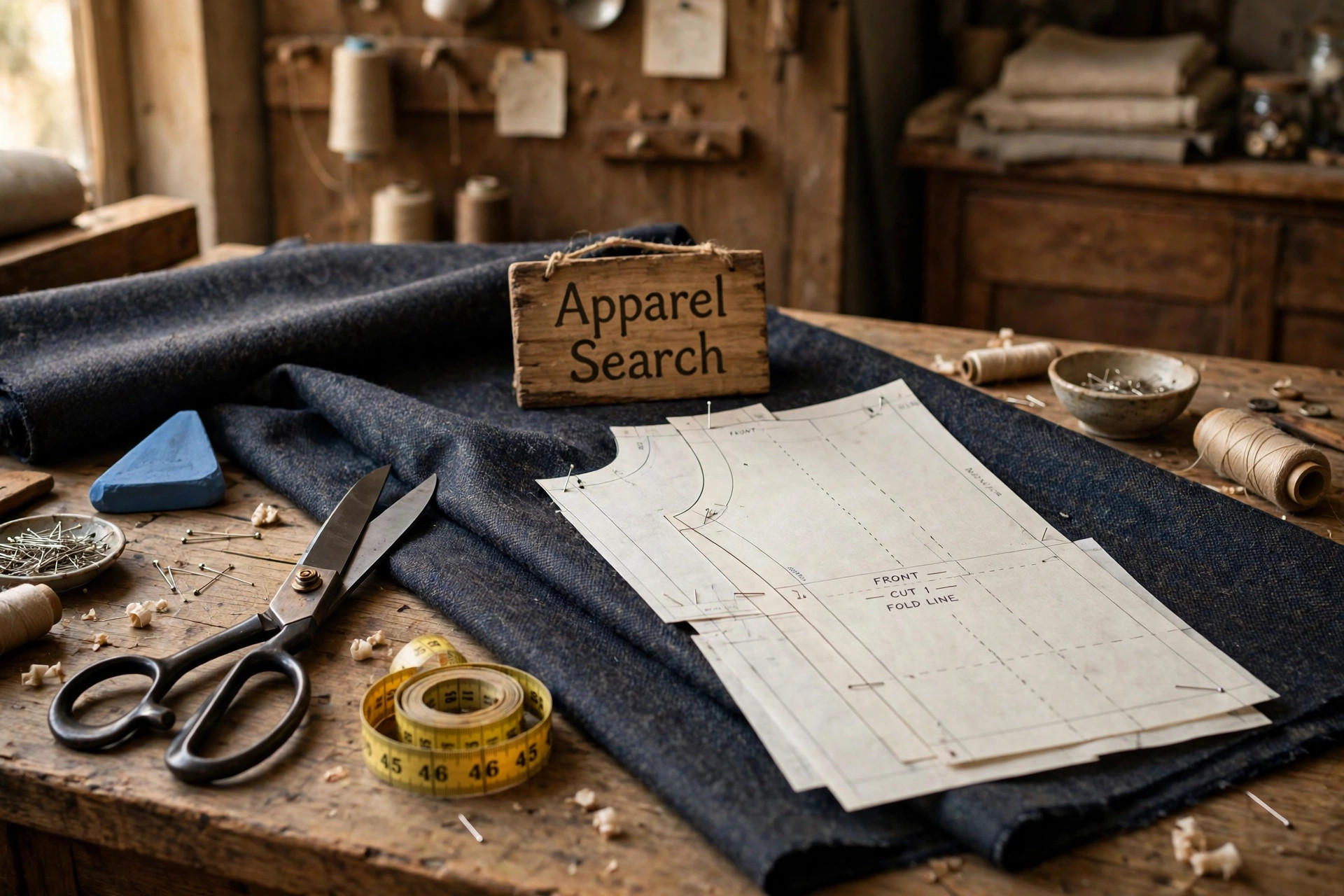
Fit is not a single measurement. A suit, coat or pair of trousers must sit correctly at the shoulder, chest, waist and seat, hang to the intended length, and allow the wearer to move, all at once. Working in wool, linen or silk, the tailor cuts and sews so those demands are met together, and then refines the garment on the wearer rather than assuming the first construction is final. The tools and stages of that work have their own definitions on Apparel Search, including the pattern the garment is cut from and the tailor's tailors chalk that marks the cloth.
From the Thirteenth Century to Bespoke and Custom
The word has a long history before its modern precision. The term dates to the thirteenth century, but tailor took on its modern sense in the late eighteenth century, when it came to refer to makers of men's and women's suits, coats, trousers and similar garments. That late eighteenth-century sense still describes the trade: structured garments, made individually, in cloth such as wool, linen or silk.
Traditional made-to-measure tailoring is called bespoke tailoring in the United Kingdom, where the heart of the trade is in London's Savile Row, and custom tailoring in the United States and Hong Kong. The two names describe the same core transaction across different tailoring cultures: a garment commissioned by one customer, made to that customer's measurements and choices, rather than selected finished from stock. Savile Row's place in the definition is geographical as much as technical, marking where the British bespoke trade concentrated and where its standards became widely referenced.
Tailor-Made, Tailored and the Dressmaker Contrast
The tailor's influence extends into ready-made language. A tailor-made is a woman's suit consisting of a (usually) woollen or tweed coat and skirt; the name arose during the Edwardian period.
As an adjective, tailor-made — from the second half of the twentieth century usually simplified to tailored — refers to clothing made by or in the style of clothes made by a tailor, characterized by simplicity of cut and trim and fine (often hand) finishing. As a women's clothing style, tailored is opposed to dressmaker, setting the crisp, structured tailor's manner against the dressmaker's softer one. The contrast is one of approach rather than of skill: both trades sew custom clothes, but the tailored style is defined by the plain cut, restrained trim and fine finishing of the tailor's structured garments. Related custom-clothing trades include the corsetry and corset maker, and the underlying craft is sewing itself.
Rodeo Tailors and the Tailor in Fiction
At the opposite extreme of decoration stands the rodeo tailor, a creator of the flamboyant costumes typical of country and western musicians, characterized by extensive hand embroidery, an abundance of rhinestones, and cowboy details such as pearl snaps and arrowhead pockets. Both extremes use the same underlying skill — cutting and sewing a garment to fit one person; what differs is how plainly or elaborately the finished surface speaks.
Even fiction keeps the figure familiar: famous fictional tailors include the tailor in The Emperor's New Clothes. The tale (Danish: Kejserens nye klæder), written by Danish author Hans Christian Andersen, tells of two weavers who promise an emperor a new suit of clothes that they say is invisible to those who are unfit for their positions, stupid or incompetent — while in reality they make no clothes at all. When the emperor parades before his subjects in his new clothes, no one dares to say they do not see any suit of clothes on him, for fear of being seen as stupid, until a child cries out, "But he isn't wearing anything at all!" The tale has been translated into over 100 languages.
Common Questions
What does a tailor do?
A tailor sews clothes custom-fit to individuals and repairs clothes. Tailors make men's and women's suits, coats, trousers and similar garments, usually of wool, linen or silk.
What is bespoke tailoring?
Bespoke tailoring is the traditional made-to-measure tailoring of the United Kingdom, where the heart of the trade is in London's Savile Row. The same work is called custom tailoring in the United States and Hong Kong.
What does tailor-made mean as a clothing style?
A tailor-made is a woman's suit consisting of a usually woollen or tweed coat and skirt, a name that arose during the Edwardian period. As an adjective, tailored refers to clothing made by or in the style of clothes made by a tailor, characterized by simplicity of cut and trim and fine, often hand, finishing.
What is a rodeo tailor?
A rodeo tailor is a creator of the flamboyant costumes typical of country and western musicians, characterized by extensive hand embroidery, an abundance of rhinestones, and cowboy details such as pearl snaps and arrowhead pockets.