Peacoat
Clothing Definitions — definitions of garments and clothing terms from Apparel Search
Search Apparel Search
At a Glance
Definition: A peacoat is a short outer coat of heavy wool, generally navy in colour, with broad lapels, a double-breasted front and vertical or slash pockets, originally worn by sailors in European navies.
Also known as: Pea jacket; P coat
Category: Clothing Definitions
Word Origin
The United States Navy account ties the name to the cloth: the heavy wool of the service coat was called pilot cloth, which was shortened in use to P-cloth — and a coat made of P-cloth became the pea coat. The name is a letter turned into a word.
A peacoat — also written pea coat, and called a pea jacket — is a short, heavy coat built for weather at sea. It is generally navy-coloured, cut from dense wool, and recognised at a glance by its broad lapels, its double-breasted front and its vertical or slash pockets. Sailors in European navies wore it first, the United States Navy fixed its best-known pattern in the early twentieth century, and civilians adopted it so completely that it is now a standard winter coat far from any dock. This page sets out the pattern, the cloth behind the name, and the difference between a service coat and the retail versions that copy it.
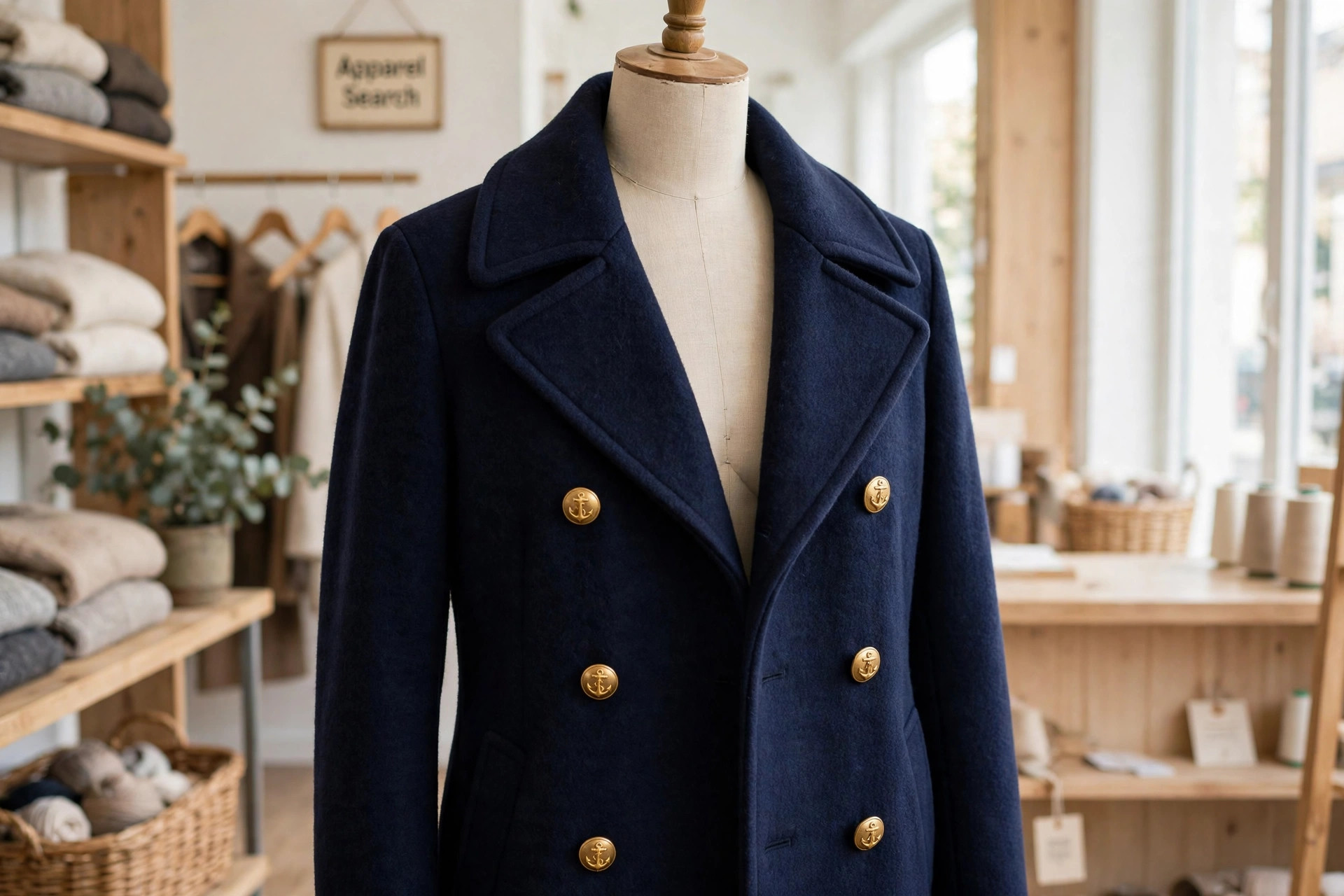
The Pattern
Every element of the peacoat answers to shipboard work. The double-breasted front doubles the heavy cloth across the chest and can be buttoned to either side as conditions require; the broad lapels turn up and close around the throat against wind. The United States Navy pattern adds the details that make the coat instantly identifiable: anchor buttons and wide, rounded lapels, on a navy blue worsted wool body. The length is the other service decision — the coat ends at the hip or mid-thigh, where a landsman's overcoat continues toward the knee, because a sailor working on deck or aloft needs his legs free and no skirts of cloth to catch on ropes, rails and gear.
The pockets follow the same logic. Vertical or slash pockets sit where cold hands naturally fall, and their placement keeps them clear of lines and equipment. Nothing on the coat is decoration first: the single-breasted fastening used on most civilian coats was passed over precisely because the overlapped front is warmer and more adaptable at sea.
The buttons deserve their own note, because they are the coat's signature. Service buttons carry the anchor, and the double-breasted arrangement — two parallel columns, the front fastening to either — is not symmetry for its own sake: a sailor could re-button the overlap against the wind's direction, and a worn or damaged button on one side did not disable the fastening. Retail copies keep the anchor motif more faithfully than any other detail, which is why it, rather than the cloth or the cut, is what most people use to identify the style.

Pilot Cloth: The Fabric in the Name
Pilot cloth is a heavy, densely woven worsted wool made to stand up to wind and spray, warm in raw sea air and hard-wearing enough for a garment that was issued to be lived in rather than kept for best. That density is the coat's whole performance: it blocks wind, sheds light spray, and keeps its shape through years of daily wear. The Word Origin box above tells how the cloth's name shortened into the coat's.
The peacoat belongs to the wider family of naval and weather coats — the belted trench coat, the hooded parka and anorak, and the full-length overcoat — but it is the shortest and squarest of them, and the only one whose pattern was settled by navies rather than by armies or explorers.
From Service Issue to Civilian Classic
Few of the peacoats seen on the street are genuine navy surplus. The style is a classic, and ordinary retailers sell it in large numbers, often with small changes that follow current fashion — a slimmer cut than the roomy service fit that had to go over a sailor's jumper, lighter wool blends in place of true pilot cloth, and buttons that keep the anchor motif as a recognised detail even when nothing else is service pattern. Worn as a jacket-weight winter coat or dressed up over tailoring, it keeps its place because every feature that served at sea also serves on land.
Buying and keeping one follows overcoat rules. The fit should still allow a sweater beneath, with the shoulders easy and the double-breasted front closing without strain. Care is wool care: brush the cloth after wear, rest the coat on a broad hanger, dry-clean when needed, and store it clean against moths. Judged that way, the peacoat's two-century run — from European navies through the American service pattern to the modern high street — rests on a rare combination: a working garment whose every feature also happens to look right.
Colour has widened with civilian use. Navy remains the defining shade and the one the service pattern specifies, but fashion versions are made in black, grey and occasionally brighter colours, and in lengths that drift a little longer than the service hip-to-mid-thigh cut. Those variations do not change the definition: heavy wool, broad lapels, double-breasted front, slash or vertical pockets and a short body are the peacoat, in whatever colour a retailer chooses to cut it.
Not to Be Confused With
Two naval coats, one ancestry. A peacoat is the sailor's short working coat: heavy wool, double-breasted, broad-lapelled, ending at the hip or mid-thigh so the wearer can move and work. A reefer — the reefing jacket — is its close relative, named for the sailors who reefed sails; in naval use the word settled on officers' and dress versions of the same double-breasted short coat, and in civilian use on similar short double-breasted jackets. If the coat is the enlisted working pattern, peacoat is the precise word; reefer is the broader, older family name.
Common Questions
Why is it called a pea coat?
The name comes from the cloth. The heavy wool of the United States Navy coat was called pilot cloth, which became known as P-cloth, and a coat made of P-cloth gave the pea coat its name.
What are the features of a peacoat?
A peacoat is a heavy wool outer coat, generally navy-coloured, with broad lapels, a double-breasted front, and vertical or slash pockets. The United States Navy pattern adds characteristic anchor buttons and wide, rounded lapels, in navy blue worsted wool.
Are peacoats seen on the street genuine navy surplus?
Few of them are. The peacoat is a classic garment sold by ordinary retailers in large numbers, often with small design changes that follow current fashion, while genuine surplus coats follow the service pattern.