Camel Hair
Fiber Definitions — camel hair and the camel family from Apparel Search
Search Apparel Search
At a Glance
Definition: Camel hair is the hair fiber of the camels — the single-humped Dromedary and the double-humped Bactrian camel of the dry and desert areas of Asia and northern Africa — grouped among the specialty animal hair fibers.
Category: Fiber Definitions
Word Origin
The name camel comes from the Hebrew gamal, meaning “to repay” or “requite”, as the camel does the care of its master.
Camel hair takes its name from the animal behind it, so this definition begins with the camels themselves. A camel is either of the two species of large even-toed ungulate in the genus Camelus: the Dromedary, the single-humped camel, and the Bactrian camel, the double-humped camel. Both are native to the dry and desert areas of Asia and northern Africa. The term camel is also used more broadly to describe any of the six camel-like creatures in the family Camelidae: the two true camels and the four South American camelids — the llama, alpaca, guanaco and vicuna. A fiber animal's coat is shaped by the climate it evolved to survive, which is why the camel belongs in a fiber glossary alongside the other hair-bearing animals.
The Two True Camels and the Wider Family
The classification given in the original runs as follows. Family Camelidae. Genus Lama: the llama, Lama glama; the alpaca, Lama glama pacos; and the guanaco, Lama guanicoe. Genus Vicugna: the vicuna, Vicugna vicugna. Genus Camelus: the Dromedary, Camelus dromedarius, and the Bactrian camel, Camelus bactrianus. For an overview of the whole family, the camelid grouping is the reference point, and the fiber pages for the individual South American members — alpaca fiber, llama wool and guanaco fiber — carry the detail for those fibers, while the vicuna has its own page.
Domestication, Range and Numbers
Humans first domesticated camels many thousands of years ago. The Dromedary and the Bactrian camel are both still used for milk, meat and as beasts of burden: the Dromedary in northern Africa and western Asia, the Bactrian camel further to the north and east in central Asia. Although there are almost 13 million Dromedaries alive today, the species is extinct in the wild: all but a handful are domesticated animals, mostly in Sudan, Somalia, India and nearby countries. There is, however, a substantial feral population of about 32,000 in central Australia, descended from individuals that escaped from captivity in the late 19th century. The Bactrian camel once had an enormous range but is now reduced to an estimated 1.4 million animals, mostly domesticated; it is thought that there are about 1,000 wild Bactrian camels in the Gobi Desert, and small numbers in Iran, Afghanistan, Turkey and Russia.
Camel Hair Among the Specialty Hair Fibers
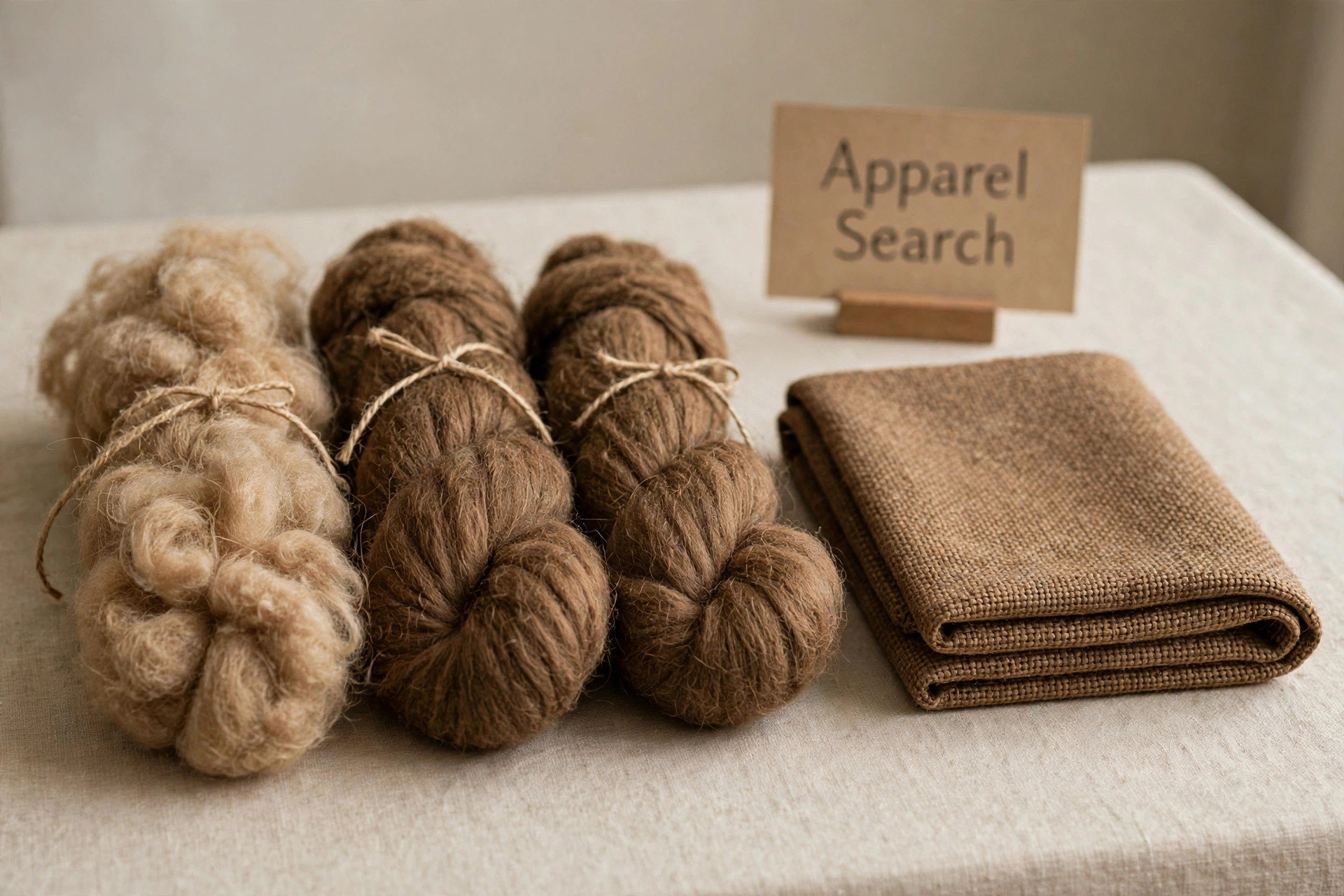
Camel hair belongs to the specialty animal hair fibers, and its glossary neighbours are the other hair-bearing members of its own family and beyond: cashmere wool, alpaca fiber, llama wool and guanaco fiber all have their own definitions alongside this one. The family structure explains the grouping. The two true camels yield camel hair in the dry and desert areas of Asia and northern Africa to which they are native, while their South American relatives — the llama, alpaca, guanaco and vicuna — yield the Andean specialty fibers. A reader comparing hair fibers is therefore comparing coats that evolved for hard climates on two continents: desert heat and cold for the true camels, high mountain cold for the South American camelids. The hair that protects the animal in its habitat is a clothing fiber in its own right, which is why the camel pages and the cashmere page are cross-linked. For the general term, see the fiber definition.
Common Questions
What are the two true camel species?
The Dromedary, Camelus dromedarius, with a single hump, used in northern Africa and western Asia, and the Bactrian camel, Camelus bactrianus, with two humps, found further north and east in central Asia. Both are still used for milk, meat and as beasts of burden.
Which animals belong to the camel family?
The family Camelidae covers the two true camels and the four South American camelids: the llama, Lama glama; the alpaca, Lama glama pacos; the guanaco, Lama guanicoe; and the vicuna, Vicugna vicugna. The South American members are the family's best known fiber producers.
Are camels extinct in the wild?
The Dromedary is extinct in the wild, with almost 13 million alive today nearly all domesticated, plus a feral population of about 32,000 in central Australia. The Bactrian camel is reduced to an estimated 1.4 million animals, mostly domesticated, with about 1,000 wild Bactrian camels thought to remain in the Gobi Desert and small numbers in Iran, Afghanistan, Turkey and Russia.