PFAS in Clothing
Forever chemicals in apparel: where they hide, which laws ban them, and how brands prove a garment is clean
For decades, the easiest way to make a jacket shed rain, a uniform shrug off gravy, or a school blazer resist ink was a fluorinated finish. That chemistry belongs to PFAS, thousands of manufactured substances built on carbon–fluorine bonds so strong the environment barely breaks them down — hence “forever chemicals.” What was once a selling point is now a regulated liability: California and New York already ban PFAS in new apparel, France bans it in consumer clothing and footwear, the EU has begun applying its first textile limits, and more U.S. states phase in restrictions through the early 2030s. This guide explains what PFAS are, why apparel used them, where they still show up, what the law requires market by market as of late November 2026, how compliance is tested, what replaced the old chemistry, and what a shopper can check. It sits in the compliance cluster anchored by the EPR Compliance Hub.
About this guide — and a note on currency: PFAS rules and regulations are subject to change, and they are changing quickly: thresholds tighten on fixed dates, agencies are still writing implementing regulations, and one major proposal below is not yet law. This page reflects the position as understood in late November 2026 and may not always reflect the most current state of the law. Before acting on anything here, verify the details against official sources — the U.S. Environmental Protection Agency (EPA), the California Department of Toxic Substances Control (DTSC), the New York State Department of Environmental Conservation (DEC), the Washington State Department of Ecology, the European Chemicals Agency (ECHA) and EUR-Lex — or consult a qualified compliance professional.
What PFAS Are, and Why Apparel Used Them
PFAS is short for per- and polyfluoroalkyl substances: a class of fluorinated organic chemicals containing at least one fully fluorinated carbon atom — the definition California and New York both write into their apparel laws, with small variations elsewhere. The carbon–fluorine bond is among the strongest in organic chemistry, giving these substances an unusual combination of talents: they repel water and oil, tolerate heat, and persist. A finish that shrugs off rain and salad dressing alike, wash after wash, was close to a miracle product.
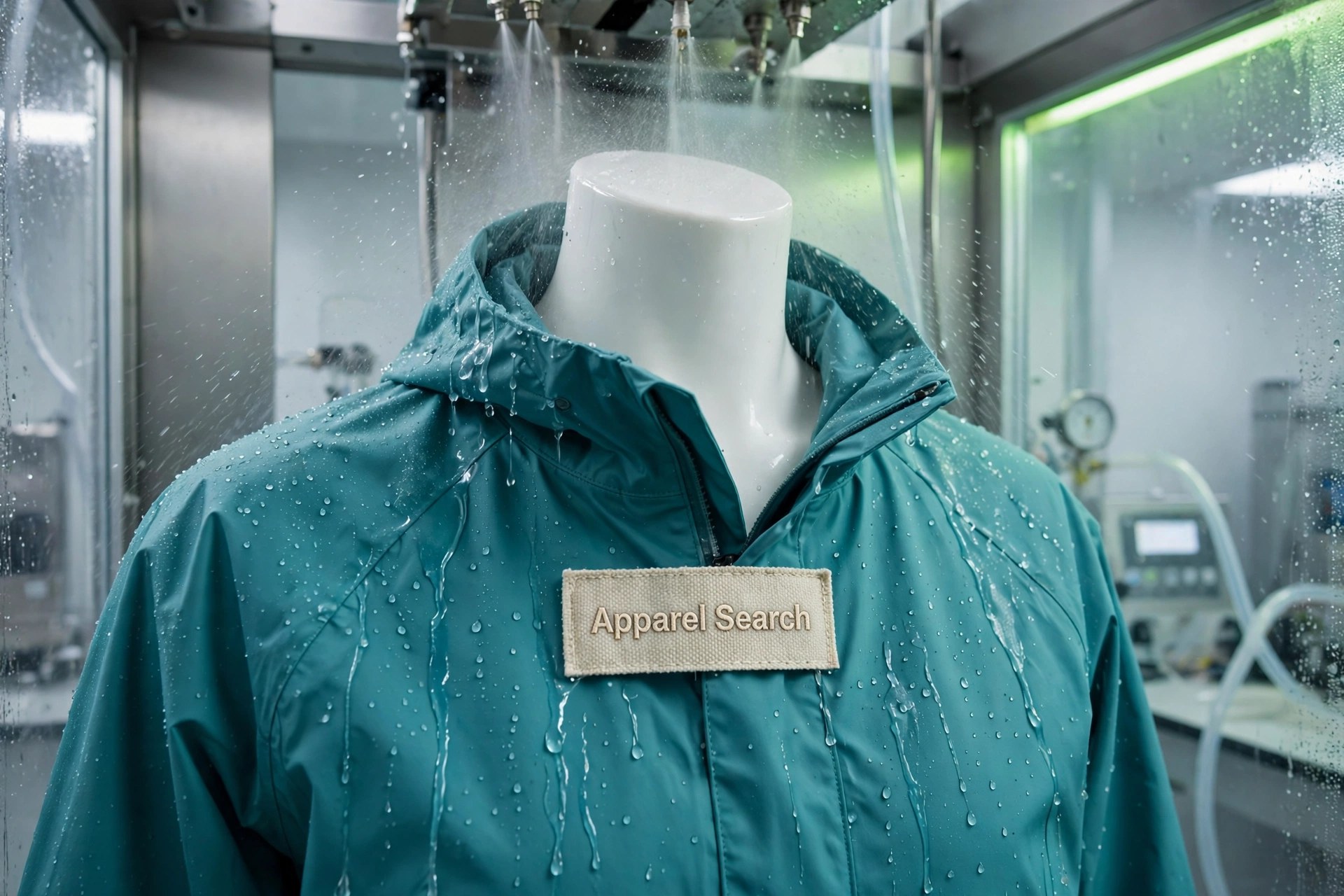
Three uses mattered most. The largest was the durable water repellent, or DWR, finish: a coating on a fabric’s outer face so rain beads off instead of soaking in — prized because, uniquely, it repelled oil-based stains as well as water. The second was stain resistance for school uniforms, workwear and rental garments facing spills and industrial laundering. The third was the membrane inside high-end waterproof-breathable clothing: the classic membrane described in our Gore-Tex fabric definition is expanded PTFE, a fluoropolymer — a plastic-like PFAS in polymer form — whose pores block liquid water while letting sweat vapor escape.
The chemistry also has a history of regrettable substitution. Early finishes relied on long-chain, so-called C8, chemistry built around PFOA and PFOS, the two most studied PFAS. As evidence hardened, manufacturers shifted to shorter-chain C6 alternatives, presented as an improvement. Regulators concluded the shorter chains were still PFAS — still persistent, still mobile in water — so the newer laws regulate PFAS as a class, not compound by compound. Swapping to another fluorinated finish no longer answers them.
Where PFAS Show Up in Clothing
PFAS in apparel are rarely visible, and they concentrate in products promising protection from water and stains. Rain jackets, ski shells and other outerwear are the best-known case, through DWR finishes and, in older or high-end constructions, fluoropolymer membranes. Stain-resistant school uniforms, children’s clothing, and workwear for food service, healthcare and industry have used fluorinated stain-release finishes. Water-resistant shoes and boots carry repellent treatments, and sometimes membranes, of their own. Performance fabrics — athletic wear marketed as sweat-proof or stain-proof, soft shells, gloves and gaiters — round out the list, and aftermarket waterproofing sprays have themselves contained PFAS, which is why France and the EU restrict consumer mixtures too.
Two cautions keep the picture honest. Presence is not uniform: a basic cotton T-shirt has little reason to contain PFAS, while a “waterproof, stain-resistant” shell is exactly where the chemistry earned its keep. And PFAS can arrive unintentionally — contamination from shared equipment or recycled feedstocks — which is why California adds a numeric backstop, in total organic fluorine, to its ban on intentional use.
Health and Environment: The Concern, Stated Carefully
The U.S. Environmental Protection Agency frames the concern plainly: PFAS are manufactured chemicals used since the 1940s that break down very slowly, are found widely in water, soil and air, and can build up in people, animals and the environment over time. Studies have shown exposure to some PFAS may be linked to harmful health effects in humans and animals, and EPA guidance associates certain PFAS with increased risk of some cancers, increased cholesterol, reduced immune response, and developmental and reproductive effects. Start with EPA’s PFAS pages, which New York’s DEC also points to.
Proportionality matters. The strongest evidence concerns heavily studied compounds such as PFOA and PFOS and routes such as contaminated drinking water; far less is known about most individual PFAS, and this guide assigns no risk figure to wearing a jacket, because the sources do not support one. The regulatory logic is persistence: fluorinated finishes wear, wash and landfill their way into water systems, adding to pollution that is extremely hard to remove once dispersed. Legislatures have chosen to stop adding to that burden at the design stage — the prevention approach New York’s DEC describes for its apparel law.
The Timeline: When Each Rule Bites
PFAS apparel law is a calendar as much as a chemistry problem; the sections after this table explain each rule.
| Date | Market | What happens |
|---|---|---|
| January 1, 2025 | California & New York | California bans new textile articles with intentionally added PFAS, or total organic fluorine at or above 100 ppm. New York bans new apparel with intentionally added PFAS. Severe-wet-conditions gear is deferred in both, with a “Made with PFAS chemicals” disclosure meanwhile. |
| January 1, 2026 | France & Maine | France bans PFAS in consumer clothing textiles, footwear and waterproofing agents, protective equipment excepted. Maine’s ban reaches textile articles. |
| October 10, 2026 | European Union | The PFHxA restriction begins to apply to clothing, accessories and footwear for the general public: 25 ppb (PFHxA and salts), 1,000 ppb (related substances). |
| January 1, 2027 | California, Washington & New York | California’s ceiling tightens to 50 ppm total organic fluorine. Washington restricts intentionally added PFAS in apparel and accessories. New York’s second phase — a numeric level DEC must set by regulation — falls due. |
| January 1, 2028 | California, New York & Colorado | The severe-wet-conditions deferral ends in California and New York. Colorado’s ban reaches textile articles and severe-wet-conditions outdoor apparel. |
| January 1, 2032 | Minnesota & Maine | Both states extend their bans to essentially all products with intentionally added PFAS, currently-unavoidable uses excepted. |
The United States: A State Patchwork, No Federal Apparel Ban
There is no general federal ban on PFAS in clothing. Federal action runs through other channels — drinking-water standards, and a one-time Toxic Substances Control Act reporting rule reaching PFAS inside imported articles — so the operative rules are state rules, and they do not match. Selling nationally means meeting the strictest state in the footprint, usually California.
California: AB 1817’s Thresholds, AB 347’s Teeth
California’s textile rule was enacted by AB 1817 (2022), in Health and Safety Code sections 108970–108971 (statute text). Since January 1, 2025, no person may manufacture, distribute, sell or offer for sale in California a new textile article containing regulated PFAS: PFAS intentionally added for a functional effect, or PFAS present at or above a total-organic-fluorine threshold — 100 parts per million from 2025, tightening to 50 ppm on January 1, 2027. “Textile articles” are defined broadly — apparel, accessories, handbags, bedding, towels and more. Outdoor apparel for severe wet conditions is deferred until January 1, 2028, but since 2025 may be sold only with a legible “Made with PFAS chemicals” disclosure, online listings included. Manufacturers must use the least toxic alternative, including alternative design, and give sellers a signed certificate of compliance; retailers relying on it in good faith are not liable. AB 347 (2024) added the machinery: DTSC is to adopt implementing regulations by January 1, 2029, and manufacturers must register with DTSC and certify compliance on or before July 1, 2029.
New York: Intentionally Added First, a Numeric Level to Follow
New York’s law, Environmental Conservation Law section 37-0121, is explained by the Department of Environmental Conservation on its PFAS in apparel page. Since January 1, 2025, no person may sell or offer for sale in New York any new, not previously used, apparel containing PFAS as intentionally added chemicals — chemicals serving an intended function in the product. Apparel runs from undergarments and shirts to outdoor apparel, onesies and diapers; professional uniforms and protective equipment are excluded. A second phase follows: no later than January 1, 2027, apparel may not contain PFAS at or above a level DEC sets by regulation, intentional or not; as of late November 2026 that rulemaking was still in progress. Outdoor apparel for severe wet conditions — extreme-use waterproof gear for experts — is covered from January 1, 2028. Sellers may rely on manufacturers’ compliance certifications, kept for DEC on request.
The Wider State Map
Minnesota’s Amara’s Law (Minnesota Statutes section 116.943) banned intentionally added PFAS from January 1, 2025 in eleven categories — carpets and rugs, fabric treatments, juvenile products and textile furnishings among them, but not general adult apparel, which is reached by the endgame: a ban on all products with intentionally added PFAS from January 1, 2032, currently-unavoidable uses excepted, plus manufacturer reporting phased in during 2026. Maine, first to legislate broadly, has narrowed its reporting duty to currently-unavoidable-use determinations; its sales bans reached textile articles on January 1, 2026, the rest following in 2032. Washington’s Safer Products program (rule chapter 173-337 WAC, adopted November 2025; see the Department of Ecology compliance page) restricts intentionally added PFAS in apparel and accessories from January 1, 2027; extreme-use apparel and footwear sit in a reporting tier, first reports due January 31, 2027, and detected total fluorine is presumed to show intentional addition unless a manufacturer rebuts it. Colorado phases in textile and severe-wet-conditions bans on January 1, 2028, disclosure meanwhile. Other states run their own schedules — hence the note atop this guide.
France and the European Union
France moved first in Europe with Law No. 2025-188 of February 27, 2025. From January 1, 2026 it prohibits the manufacture, import, export and placing on the market of PFAS-containing cosmetics, ski wax, clothing textiles, footwear and consumer waterproofing agents — protective clothing and footwear for defense and civil security excepted. Implementing Decree No. 2025-1376 of December 28, 2025, published on Légifrance, set the tolerated residual traces separating contamination from a ban-triggering presence: 25 parts per billion for any single PFAS by targeted analysis excluding polymers, 250 ppb for the sum of targeted PFAS, 50 parts per million for PFAS including polymers. Pre-2026 products may be sold through for twelve months at most. From January 1, 2030 the prohibition extends to all textiles, essential and technical uses excepted by decree.
The EU proceeds on two tracks. The first is finished law: Commission Regulation (EU) 2024/2462 added a restriction on PFHxA — undecafluorohexanoic acid, a short-chain PFAS used in water-repellent treatments — its salts and PFHxA-related substances to Annex XVII of REACH; the text is on EUR-Lex. From October 10, 2026, clothing textiles, leather, furs and hides, related accessories and footwear for the general public may not be placed on the market at or above 25 ppb (sum of PFHxA and its salts) or 1,000 ppb (sum of PFHxA-related substances), measured in each homogeneous material; other textiles follow on October 10, 2027. The second track aims at the whole class: the universal PFAS restriction proposal, submitted to ECHA in January 2023 by Denmark, Germany, the Netherlands, Norway and Sweden. Its status as of late November 2026 is genuinely in flux: ECHA’s Committee for Risk Assessment adopted its final opinion in March 2026, concluding PFAS pose an EU-wide risk justifying restriction; the Committee for Socio-Economic Analysis has issued a draft opinion favoring a broad restriction tempered by time-limited derogations, its final opinion expected by the end of 2026. Only then does the Commission draft the actual restriction — treat any application date for the universal ban as provisional.
What Brands and Importers Must Actually Do
Compliance starts with knowing your own product: which styles carry water-repellent, stain-resistant or waterproof claims, and which mills and finishers supply them — the PFAS in a garment is usually chosen tiers upstream of the brand on the label. Then collect the paperwork: signed supplier declarations and, for California, certificates of compliance sellers can rely on. Paper alone is weak evidence, so brands back it with testing, and the two test families answer different questions. Industry programs add a third layer: the ZDHC MRSL restricts what chemical suppliers may sell into textile production, and bluesign-type input management audits chemistry entering a supply chain. Keep records market by market: a file satisfying California’s threshold does not answer France’s targeted limits or the EU’s PFHxA numbers, because each rule measures something different. The same discipline runs through this cluster — supplier evidence gathered for PFAS feeds directly into Digital Product Passport and traceability work, and proving claims about a product’s origins is a habit shared with UFLPA forced-labor compliance.
| Approach | What it establishes | Where it falls short |
|---|---|---|
| Declare: supplier declarations and certificates of compliance | That each supplier states, signed and in writing, that PFAS was not intentionally added and the article complies — the document California and New York let sellers rely on. | It proves what a supplier believes, not what is in the fabric: no catch for contamination, undisclosed sub-suppliers, or a finish swapped mid-production. |
| Screen: total fluorine / total organic fluorine testing | A fast, inexpensive laboratory screen, commonly run by combustion ion chromatography with total-fluorine methods referenced to standards such as EN 14582, measuring total fluorinated load against thresholds such as California’s 100, then 50, ppm. | It counts fluorine, not PFAS identity: non-PFAS fluorine can register, and the screen cannot say which substance is present, or whether it was intentional. |
| Target: targeted laboratory analysis | Identification of specific named PFAS, typically by liquid chromatography–mass spectrometry, at the parts-per-billion levels French and EU limits are written in. | It only finds compounds on its target list, costs more per sample, and a clean result can coexist with a fluoropolymer it was not asked to see. |
The working consensus is layered: declarations, screening, then targeted testing where a screen, a claim or a limit demands it.
The One-Sentence Version
If a garment’s selling point is that water beads on it or stains wipe off it, someone in its supply chain must now be able to say — in writing, and increasingly to a regulator — what chemistry makes that happen. In California, New York, France and the wider EU, it can no longer be a fluorinated one.
Alternatives: Keeping the Performance, Losing the Fluorine
Substitution is a chemistry change, a product change, or both — and California’s least-toxic-alternative duty, expressly including alternative design, rewards brands that consider all three. Non-PFAS durable water repellents are the direct swap: silicone-based, hydrocarbon and wax-based finishes, and other non-fluorinated chemistries. Their honest tradeoff is oil repellency: fluorinated finishes repelled oil and water together; non-fluorinated finishes repel water well but oil poorly, so a rain shell gives up little while a chef’s jacket gives up more. For membranes, polyurethane was always fluorine-free, and Gore’s ePE membrane, in products from late 2022 and made without PFAS, replaced the fluoropolymer at the premium end. Design-out is the third route: tightly woven fabrics shedding light rain by construction, plus ventilation. Our sustainable fabrics guide places these choices in the wider materials picture. Expect a care adjustment too: non-PFAS finishes benefit from clean washing and dryer heat to restore beading, and may need re-proofing sooner — with a PFAS-free proofer, naturally.
What Consumers Can Check
A shopper cannot test a jacket at the rack, but the information has improved. Look first at the claim’s wording: “made without intentionally added PFAS” is precise and checkable, while a bare “PFAS-free” or a leaf logo says little — our guide to greenwashing and environmental claims explains how to weigh the difference. In California and Colorado, severe-wet-conditions gear that still contains PFAS must say so — the “Made with PFAS chemicals” disclosure, on the product and in online listings — so its absence on expedition-grade gear is itself information. Brands increasingly publish chemical policies naming PFAS, with test methods and thresholds that can be audited. And keep perspective: the laws target new products, closet garments are yours to wear out, and the most defensible purchase is a well-made garment, in checked chemistry, kept for years.
Common Questions
What does PFAS-free mean on a clothing label?
There is no single government definition of the claim for apparel. In practice it means the brand states the garment was made without intentionally added PFAS, judged against its own chemical policy or a program such as a restricted substances list. Because definitions differ, look for the basis of the claim — a named standard, a test method, a published policy — rather than the words alone.
Is it illegal to wear or resell an older rain jacket made with PFAS?
No. The California and New York rules in this guide apply to new, not previously used, apparel. Wearing a jacket you already own is unaffected; the bans govern manufacture, distribution and sale of new articles, not garments in wardrobes or secondhand circulation. Rules differ by place, so check the current text for your state or country.
How does a brand prove a garment contains no PFAS?
Usually with paperwork and testing combined. The brand collects signed declarations or certificates of compliance from mills and finish suppliers, screens materials for total fluorine or total organic fluorine to catch what paperwork missed, and uses targeted analysis to identify specific PFAS where a screen or regulation requires it. No single document proves a negative — which is why regulators accept certificates but also test products themselves.
Are all waterproof membranes made with PFAS?
No. The classic expanded PTFE membrane is a fluoropolymer, inside the broad PFAS definitions most laws use, but waterproof-breathable membranes also exist in polyurethane and in expanded polyethylene, Gore’s alternative made without PFAS. The membrane is only half the question, though: the finish on the outer fabric has historically been the more common PFAS source in rainwear.
More to Explore
Compliance Guides
- California SB 707 EPR Guide
- EU & Global EPR Regulations
- DPP Data Carriers: QR & NFC
- De Minimis & Tariffs Guide