The End of De Minimis & the 2025–26 Tariff Regime
What the $800 exemption was, how it ended, and what apparel imports pay now
For almost a decade, a parcel of clothing worth $800 or less could fly into the United States, clear customs with minimal paperwork, and arrive at a customer's door owing no duty at all. That rule — the de minimis exemption in Section 321 of the Tariff Act of 1930 — became the load-bearing wall of direct-from-factory apparel e-commerce. Between May and August 2025 the wall came down, first for China and Hong Kong and then for every country, and what replaced it is more complicated: ordinary customs duties, two different Section 301 layers, a Supreme Court decision that wiped out one tariff program and triggered refunds on a vast scale, and an entry process in which a $30 dress is now paperwork. This guide explains what the exemption was, the dated sequence that ended it, the tariff stack an apparel import pays in late November 2026, and the practical responses importers are using. The site's importing clothing guide covers the standing mechanics of bringing garments into the country.
About this guide and its currency: Tariff and customs rules are subject to change at short notice, and they have changed repeatedly throughout 2025 and 2026. This guide states the position as understood in late November 2026, but it may not always reflect the most current state of the law. Before acting on anything here, verify the details against official sources — U.S. Customs and Border Protection (CBP), the Federal Register, the U.S. Trade Representative and the U.S. International Trade Commission's tariff schedule — or take advice from a licensed customs broker or trade attorney.
What De Minimis Was, and How Apparel E-Commerce Used It
De minimis is Latin for a thing too small to matter, and in customs law it named an administrative exemption: under Section 321(a)(2)(C) of the Tariff Act of 1930, codified at 19 U.S.C. 1321(a)(2)(C), U.S. Customs and Border Protection could admit articles imported by one person on one day with an aggregate fair retail value of $800 or less free of duty and tax. The threshold had been $200 for years; the Trade Facilitation and Trade Enforcement Act of 2015 raised it to $800 in 2016, and cross-border e-commerce grew into the space that created. CBP's figures, published with its June 2026 rules, show de minimis shipments rising from about 139 million in fiscal 2015 to more than 1.36 billion in fiscal 2024 worth about $64.6 billion.
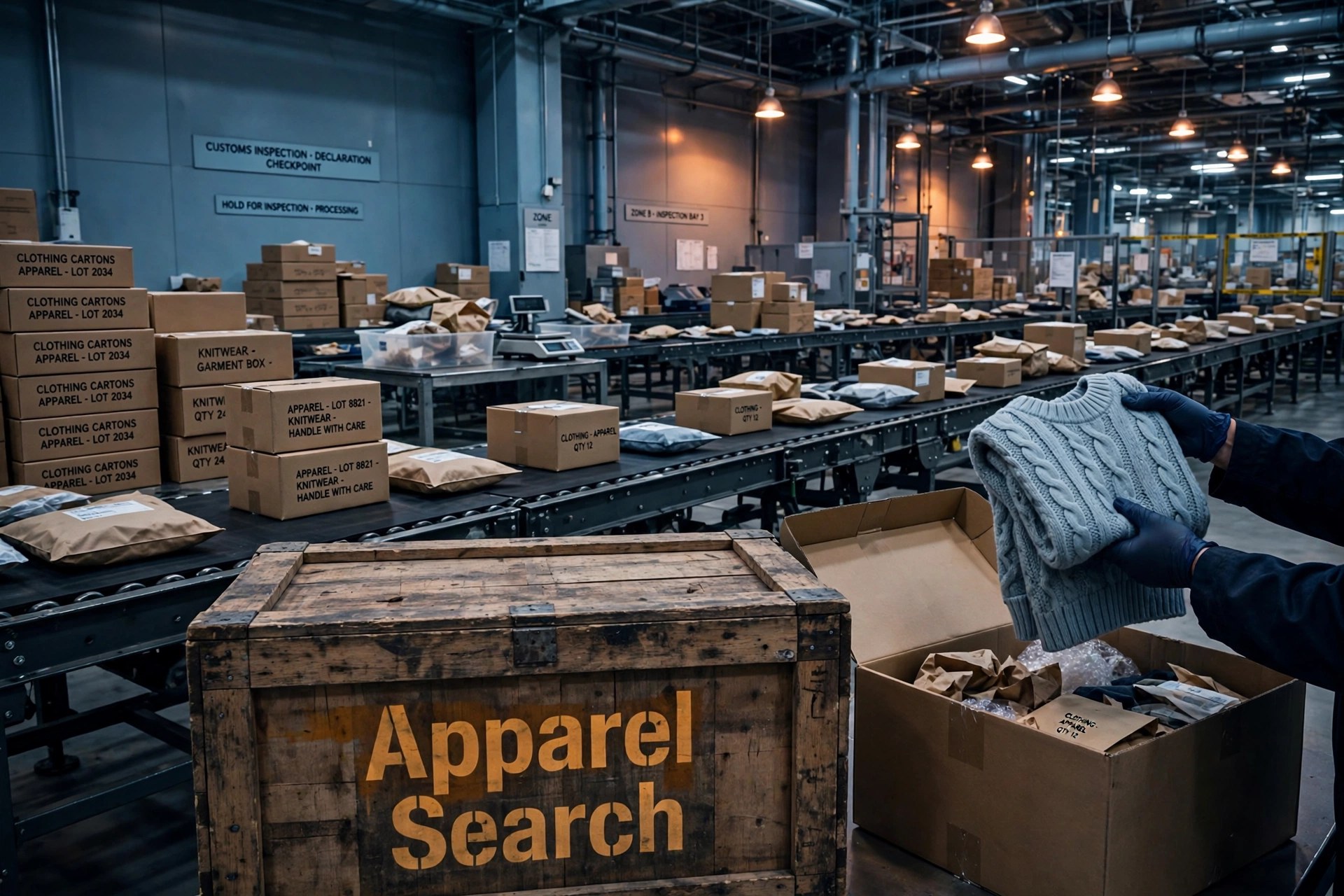
Apparel was the exemption's natural cargo: light, compact, cheap to air-freight and bought a piece or two at a time, so what would once have moved as a container shipment became thousands of individual consumer parcels, each under $800. A seller listed a garment it did not hold, the order triggered picking at an overseas supplier, and the parcel travelled directly to the buyer's door — with no customs entry, no duty even on the highest-rated synthetic garments, minimal data filed with CBP, and, from 2019, a streamlined electronic filing, Entry Type 86, built for these shipments.
The 2025–26 Timeline: How the Exemption Ended
The end came in stages, under three legal instruments; dates are effective dates, eastern time.
- Feb 2025 IEEPA executive orders — including Executive Order 14195 on China of February 1 — first ordered de minimis suspended for China, Canada and Mexico. The China suspension was paused on February 5 until Commerce confirmed systems existed to collect duties on low-value parcels.
- Apr 2, 2025 Executive Order 14256 ended de minimis for products of China and Hong Kong, effective May 2, 2025 — non-postal parcels now needed a real entry in ACE with all duties; postal parcels moved to a carrier-collected regime. The same day, Executive Order 14257 announced the IEEPA “reciprocal” tariffs.
- Jul 4, 2025 The One Big Beautiful Bill Act was enacted. Its Section 70531 repeals the Section 321 exemption for commercial shipments by statute, effective July 1, 2027, and added misuse penalties — up to $5,000 for a first violation and $10,000 for each subsequent one, from August 3, 2025.
- Aug 29, 2025 Executive Order 14324 of July 30, 2025, “Suspending Duty-Free De Minimis Treatment for All Countries,” took effect at 12:01 a.m. ACE now rejected Section 321 manifest filings and Entry Type 86 transactions; every non-postal shipment needed a formal or informal entry, and international mail moved to carrier-collected duties — the origin's ad valorem rate or, for a six-month transition, flat charges of $80, $160 or $200 per item.
- Feb 20, 2026 The Supreme Court decided Learning Resources, Inc. v. Trump, 6–3: IEEPA does not authorize the President to impose tariffs, so the reciprocal and trafficking tariffs built on it were unlawful. The same day, Executive Order 14389 ended collection of IEEPA duties from February 24, and Executive Order 14388 continued the de minimis suspension — the ruling did not bring the exemption back.
- Feb 24, 2026 A temporary 10 percent global surcharge under Section 122 of the Trade Act of 1974 (Proclamation 11012) replaced the IEEPA tariffs. Section 122 caps such surcharges at 150 days; this one expired on July 24, 2026.
- Jun 24, 2026 CBP published two interim final rules writing the suspension into its own regulations under 19 U.S.C. 1321(b), independent of any executive order: one for all modes other than mail, effective June 24, and one for the postal network, effective July 24, creating a postal informal entry for mail valued at $2,500 or less. (A later extension moved one postal compliance date to January 20, 2027.)
- Jul 24, 2026 As the Section 122 surcharge expired, new Section 301 tariffs took effect: following investigations opened in March 2026 into trading partners' failure to prohibit imports made with forced labor, USTR imposed additional duties of 10 or 12.5 percent on imports from 60 economies.
- Jul 1, 2027 The statutory repeal takes effect: whatever happens to the executive orders and regulations, the commercial de minimis exemption ends by act of Congress on this date.
Who It Hits, and How the Models Changed
Importers of record
Every entry now has a legally responsible importer of record, who owes the duties, the accuracy of the classification and valuation, and the record-keeping — container or single dress alike. Businesses that once received supplier-shipped parcels untouched by customs paperwork discovered they had been importers all along,. Undervaluation and split shipments, always unlawful, carry sharper consequences now that the statute adds its own misuse penalties to the ordinary customs penalty regime.
Marketplaces and the direct-from-China platforms
No business model was built more completely on de minimis than the direct-shipping platforms — the two largest are profiled in the site's pages on Shein and Temu. When China-origin parcels lost the exemption on May 2, 2025, both repriced and rebuilt within weeks. Temu switched its U.S. storefront to goods already held in U.S. warehouses and recruited local sellers,; in the last days before the deadline it had shown import charges on direct listings that in some checkouts exceeded the price of the goods. Shein raised U.S. prices, moved inventory and order handling into its customers' markets, and took on full customs filing — changes its later listing documents describe as a material drag on U.S. sales and a rising cost per delivered order. Both have since moved toward the ordinary importer's model: bulk-import into regional warehouses, pay duty once on the container, sell domestically. Social-commerce sellers face the same mechanics: the direct-shipping storefronts discussed in the TikTok Shop and social commerce guide must now price duty into every cross-border order or hold stock locally.
Small brands and dropshippers
For a small label that dropshipped or air-freighted small lots from overseas suppliers, the change is mostly fixed cost: a broker's per-entry fee is trivial on a container and punishing spread over a $60 parcel, and duty that was zero is now the garment's full rate. Many responded by consolidating — fewer, larger shipments into a domestic warehouse or third-party logistics provider. Others moved to delivered-duty-paid terms so the customer never meets a surprise bill, at the cost of the seller's margin.
Consumers
Shoppers meet the new regime as higher prices, explicit “import charges” lines at checkout, longer delivery windows on anything still shipped direct, and — where goods are sold duty-unpaid — a carrier's bill before delivery. The burden is uneven: the households that bought most heavily through duty-free direct shipping were disproportionately lower-income, and basic apparel carries some of the highest ordinary duty rates in the schedule.
The Current Tariff Stack for Apparel (Late November 2026)
An apparel import today pays in layers, and a landed-cost calculation has to build all of them. This is the position as of late November 2026; re-check the country layer against Chapter 99 of the tariff schedule for any specific entry.
Layer 1 — The ordinary (MFN) rate, which was never low
Underneath everything sits the Column 1 General rate of the Harmonized Tariff Schedule — the most-favored-nation rate — and for apparel it is among the highest in the book. Knitted apparel classifies in Chapter 61 and woven apparel in Chapter 62, split further by fiber, and the rate follows the fiber more than the garment: a cotton knit T-shirt (6109.10.00) pays 16.5 percent, a men's woven cotton shirt 19.7 percent, and man-made fiber knitwear runs up to 32 percent. The site's duty rates guide for the apparel industry explains how classification decides which line a garment lands on.
Layer 2 — The older China Section 301 duties (China origin only)
The Section 301 action against China that began in 2018–19 survived the IEEPA litigation untouched, because it rests on a different statute and a USTR investigation. Most Chapter 61 and 62 apparel sits on List 4A at an additional 7.5 percent; bags, hats and many fabric and trim inputs sit on List 3 at 25 percent; Product exclusions have been renewed repeatedly and were most recently extended into January 2027 — check USTR's current notice before assuming one covers your line.
Layer 3 — The 2026 Section 301 forced-labor duties (most origins)
The current country layer, effective July 24, 2026, comes from USTR's Section 301 investigations into whether 60 economies prohibit imports made with forced labor — the same concern that drives the import bans explained in the UFLPA forced labor compliance guide — here as a tariff rather than a detention. Origins credited with having, or committing to, a forced-labor import prohibition — including Bangladesh, Cambodia, India, Indonesia and Pakistan — pay an additional 10 percent on top of the MFN rate. Most other investigated economies — including China, Vietnam, Thailand and the Philippines — pay an additional 12.5 percent. For the European Union and Taiwan the duty tops the combined rate up to 10 percent, and for Japan, South Korea and Switzerland up to 12.5 percent, so a garment whose MFN rate already exceeds the ceiling pays nothing extra here. USMCA goods and CAFTA-DR apparel entered duty-free are exempt from this layer, as are goods already covered by Section 232. Further Section 301 investigations, including one into excess industrial capacity, were still open in late 2026, so this layer is the likeliest to move next.
A worked stack
Put the layers together on the benchmark garment. A cotton knit T-shirt made in China pays 16.5 percent MFN, plus 7.5 percent List 4A, plus 12.5 percent under the 2026 action: 36.5 percent total duty before freight and fees. The same shirt from Vietnam pays 29 percent, and from Bangladesh 26.5 percent. In man-made fiber the numbers climb steeply, because the MFN layer starts at up to 32 percent.
What about Section 232, and the IEEPA refunds?
Section 232, the national-security authority, produced large duties in this period — steel, aluminum and copper, vehicles, lumber — but no Section 232 program targets finished apparel as such. Its reach into a clothing business is indirect, through listed metal derivative articles that can include metal inputs and components — a line heavy in metal trims should be checked against the Chapter 99 annexes rather than assumed clear. The IEEPA tariffs, by contrast, are gone and partly coming back as cash: collection ended February 24, 2026, and CBP built a refund process, CAPE, in the ACE portal, through which the importer of record claims duties paid on IEEPA entries. By early November 2026 CBP had accepted about $138.3 billion of refund claims and certified about $128.4 billion for payment — most of the money, but not automatic: importers who never filed have not been paid, and entries liquidated long before the ruling have depended on court orders. Only the IEEPA layer is refunded; Section 301 and 232 duties are not.
How an Import Entry Works Now
A low-value shipment now goes through the same process as any other import. The steps describe the non-postal route; mail is the variant in step 5.
Classify and value the goods
Assign the 10-digit HTS line — for apparel, the Chapter 61 or 62 line set by construction and fiber — determine origin by where the garment was made, not shipped from, and establish the customs value, generally the transaction value.
Choose the entry type
Shipments valued at $2,500 or less generally move as an informal entry, Type 11: lighter paperwork, usually no bond. Above $2,500, or where quotas, trade remedies or agency requirements demand it, a formal entry, Type 01, is required, with a bond and full entry summary (CBP Form 7501). Entry Type 86 no longer exists — ACE rejects it.
File electronically in ACE
The importer of record, or a licensed customs broker filing for them, submits the entry in ACE with classification, value, origin and any partner-agency data. The data demanded per shipment is far richer than the old manifest filings, and paper filings are not accepted for this traffic.
Pay duties and fees at the applicable stack
CBP assesses the MFN rate plus any Section 301 layers for the origin, with the merchandise processing fee and, for ocean freight, the harbor maintenance fee. Informal entries collect these with the entry; formal entries settle them through the entry summary and bond.
Postal shipments: the separate lane
International mail was handled apart from the start: first by carrier-collected duties under the executive orders, and since July 24, 2026 under CBP's postal rule, which suspends de minimis for mail and provides a postal informal entry for items valued at $2,500 or less. Carriers and CBP-qualified parties collect and remit the duty, and CBP's Entry Type 13 test, running since September 2026, pilots fully electronic postal entry.
Keep records and watch liquidation
Entries liquidate — CBP's final computation of duty — on their own timetable, and liquidation status controls what an importer can still fix or claim: protests and refund claims all key off it. Retain entry records for five years, and diarise liquidation on any entry where money may still move.
Practical Responses: Rebuilding the Numbers
Recalculate landed cost from the entry up. Pricing built in the de minimis years assumed duty of zero. The honest figure now stacks the garment's MFN rate, the origin's Section 301 layers, brokerage spread across realistic shipment sizes, and processing fees. The site's landed cost guide for apparel imports walks through that stack for repricing a line.
Re-run sourcing with the real map. Moving production out of China still removes the List 4A layer, and USMCA and CAFTA-DR apparel entered duty-free escapes the 2026 layer as well. But with forced-labor duties covering 60 economies at 10 or 12.5 percent, shifting origin now buys a few points rather than an exemption — and origin means where the garment is substantially transformed: routing Chinese-made goods through a third country changes nothing but the importer's legal exposure.
Consolidate, warehouse, defer. The structural answer most direct sellers reached is to import in bulk and fulfill domestically, spreading entry costs over a container. Bonded warehouses and foreign-trade zones add a timing tool: duty is deferred while goods sit in bond or in a zone, and goods re-exported from them may never incur it.
Use the valuation and refund tools that remain. In a genuine multi-tier transaction, the first sale rule can lawfully base customs value on the earlier sale between manufacturer and middleman, if documented, at arm's length, and the goods are clearly destined for the United States. And where imported goods or their materials are later exported, duty drawback can recover up to 99 percent of duties paid; the site's customs duty drawback guide covers eligibility and claims.
Price and promise honestly. Decide who is the importer of record in your channel and say so at checkout: delivered-duty-paid pricing costs margin and buys trust, while duty-unpaid pricing on consumer orders mostly buys refusals and chargebacks now that the bill is real. And monitor the moving parts — exclusion expiries, open investigations, CBP's postal timetable — because the rate in your costing sheet now has a shelf life.
The same supply chains also carry the producer-responsibility duties collected in the EPR compliance hub, and the chemical rules in the PFAS in clothing guide increasingly decide what may be sold at all once it clears.
Common Questions
Is the de minimis exemption coming back?
There is no visible route back. The suspension now sits in CBP's own regulations as well as in executive orders, and Congress has repealed the exemption for commercial shipments by statute effective July 1, 2027. Businesses should plan on every commercial import needing an entry and paying its duties, whatever its value.
Did the Supreme Court's IEEPA decision restore duty-free small parcels?
No. The Court held on February 20, 2026 that IEEPA does not authorize tariffs, and collection of the IEEPA duties ended on February 24, 2026. The de minimis suspension was continued the same day by a separate executive order, and CBP later wrote the suspension into its own regulations, so low-value parcels stayed dutiable throughout.
What entry does a $60 parcel need now?
A real one. Non-postal shipments are entered in ACE as an informal entry (Type 11) if they are valued at $2,500 or less, or a formal entry (Type 01) above that. Entry Type 86, the old de minimis filing, is closed. Parcels arriving by international mail follow CBP's postal informal entry process instead.
Can I get back the IEEPA duties I paid in 2025?
In principle, yes, but refunds are not automatic. The importer of record, or the broker who filed its entries, claims through CBP's CAPE process in the ACE portal. By early November 2026 CBP had accepted about $138 billion of claims and certified about $128 billion for payment, but importers who have not filed have not been paid, and some entries liquidated long ago still depend on court orders.
Are gifts and travelers' purchases still exempt?
Yes. The suspension targets the commercial $800 exemption in Section 321(a)(2)(C). The separate exemptions for bona fide gifts valued at $100 or less ($200 from the U.S. Virgin Islands, Guam and American Samoa) and for personal or household articles accompanying travelers were expressly left in place.