TikTok Shop & Social Commerce Guide
How apparel brands sell through short video, livestreams and creator shops — and what it really costs
Social commerce means selling inside the social feed itself: the shopper discovers a garment in a video, taps the product link pinned to that video, and checks out without leaving the app. TikTok Shop, launched in the United States in September 2023, is the fullest version of the model — a complete marketplace with listings, checkout, fulfillment and returns built into an entertainment app. For apparel brands it is now a genuine sales channel: according to Momentum Works, its global gross merchandise value (GMV) reached an estimated $64.3 billion in 2025, up 94 percent on the year, with the US its largest single market at an estimated $15.1 billion. This guide explains how the channel works as of late November 2026 — including its settled US legal position — what it charges, how creator affiliates drive most apparel sales, how to start, and where brands lose money.
About this guide and its currency: platform rules, seller fees and regulations such as the ones described here are subject to change, sometimes at short notice, and this page may not always reflect the most current state of them. Treat the figures and requirements below as a well-checked starting point, and verify anything you plan to act on against official sources — TikTok's Seller Center and Seller University for platform rules, and US Customs and other government sources for trade rules — or a qualified professional, before relying on it.
Why Apparel Fits Social Commerce
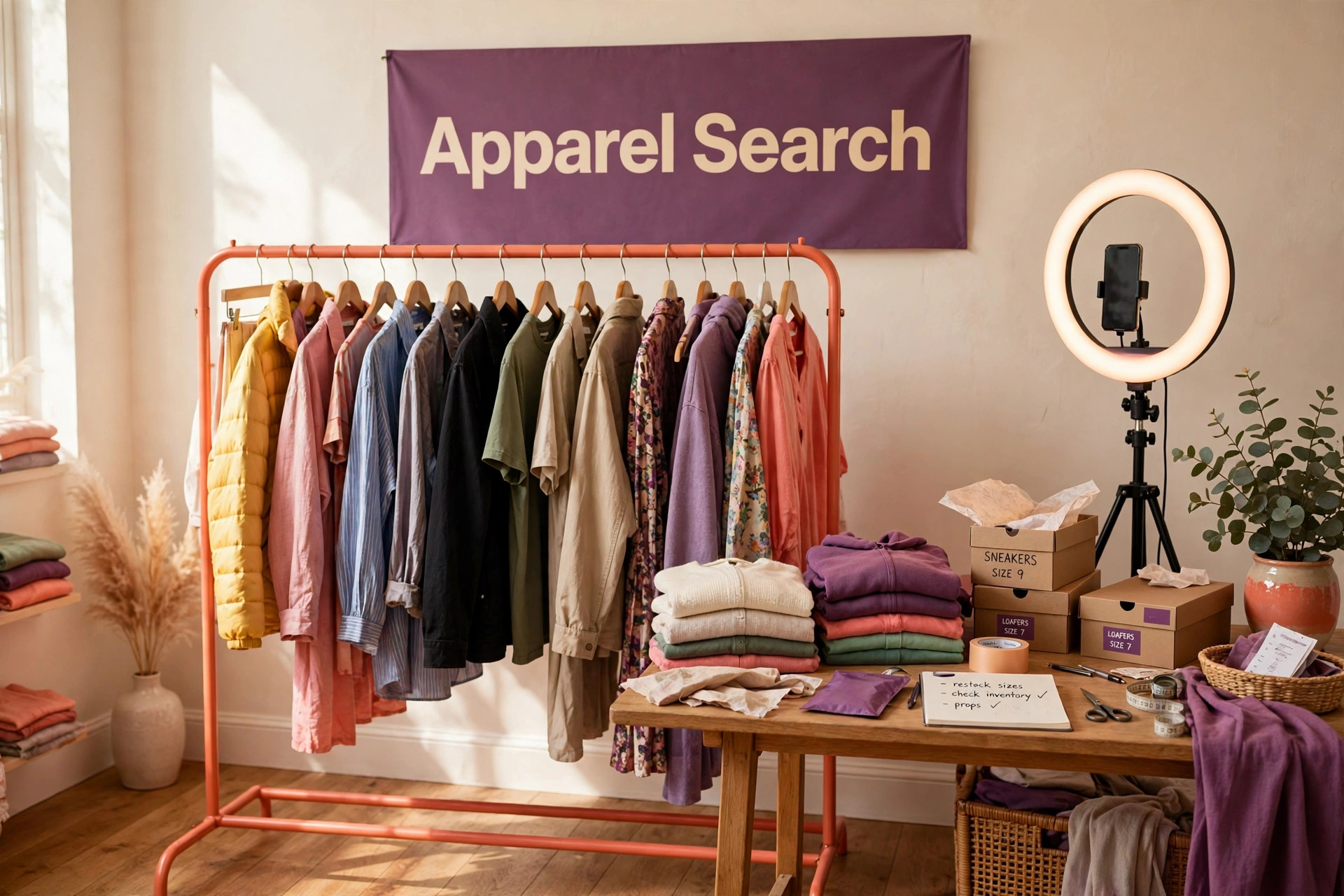
Clothing is unusually well suited to being sold by video. A garment's selling points — drape, stretch, fit on a real body, how a color reads in daylight, how many ways a piece can be styled — are what a still photo struggles to show and a sixty-second video shows easily. A creator can try on a dress, tug a legging's waistband, hold a fabric to the light, and answer shoppers' real questions in the time a product page takes to load. Social commerce also collapses the distance between trend and transaction: the feed that creates a style moment carries the checkout for it, so demand is captured at the moment of interest. The TikTok fashion term page covers the style-content side of the platform; this guide covers the selling machinery underneath it.
The fit is not free of friction. Apparel carries the highest return rates in online retail because fit is personal, and impulse buying adds shoppers who ordered a trend rather than a garment they needed. Successful sellers treat those costs as part of the channel's economics from day one, as the fees and pitfalls sections below explain.
TikTok in the United States: The Legal Position as of November 2026
For two years the first question about TikTok Shop was whether the platform would exist in the US at all. As of late November 2026 that question is settled. Congress passed the Protecting Americans from Foreign Adversary Controlled Applications Act on April 24, 2024, requiring TikTok's Chinese parent, ByteDance, to divest its US operations or face a ban. The prohibitions took effect on January 19, 2025 — the app briefly went dark — after the Supreme Court upheld the law on January 17, 2025. Executive orders then paused enforcement while a sale was negotiated, and on September 25, 2025 an order declared the agreed framework a qualified divestiture.
The deal closed on January 22, 2026. A new company, TikTok USDS Joint Venture, now operates TikTok in the United States. Oracle, the private-equity firm Silver Lake and the Abu Dhabi investment firm MGX each hold 15 percent; non-Chinese investors hold about 80 percent in total; and ByteDance retains a 19.9 percent minority stake. The joint venture controls US user data — held in Oracle's US cloud environment — along with content moderation and the recommendation algorithm, which is licensed from ByteDance and being retrained on US user data under the venture's oversight. For sellers the consequences are practical: TikTok Shop US is a stable, lawful channel, not one operating under a countdown; American shoppers use the same app, with no separate download; and the risks that remain — fee changes, policy enforcement, trade rules — are the ordinary risks of a marketplace, not of a platform about to vanish.
The Four Selling Surfaces
A TikTok Shop seller does not have one storefront but four, and apparel brands usually need all of them working together.
Shoppable Videos
Short in-feed videos — the brand's own or a creator's — carry a pinned product link. The viewer taps through to the listing and buys without leaving the app. By Momentum Works' estimate this is the largest US sales surface, at roughly half of GMV: it is where discovery happens.
LIVE Selling
Livestreams with products pinned on screen, priced drops, limited-time offers and a host answering fit questions in real time. Live is the smallest of the three main surfaces in the US (roughly 14 percent of estimated GMV) but the most powerful per hour for demonstrations, launches and clearing stock.
The Shop Tab & Storefront
The marketplace tab and each seller's shop page work like a conventional store: search, category browsing, product grids, reviews and repeat buying. An estimated 36 percent of US GMV flows here, and its share has been growing — this is where demand created by video gets harvested by shoppers who arrive ready to buy.
Product Showcase & Listings
Every product has a listing page with photos, video, size and color variants, sizing information and reviews, and creators can pin products to a showcase on their own profiles. Listings are the conversion layer for everything else: weak titles, thin size information or poor images tax every video and livestream that points at them.
The working pattern is a loop rather than a funnel. Videos and livestreams create demand and send shoppers to listings; good listings convert and generate reviews; reviews and sales history improve how the platform recommends the products; and the Shop tab catches shoppers who come back to search by name. Brands that treat the channel as only video, or only a store, leave half the loop idle.
The Creator Affiliate Engine
Most apparel sales on TikTok Shop are made by people other than the brand. Under the affiliate program, creators promote products in their videos and livestreams and earn a commission on each sale, paid by the seller. The seller sets the rates; TikTok provides the machinery. Three plan types structure the offers:
Open Plan
Products are listed in the affiliate marketplace at a commission any eligible creator can earn by promoting them — no invitation needed. This is the discovery engine: it lets hundreds of small creators test a product, and the brand learns which faces, styles and hooks actually convert.
Targeted Plan
The brand invites specific creators and offers them a custom, usually higher, commission, often with free samples and agreed deliverables such as a set number of videos or a livestream. This is where proven sellers are recruited and retained.
Shop Plan
A single commission rate applied across the whole shop, useful as a simple baseline underneath product-level open and targeted offers.
Commission levels are set by sellers, not fixed by the platform, so published figures are market ranges rather than a tariff. Across seller and agency reporting, apparel open-plan rates commonly sit around 10 to 15 percent, with targeted offers to proven creators frequently in the 15 to 25 percent range; beauty often runs higher and electronics lower. Price your rates from your margins, not a rival's listing: the referral fee, shipping, returns and commission all come out of the same garment. Sample seeding is the fuel of the system — creators cannot try on what they do not have — so most brands run a standing sample budget and judge the spend on content and sales over weeks, not days. The creator relationship side of this work connects directly to the wider world of fashion influence: the same judgment about audience fit, authenticity and disclosure that governs influencer marketing applies here, with the difference that every post carries a checkout.
Fees, Fulfillment and Returns: The Real Economics
TikTok Shop's headline economics are simple. There is no monthly subscription. The main charge is a referral fee of 6 percent for most categories, apparel included, calculated on the customer payment plus any discount TikTok funded, minus sales tax — and the fee includes payment processing, so there is no separate card charge on domestic orders. A few categories pay less: certain fine jewelry (diamond, gold, jade, platinum, and ruby, sapphire and emerald) and pre-owned goods pay 5 percent. TikTok has periodically offered new sellers a reduced introductory referral rate; price your products at the standard rate and treat any introductory discount as windfall. On top of the referral fee, sellers fund their own affiliate commissions, any advertising, and shipping costs not charged to the buyer.
Returns are where apparel economics bite. When an order is refunded, TikTok returns the referral fee minus a refund administration fee equal to 20 percent of that fee, capped at $5 per item — small in itself, but the real costs are the returned garment's shipping, inspection, repacking and frequent inability to resell at full price. A style with a high return rate can lose money at a healthy-looking sales volume, which is why the measurement section below puts return rate per style at the top of the dashboard. TikTok sets the return framework and sellers must offer returns under the platform's policies; clear sizing information and honest fit notes in the listing are the cheapest return-reduction tools a brand owns.
Fulfillment offers several routes. With Fulfilled by TikTok (FBT), the brand ships inventory into TikTok's warehouses and the platform stores, picks, packs, ships and handles returns, for fulfillment fees on top of the referral fee — the route to the platform's fastest delivery promises. Upgraded TikTok Shipping keeps stock in the seller's warehouse while TikTok controls labels and carrier selection; Collections by TikTok adds door-to-door pickup. Sellers can also ship orders themselves under Seller Shipping, meeting the platform's dispatch and tracking standards. This area shows how quickly platform policy can move: TikTok announced in early 2026 that independent seller shipping would be phased out by the end of March 2026 in favor of its own logistics services, then reversed the decision in February 2026 and left Seller Shipping in place. Build your operation so it can switch routes.
Getting Started as a Brand
US shops are for US sellers. An individual seller must be an adult residing in the United States; a business seller registers a US-based business — sole proprietorship, LLC, corporation or partnership — with its tax identification, a US bank account for payouts, identity verification for its representative, and a US return address. There is no minimum follower count for sellers. From there, the sequence that works is unglamorous and repeatable:
Register and verify. Apply in the US Seller Center, complete business and tax verification, and link the brand's TikTok account.
Build listings properly. Accurate titles, full size and color variants, honest fabric and fit information, strong images and a short product video for every style.
Set the economics. Price each style with the 6 percent referral fee, your target affiliate commission, shipping and an assumed return rate inside the margin.
Open the affiliate plans. Set a competitive open-plan rate, then recruit a first group of targeted creators who genuinely match the garment.
Seed samples and post. Send samples out, publish the brand's own try-on and fit videos on a steady cadence, and answer comments like a fitting room, not a billboard.
Go live on a schedule. A regular weekly livestream — new drops, fit sessions, last sizes — beats occasional marathons. Promote each show in short videos beforehand.
What actually sells is clothing that performs on camera. Dresses, denim, leggings and activewear, and shapewear lead apparel because a creator can demonstrate fit, stretch and movement in seconds; haul and try-on formats let one creator show a whole rail; and limited drops give a livestream a reason to exist. Womenswear, menswear and shoes together account for roughly a quarter of tracked US TikTok Shop GMV, according to AfterShip's Charm.io category data for 2025 — a large, contested market in which listing quality and creator fit matter more than brand size. Keep prices honest: a style that needs a long explanation to justify its price will struggle against one that explains itself in a mirror.
Measurement and Pitfalls
Run the shop on a small set of numbers reviewed weekly: sales by surface (video, live, Shop tab), conversion rate per listing, affiliate cost as a share of sales, and — above all for apparel — return rate per style, with the reason codes read, not just counted. A style returned for running small is a listing fix; one returned for fabric disappointment is a product problem; one returned because the video oversold it is a creator-briefing problem. Each has a different cure, and all three are cheaper than discounting.
The discount culture is the channel's standing temptation. Coupons, promotions and livestream price drops train shoppers to wait for the next cut, and brands that compete only on price find their margins competed away. The durable defenses are fit, fabric, honest value and creators whose audiences trust their judgment. Brand protection deserves equal attention: popular listings attract copies and counterfeit sellers, so register your trademarks, use TikTok Shop's intellectual-property protection tools to report infringing listings, and keep your own product claims clean — environmental and performance claims in listings and videos are advertising, and the rules in our green claims guide apply to a livestream pitch exactly as they do to a hangtag. Finally, respect the policy system: TikTok scores seller performance and issues violations for late dispatch, poor tracking, prohibited products and misleading listings, and accumulated strikes can restrict or close a shop. Treat a first warning as an operations fix, not a nuisance.
Cross-Border Selling After De Minimis
One structural change sits underneath the whole channel. The de minimis rule once let shipments worth up to $800 enter the US duty-free with minimal paperwork, and overseas sellers built direct-mail models on it — the model behind the rise of Temu and much of Shein's US business. That exemption was suspended for China and Hong Kong in May 2025 and for all countries from August 29, 2025, and Congress has legislated to repeal it outright from July 1, 2027. Cross-border parcels now bear duties and full entry costs, which raised prices and pushed serious overseas sellers toward US warehouses and US entities. TikTok Shop US orders are fulfilled domestically in any case, so the change mainly removed a competing ultra-cheap channel and leveled the field for brands holding US stock. Our de minimis and tariffs guide explains the change in full.
The Wider Field: Live and Social Commerce Beyond TikTok
TikTok Shop is the largest social commerce marketplace in the US, but it is not the only place apparel sells in a feed, and a brand's channel mix should be chosen deliberately. Whatnot is the livestream auction specialist: scheduled shows, fast bidding and buy-now sales, strong in sneakers, vintage and collectibles as well as fashion. Amazon Live lets brands and creators stream to Amazon's shoppers with products attached and Amazon's checkout behind them — most valuable to brands already selling on Amazon. YouTube Shopping tags products in videos, Shorts and livestreams and runs a creator affiliate program, generally sending buyers to the retailer's own store; it suits brands whose audience watches long-form fit and review content. Meta's position needs care, because it changed: Facebook ended live shopping in October 2022 and Instagram removed product tagging from livestreams in March 2023, so neither offers in-live checkout in the US, though both still run shops and product tags in posts and Reels and remain powerful discovery channels that feed sales elsewhere. eBay Live and Poshmark's Posh Shows serve resale and pre-owned fashion audiences. Shoppers comparing all of these channels as buyers will find the consumer-side view in the shopping directory, and store-based sellers should weigh social commerce against the conventional channels in the retail directory rather than treating it as a replacement for them.
The sensible strategy for most apparel brands is sequencing, not sprawl: build one channel properly — listings, creators, live cadence, returns discipline — learn its economics on real orders, and only then port what works to the next platform. Social commerce rewards brands that treat it as a trade to be learned rather than a lottery to be entered, and the learning compounds: the fit content, creator relationships and listing craft built for one feed make every other feed cheaper to enter.
Common Questions
Is TikTok Shop operating legally in the United States in 2026?
Yes. The divest-or-ban law of April 2024 was satisfied by a qualified divestiture: on January 22, 2026, TikTok completed the creation of TikTok USDS Joint Venture, majority-owned by non-Chinese investors including Oracle, Silver Lake and MGX, with ByteDance retaining 19.9 percent. TikTok Shop US has operated continuously, and brands can sell on it as an ordinary US sales channel, while keeping an eye on platform policy, which changes far more often than the law now does.
How much does TikTok Shop charge sellers?
The main charge is a referral fee of 6 percent on most categories, including apparel, calculated on the customer payment plus any platform-funded discount, minus tax; the fee includes payment processing, and there is no monthly subscription. Certain fine jewelry and pre-owned categories pay 5 percent. Creator affiliate commissions are separate and are set by the seller; apparel brands commonly offer roughly 10 to 20 percent. Returned orders refund the referral fee minus a refund administration fee of 20 percent of that fee, capped at $5 per item.
Does a clothing brand need a big following to sell on TikTok Shop?
No. Sellers do not need a minimum follower count to open a shop; a US-based individual or a US-registered business with the required identification, tax details and a US return address can register. Most apparel sales are driven by affiliate creators rather than the brand's own following, so a new shop with strong listings and a well-run creator program can sell from a standing start.
What kind of apparel sells best on TikTok Shop?
Clothing that demonstrates well on camera: dresses, denim, leggings and activewear, shapewear and other fit-driven items that a creator can try on, stretch, style several ways or compare against an alternative in under a minute. Trend-led pieces at accessible prices move fastest, especially when the video answers the shopper's real questions about fit, fabric and sizing. Slow, hard-to-explain or fit-critical tailored items are harder work.
Can a brand based outside the United States sell on TikTok Shop US?
Not directly in the way it once could. US shops are for US-based individuals and US-registered businesses, and orders are fulfilled domestically. Since August 29, 2025, the de minimis duty-free exemption has been suspended for shipments from all countries, so the old model of mailing individual low-value parcels duty-free from overseas is gone; overseas brands generally enter through a US entity holding US stock.