Apparel Search Consumer Guides
Small Closet Organization Ideas
A small closet is a rotation problem, not a space problem — solve it vertically and seasonally.
A small closet fails in a specific way: it is asked to hold everything you own, in every season, all at once — and then blamed for being small. Treat it instead as the home of your current rotation, with the rest of your home serving as its archive, and the same square footage suddenly performs like a closet twice the size. This guide, part of our closet organization guide, covers the three moves that make small closets work: think vertically, rotate by season, and use the door and the space under the bed.
Think Vertically
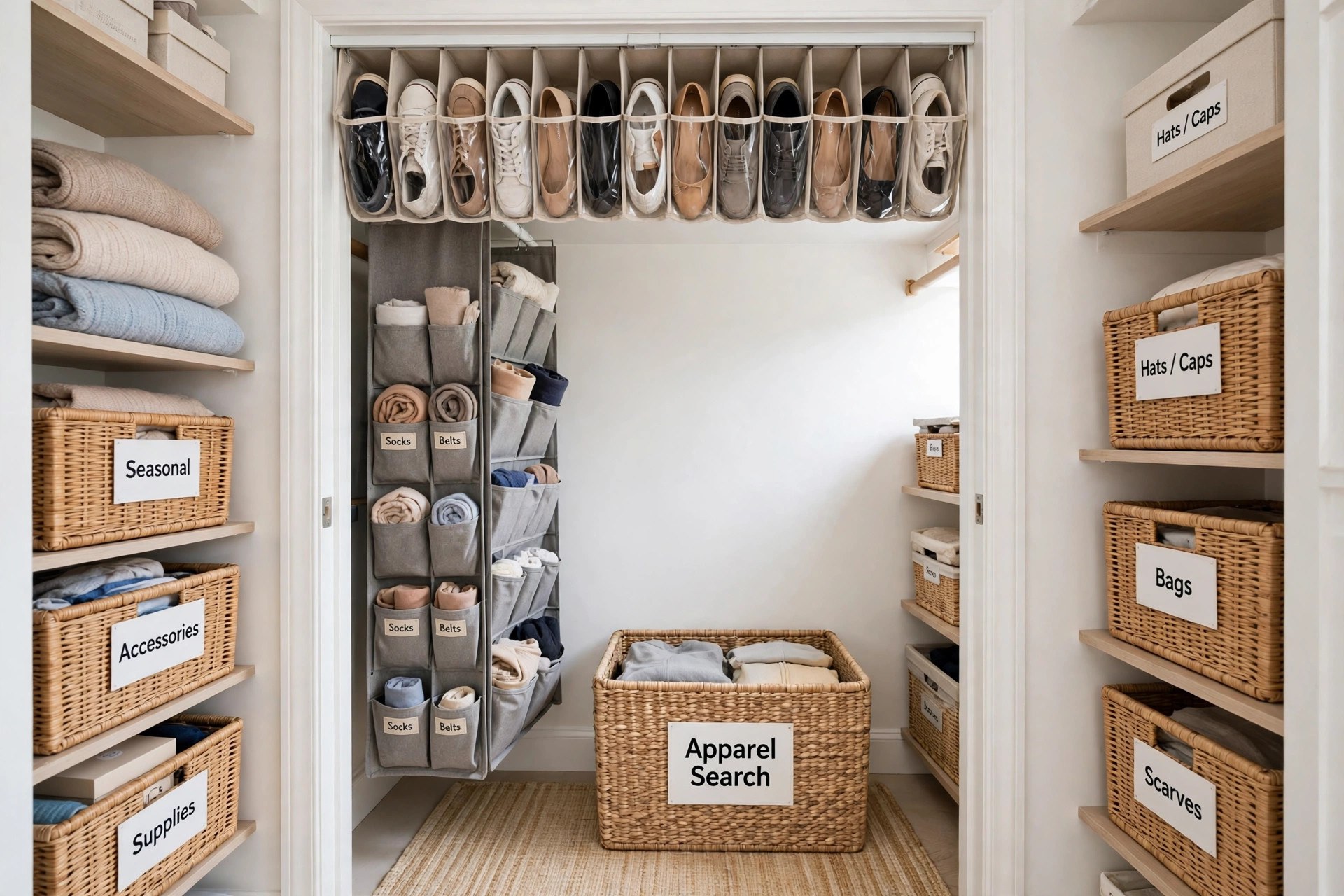
Floor space is fixed; height usually is not. The top shelf — above the rail, often half empty or holding one drifting pile — takes labeled boxes for the least-used current items: occasion accessories, the good handbag, swim or ski pieces in their season's edge weeks. Where garment lengths allow it, a second short rail beneath hanging shirts doubles the hanging capacity for folded-length pieces. Hooks on the inside walls take belts, scarves and the bag of the week. A hanging pocket organizer turns a hand's breadth of rail into a full set of shelves for knits, tees and shoes — in a small closet it is often the single highest-value change.
Storage That Earns Its Space
Ready to shop? Product links are kept in one place on the Apparel Search shopping guide:
Shop Clothing on AmazonThis link opens the Apparel Search shopping guide for Amazon, where the product links are kept in one place.
Rotate by Season
The rotation is the real small-closet system. At each season change, the off-season clothes leave the closet for labeled boxes — under the bed, on a high shelf elsewhere, inside the suitcase that sits empty between trips — and the incoming season takes the whole closet for itself. Working room, visibility and air around the clothes all improve at once, and the swap doubles as a light wardrobe audit: anything that did not get worn all season gets its honest question asked while it is already in your hands. Two rules make rotation work: label every box with its contents and season, and store nothing you would not happily wear again — an archive of regrets is just a second closet problem.
The Door and Under the Bed
- Over-door organizers hold shoes, accessories, scarves and small folded items on space that otherwise does nothing. Clear or open pockets keep it visible — in a small closet, invisible storage is where duplicates are born.
- Under-bed boxes are the classic off-season archive: flat, lidded, labeled. Sweaters in summer, sandals and linens in winter, occasion wear all year if it is rarely reached for.
- The closet floor earns one row of shoes or a single box — the moment it becomes a general pile, the whole closet's visibility goes with it.
- Vacuum and compression bags suit bulky off-season pieces (puffers, heavy knits) but not structured garments or leather, which crease and crack under compression. Use them for volume, not for your best pieces.
Edit the Rotation, Not Just the Space
Finally, the honest arithmetic: a small closet comfortably holds one season's genuine rotation — for most people some thirty to forty pieces hung and folded, with the vertical storage above. If the rotation itself is far larger than that, no organizer will fix it; the audit and a little capsule thinking will, by shrinking the rotation to what a week actually uses and letting storage hold only the true off-season. Small closets reward exactly the discipline the rest of this section teaches — which is why so many people who organize one report that getting dressed got easier, not harder.
Common Questions
How do I organize a small closet with no shelves?
Create the shelves: a hanging pocket organizer gives you a full column of cubbies from a few inches of rail, and a tension rod under long garments adds a second short rail for shirts and folded-length pieces. Boxes on the closet floor — one row, labeled — stand in for the bottom shelf you do not have.
Where do off-season clothes go in a small apartment?
Under the bed in flat lidded boxes is the first choice, then inside the suitcase that otherwise sits empty, then a high shelf in any room. The rules are only that boxes are labeled by contents and season, and that nothing goes into storage you would not wear again — storage is for seasons, not for indecision.
How many clothes can a small closet actually hold?
One season's working rotation: roughly thirty to forty pieces hung and folded in a standard single closet, using the top shelf and a hanging organizer. That is more than a capsule wardrobe and enough for most people's real weeks — the constraint bites only when two or four seasons try to live there at once.
Should I buy storage products before or after decluttering?
After, always. Containers bought first get sized for the clothes you are about to release, and the wrong sizes then anchor the clutter they were meant to fix. Audit and release first, measure the wardrobe that remains, and buy exactly the storage it needs.
The Rotation Mindset
Seasonal rotation is the home version of a skill travelers already know: packing only what the days ahead require. Our travel capsule wardrobe guide runs the same arithmetic for a suitcase.
More to Explore
Back to the Closet Organization Guide
Return to the hub: Closet Organization Guide — the audit-first system, decluttering without regret, and small closet ideas.