Apparel Search Consumer Guides
Closet Organization & Wardrobe Audit
See everything you own, keep what earns its place, and arrange the rest around your real life.
An organized closet is not really a tidier closet. It is a legible one — a closet where you can see everything you own, reach the pieces your actual week requires, and notice at a glance what is missing and what is quietly duplicated. Most closets do not fail because they hold too many clothes. They fail because of invisibility: coats buried behind coats, categories scattered across three rooms, and last year's life hanging in front of this year's. This guide is the system for fixing that, in the order that works: audit what you own first, release what no longer serves you, then organize what stays around the way you actually dress.
It is also the natural front door to our capsule wardrobe guide. A capsule is easy to build once you can see your whole wardrobe clearly — the audit below is where every good capsule starts — and a well-organized closet is what keeps one working afterward. Work through these pages in order, or dip into the one that matches the problem in front of you.

Search Apparel Search
The Guides in This Section
 How to Do a Wardrobe AuditThe step-by-step audit: empty and sort by category, count what you own, work the keep, mend, alter and release piles — and write the gap list that plans everything after.
 Closet Declutter GuideDecluttering without regret: what earns a release, the holding-box test for maybes, and where released clothes go — donate, sell, or recycle.
 Small Closet Organization IdeasA small closet is a rotation problem: vertical storage, seasonal swaps, the door and under-bed archive, and keeping only the current season inside.
The Order of Operations
Closet advice usually starts with buying containers. That is the last step, not the first — containers bought early get sized for clothes you are about to let go. The sequence that works has four stages:
- Audit. Empty one category at a time, sort it, count it, and try on anything you are unsure about. Until you have seen all of it at once, every later decision is a guess. Our wardrobe audit guide walks the whole process in an afternoon.
- Release. Move out what no longer fits your body, your life or your other clothes — calmly, in passes, through the routes in our closet declutter guide: donation for the wearable basics, selling for the pieces with value, recycling for the worn-out.
- Organize. Put back only what stays, arranged by how you dress: the current rotation at eye level, zones for work and occasions, and labeled storage for the off-season. This page's system, below.
- Maintain. Small habits — a one-in, one-out rule for new pieces, a ten-minute reset each week, a fresh audit at each season change — keep the system from quietly decaying back into a pile with a door.
Organize by How You Dress
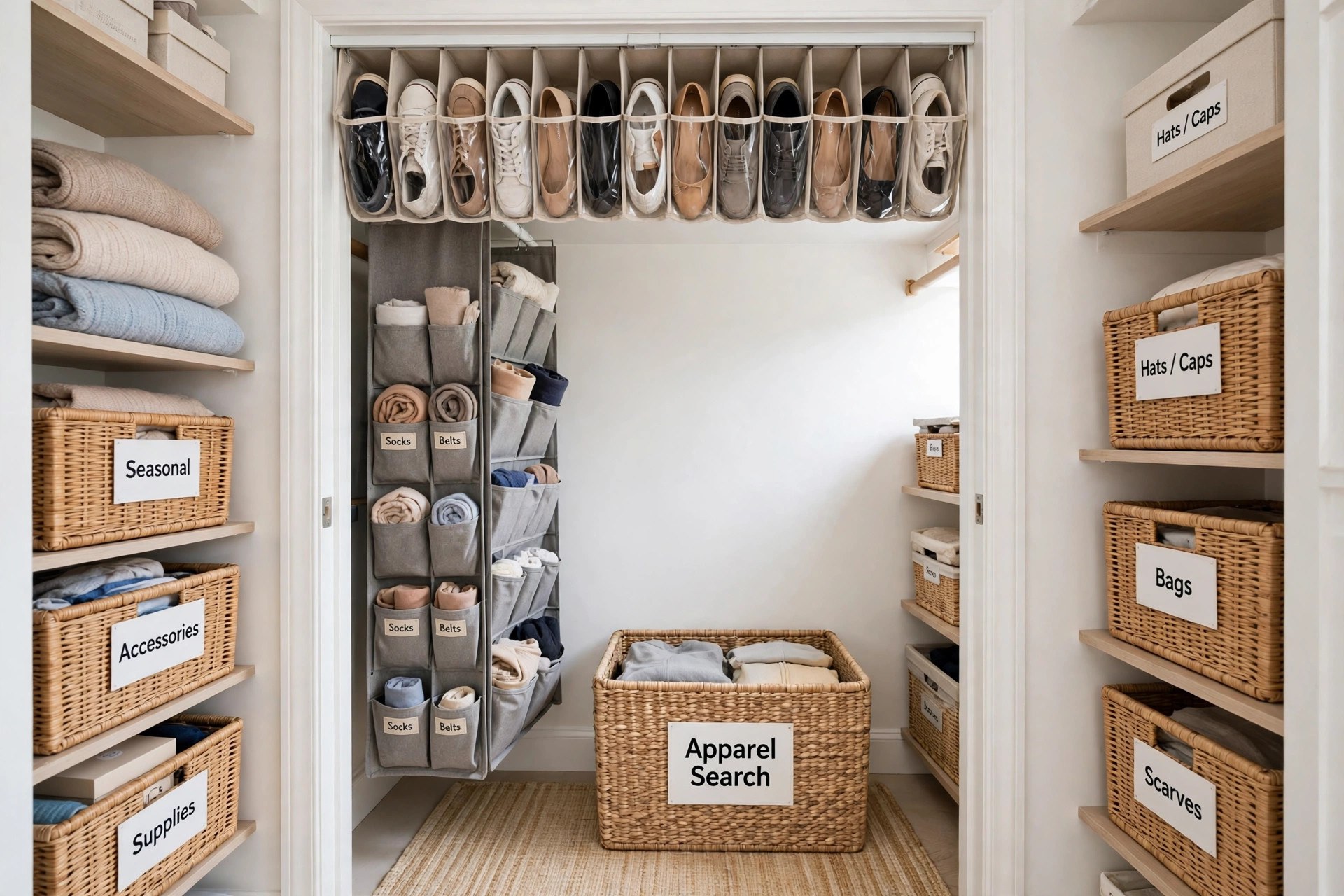
Zone by routine, not just by garment. Categories matter — all trousers together, all knits together — but within and across categories, position should follow frequency. The clothes of your ordinary week belong at eye level and within easy reach: your work rotation, your everyday trousers and tops, the shoes you actually walk in. Occasion pieces go higher or further back, where their rarity is no obstacle. Off-season clothes leave the closet entirely, into labeled boxes, so the current season never has to compete for rail space.
Make everything visible. Nothing stacked so deep it hides the piece beneath it; nothing in an opaque box without a label; folded knits in short piles you can read at a glance. If a category cannot be seen, it will be bought again — the single most common cause of owning five near-identical black tops is that four of them were invisible. Visibility is also what makes the next audit take an hour instead of an afternoon.
Give every category a boundary. A shelf, a section of rail, a drawer: when a category outgrows its boundary, that is the signal to edit it, not to annex the next shelf. Boundaries turn "the closet is exploding again" into a small, specific, early decision about one group of clothes.
The Front Door to a Capsule
Readers who finish an audit often discover they are already most of the way to a capsule wardrobe — the favorites are identified, the gaps are written down, the orphans are obvious. Our step-by-step guide to building a capsule wardrobe picks up exactly where the audit leaves off: palette, core list, outfit testing, gaps shopping last.
Know the Pieces You Are Organizing
Common Questions
Where do I start organizing a closet?
With the audit, not with storage products. Empty one category at a time, sort and count what you own, and decide what stays before arranging anything. Organizing pieces you are about to release just hides them more neatly; the audit first is what makes the organized closet stay organized.
How often should I audit my wardrobe?
Twice a year, at the season changes, is enough for most people — it pairs naturally with swapping seasonal clothes in and out of storage. Add a lighter pass whenever getting dressed starts to feel like searching: that feeling is the early warning that visibility is slipping.
Should I organize clothes by color or by type?
Type first, color second. All trousers together and all knits together means a category can be surveyed at once; within each category, running light to dark makes individual pieces easy to spot and outfits easy to assemble. Color-only systems look lovely and hide duplicates badly.
What should I do with clothes I am not sure about?
Put them in a labeled holding box with a date on it, out of the closet. If you reach into it, the piece has argued its way back. If the box is still sealed at the next season change, it has answered the question for you — release its contents without reopening the debate.
Start With the Audit
Every stage of this system depends on the first one: knowing, precisely, what you own. Our step-by-step wardrobe audit takes an afternoon and replaces every later guess with a written list.