Apparel Search Manufacturing Guides
Social Compliance Audits Explained
A social compliance audit is a structured inspection of a factory's working conditions, carried out by an independent audit firm against a published code. For clothing brands it is the standard way to answer a question no buyer can dodge: under what conditions was this made? This guide explains what the major schemes actually are, how they differ, and how to read their results like a buyer rather than a box-ticker. It is part of our Factory Audits & Product Compliance guide.
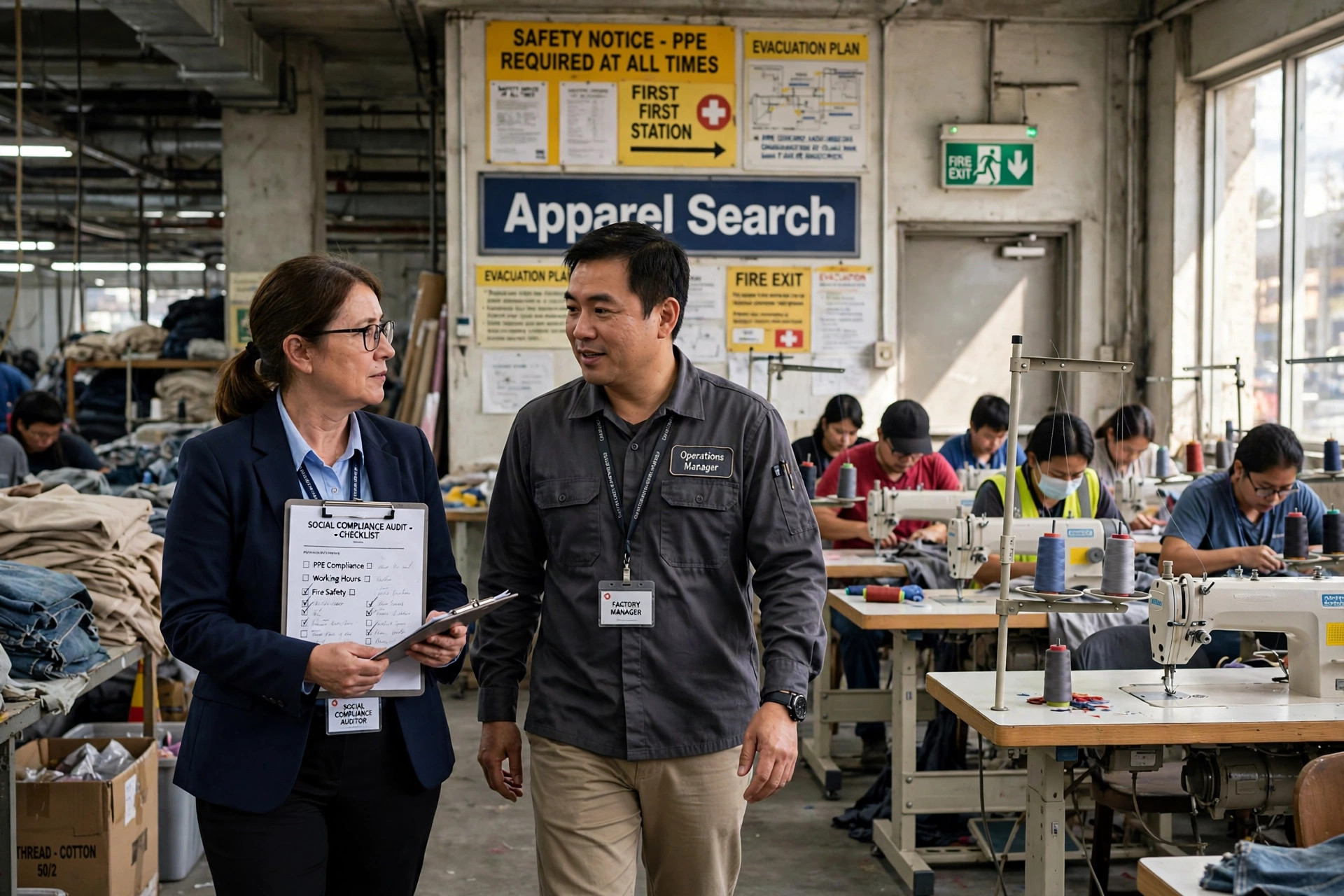
What a Social Audit Examines
Whatever the scheme, the subject matter is consistent, because all of them trace back to International Labour Organization conventions and local law: prohibition of child labor and forced labor; wages, benefits and payslips that match legal minima; working hours, rest days and overtime that stay within legal limits; occupational health and safety — fire safety, machine guarding, chemicals, dormitories where provided; no discrimination or harsh discipline; and freedom of association. The auditor's craft is triangulation: payroll records against time records against what workers say in interviews, and production records against the workforce supposedly producing them. Findings are graded by severity, and most schemes require a corrective action plan (CAP) with deadlines for everything found.
The Main Schemes, Compared Honestly
WRAP — Worldwide Responsible Accredited Production
WRAP is a US-based, apparel-focused certification program. Factories apply, are audited by accredited monitoring firms against WRAP's 12 principles, and — if compliant — receive a certificate at Silver, Gold or Platinum level with validity periods that lengthen by level. Because it certifies rather than merely reports, a WRAP certificate is a simple signal for a buyer to request; the trade-off is that the certificate alone conceals the detail a full report would show.
SMETA — the Sedex audit method
Sedex is a membership platform where suppliers publish their ethical-trade data to the customers they choose. SMETA is its audit methodology, performed by Sedex-approved audit companies. A SMETA audit comes in two-pillar form (labor standards plus health and safety) or four-pillar form (adding environmental assessment and business ethics). SMETA issues a report and corrective action plan, not a pass certificate — the buying company reads the findings and decides what it accepts, which makes SMETA more transparent and more demanding of the reader at the same time.
amfori BSCI
BSCI is run by amfori, a business association whose members (many of them European retailers and brands) commit their supply chains to the amfori BSCI Code of Conduct. Audits are carried out by approved firms and graded on a letter scale; results are shared on the amfori platform among participating members. Like SMETA it is a monitoring and improvement system rather than a certification: the grade summarizes performance, and members are expected to work with factories on the gaps.
SA8000
SA8000, maintained by Social Accountability International, is a certifiable management-system standard — closer in spirit to ISO standards than to a one-off audit. It covers child labor, forced labor, health and safety, freedom of association, discrimination, disciplinary practices, working hours, remuneration, and the management systems that keep those in place between audits. Certification involves surveillance visits across a multi-year cycle. It is demanding and comparatively uncommon in garment supply chains, and is generally regarded as one of the most rigorous options.
| Scheme | Run by | What the factory gets | How results are shared |
|---|---|---|---|
| WRAP | WRAP (industry non-profit) | Certificate at Silver, Gold or Platinum level | Certificate shown to buyers on request |
| SMETA | Sedex (methodology); approved audit firms perform it | Audit report + corrective action plan (no pass/fail) | Uploaded to the Sedex platform; factory shares with chosen customers |
| amfori BSCI | amfori (business association) | Graded audit result | Shared among amfori members on its platform |
| SA8000 | Social Accountability International | Certification with ongoing surveillance | Certificate; certification body oversight |
Announced, Semi-Announced and Unannounced
How much warning a factory gets changes what an audit can find. Announced audits are scheduled openly — efficient, cooperative, and the easiest to stage-manage. Semi-announced audits give the factory a window of several weeks in which the visit will fall, without the day — the common compromise in SMETA and BSCI practice. Fully unannounced audits arrive without warning and are the hardest to game, but the most disruptive and the least common. When you read a report, note which type it was; the same score means different things depending on how much preparation was possible.
Beyond the Certificate: What a Buyer Should Ask
Ask for the full report, not the summary
The findings, non-conformances and auditor comments are the audit. A certificate or a grade tells you the conclusion; the report tells you whether to share it.
Read the corrective action plan and its status
What was found matters less than what was fixed. Check the CAP deadlines and whether a follow-up audit or desktop review verified closure.
Confirm scope
Which buildings, lines and worker populations did the audit cover? Dormitories, canteens, subcontracted processes and homeworkers are frequent blind spots.
Check the dates and the firm
When was it performed, by which accredited audit firm, and when does it expire? An old report from an unknown firm carries little weight.
Triangulate with your own evidence
Compare the factory's audited capacity and headcount with your order volumes and lead times. Impossible arithmetic is how unauthorized subcontracting and hidden overtime announce themselves.
Ask about grievance channels
How can workers raise problems between audits — and can the factory show cases that were raised and resolved? A working grievance mechanism is evidence an annual audit cannot fake as easily.
The Honest Limits of Auditing
Audits have real limits, and credible buyers say so: records can be double-kept, workers can be coached, and an audit industry paid by the audited has structural conflicts. Auditing works best as one instrument among several — alongside long-term factory relationships, realistic lead times and prices that make compliance affordable, and the traceability work described in our supply-chain guides. A brand that squeezes price and deadlines while demanding perfect audits is asking factories to lie, and factories under that pressure often do.
Common Questions
What does a social compliance audit check?
Working conditions against a code drawn from international labor standards: no child labor or forced labor, legal wages and benefits, working hours within legal limits, a safe and healthy workplace, no discrimination or harsh discipline, and respect for workers' freedom of association. Auditors combine document review (payroll, time records, permits), a site walk-through and confidential worker interviews.
What is the difference between SMETA and Sedex?
Sedex is the membership platform — a database where factories share their ethical data with customer brands. SMETA is the audit methodology Sedex publishes: the actual on-site audit procedure performed by approved audit firms, whose report is uploaded to the Sedex platform for members the factory chooses to share it with.
Is a WRAP certificate the same as a SMETA report?
No. WRAP is a certification program: the factory is audited against WRAP's principles and, if it passes, receives a certificate at one of three levels with a set validity period. SMETA produces an audit report and a corrective action plan rather than a pass/fail certificate — buyers read the report and judge the findings themselves.
Can a factory pass an audit and still have problems?
Yes. Audits are snapshots taken on particular days, records can be coached or falsified, and some issues — unauthorized subcontracting, off-the-books hours — are specifically designed to hide from auditors. That is why experienced buyers read full reports, prefer semi-announced or unannounced visits, cross-check with production capacity, and treat worker grievance channels as evidence alongside audit scores.
More to Explore
- Supply Chain Tier Mapping — knowing which factories are actually in your chain, tier by tier.
- Quality Testing & Factory Inspection — the product-side counterpart: inspections and lab testing.
- Factory Evaluation Checklist — a structured first assessment before audits enter the picture.
- Human Rights — the broader rights framework social auditing grew out of.
- Apparel & Textile Compliance Guide — the full compliance map this audit guide sits inside: product safety, chemicals, labeling and traceability.
Search Apparel Search