Fashion Vest
Apparel Search fashion summary — a short guide to fashion vest.
That is a lovely vest you are wearing — and if you are not wearing one at the moment, the one you recently wore is meant. A vest is a sleeveless, close-fitting, waist-length garment worn over a shirt, typically having no collar and buttoning down the front. The vest is often seeking its place in the world of fashion: the category is almost always around, but whether any given vest is truly in fashion is another question.
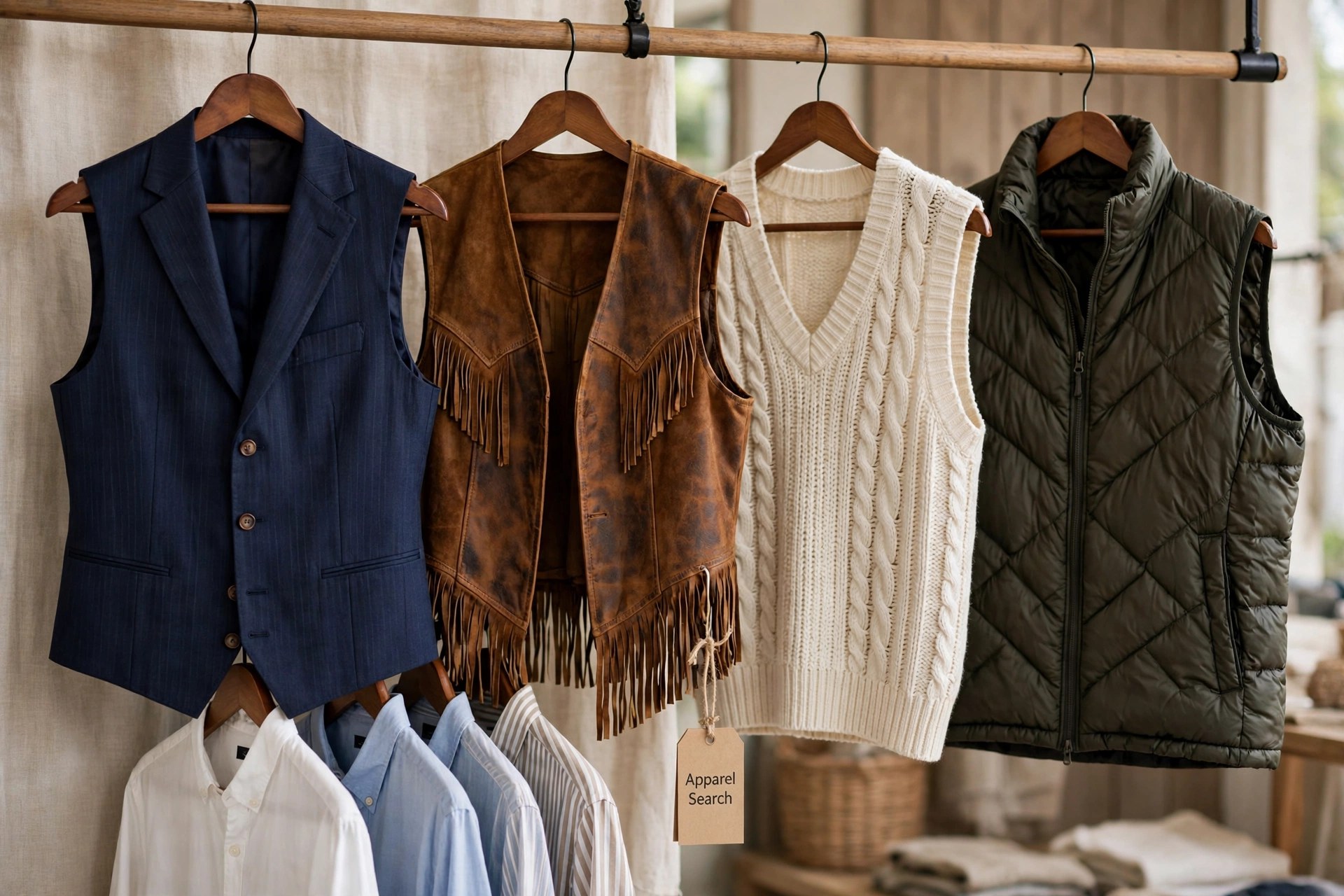
Fashion Vest — Explore & Resources
Basic Vests and Fashion Vests
In general, vests come in and out of fashion from time to time. When the category is actually in style, consumers still have the option of basic vests or fashion vests — fashion vests being vests that attempt to be stylish or trendy for the times. A tuxedo vest is basic if its style or colour has not changed for decades; the same vest becomes more fashionable with a new splash of colour, or an adjustment to the silhouette or fabric.
The category also has a cautionary tale: the ugly Christmas sweater vest, cousin to the ugly Christmas sweaters linked from this page. Vests can be stylish, but they can go horribly wrong — the garment's small surface gives a bad pattern nowhere to hide. The vest definition page and the guide to selecting insulated vests, both linked here, cover the term and the outdoor branch of the family.
The Vest Through the Seasons
Fringed leather vests were fashionable in the 1960s — and the fashion of the 60s is not necessarily fashionable today, as the fashion of the 60s summary linked from this page makes clear. That cycle is the vest's normal life: a waistcoat era in formal dress, a workwear and outdoor era in insulated and utility vests, a bohemian era in fringe, each returning in turn.
The trade behind the garment is mapped by the fashion vest manufacturers and fashion vest stores pages linked from this page. For the wearer, the practical rule follows from the definition: a vest is worn over a shirt, so it is judged as a layer — its fit across the shoulders and waist, its buttons, and whether its fabric argues with or answers the shirt beneath it.
Styling the Vest Without the Costume Effect
The vest fails when it reads as costume — a waistcoat quoting a period the rest of the outfit has not agreed to join. It succeeds as contrast and structure: a knit vest softening a shirt's formality, a tailored vest sharpening trousers and an open collar, a padded vest adding the outdoor layer that lets a jacket stay home. Colour discipline does most of the work — the vest either matches a suit exactly, as part of the three-piece tradition, or clearly does not match anything and is judged as the outfit's accent instead. The in-between vest, almost matching, is the one that looks like a mistake. Buttons set the other rule: a vest is cut to be buttoned, and worn open it should be a deliberate layer — gilet or knit — rather than a tailored waistcoat left undone. Treated as the outfit's middle voice, neither base nor decoration, the vest earns the place it keeps seeking in the fashion wardrobe.
Photos

Common Questions
What is a vest?
A sleeveless, close-fitting, waist-length garment worn over a shirt, typically with no collar and buttoning down the front.
What is the difference between a basic vest and a fashion vest?
A basic vest keeps an unchanged style — a classic tuxedo vest, for instance. A fashion vest updates colour, silhouette or fabric to be stylish for its time.
When were fringed leather vests fashionable?
In the 1960s. The style is a period marker of that decade, which does not by itself make it fashionable today.