CPSIA Technology Solutions
Software and labeling systems that put a permanent tracking label — and the data behind it — on every children's product
CPSIA is an acronym for the Consumer Product Safety Improvement Act — the United States law that made product tracking a permanent part of making and importing children's products, including children's apparel. This page explains what the Act's tracking-label rules require and profiles the technology built to meet them: compliance software that manages the data, and labeling programs that carry a unique identifier on the garment itself.
The two approaches work together. A software system such as a PLM or ERP platform holds the production record — where a product was made, when, by whom, and in which batch or lot. A tracking label applied to the product carries the identifier that points back to that record. When a product is questioned, that identifier is what lets a company trace a garment back through its components and work out exactly which other goods share the same history.
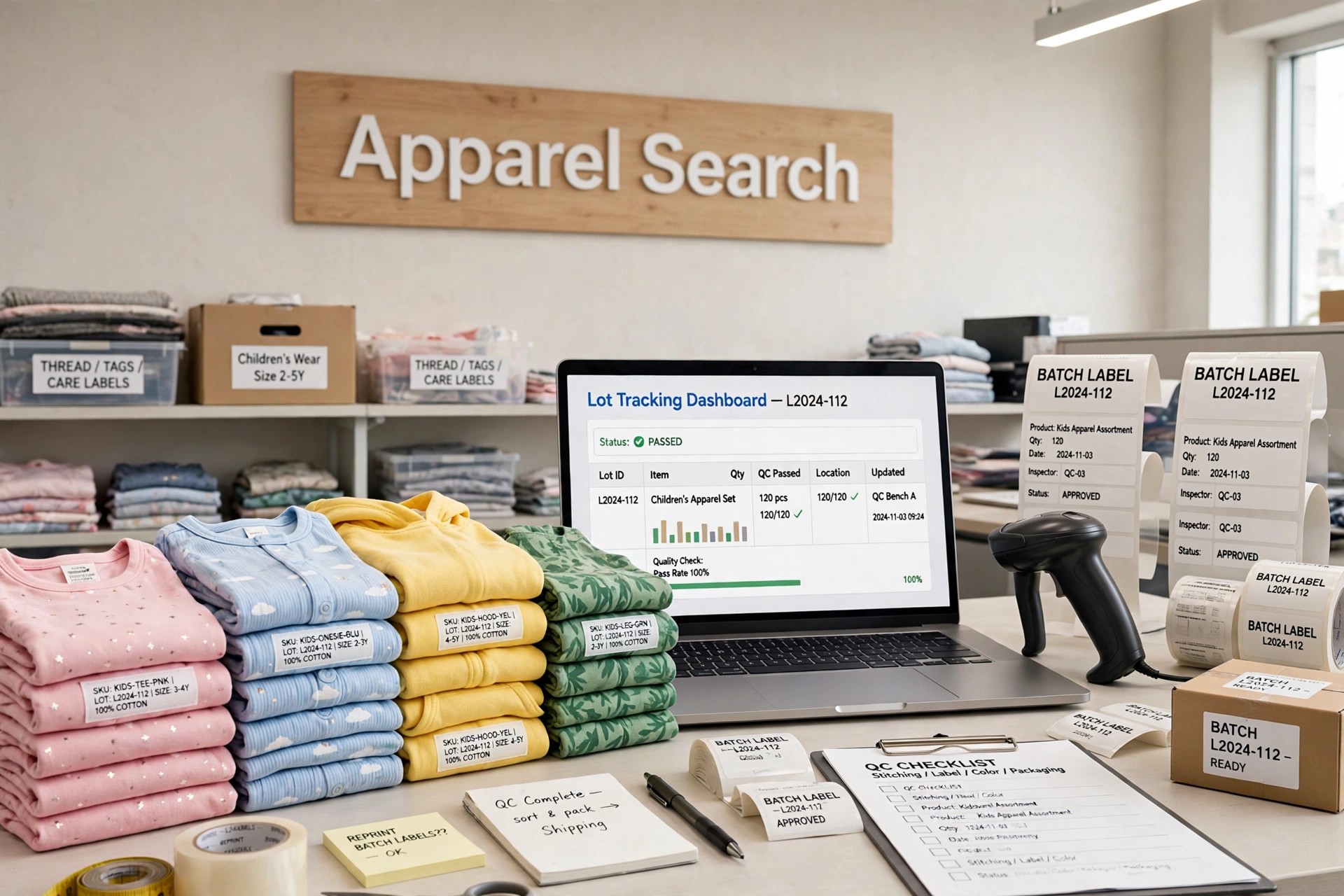
What the CPSIA Requires
The CPSIA regulations, which became effective August 14, 2009, are designed to protect children by aiding in the recall of unsafe products, including apparel, footwear, bedding and accessories. The regulations require that a permanently applied label contain the product's production location and date, as well as the manufacturer's name and the product's batch or lot number. The mandate affects apparel manufacturers and importers who supply children's products. Learn about CPSIA and the full text of the requirements on the Apparel Search CPSIA guide.
Three features of the rule shape the technology built around it. The label must be permanent — it has to stay with the product, not ride on a removable hangtag. The information must identify production facts — location, date, manufacturer, batch or lot — rather than marketing copy. And the rule reaches everyone who supplies children's products, from the factory that sews the garment to the importer who brings it into the United States, which is why compliance tools are sold to brands, retailers and importers as well as to manufacturers. The products covered are the ones children wear and sleep in — see the Children's Clothing guide for the range of children's apparel the rule touches.
Why a Label Becomes a Technology Problem
A tracking label is only as good as the data behind it. The production location, date, manufacturer and batch or lot printed or sewn onto a garment have to be captured accurately while the garment is being made — across purchase orders, fabric lots, cutting and sewing lines, and packing — and then kept retrievable for as long as the product is in use. For a single style made in one factory that is a paperwork task; for a children's line made in several countries from components supplied by several mills, it becomes a data-management task, and that is the gap CPSIA technology fills.
The systems divide into two families. Compliance and product-lifecycle software manages the record centrally: it knows which components went into which lot, and it can generate the label data each product needs. Labeling and track-and-trace programs manage the physical end: they put a unique identifier on each product and host the tracking data online, so the identifier on a garment in a store or a home can be followed back to its manufacturing data. Most children's-product suppliers end up needing both halves — a record worth tracing to, and a label that carries the trace.
New Generation Computing (NGC)
New Generation Computing provides PLM, global sourcing and ERP solutions to brands, retailers and importers of consumer products. NGC customers increase gross margins, reduce the cost of goods sold, improve speed to market and product quality, and manage CPSIA compliance with NGC software. NGC offers a comprehensive suite of integrated, end-to-end solutions for PLM, Global Sourcing, ERP, Shop Floor Control, Factory Labeling & Packing, CPSIA & Business Intelligence Tools. Its solution areas are listed as PLM, ERP, CPSIA and SCM — the CPSIA module sits inside the same system that runs product development and sourcing, so the compliance record is built from live production data rather than re-entered after the fact.
Contact details carried with the listing: New Generation Computing, 14900 NW 79th Court, Miami Lakes, FL 33016; phone 305 556 9122; fax 305 828 6358; email sales@ngcsoftware.com. The company's website address now redirects to Logility's apparel-industry pages, where its software for the apparel industry is presented today.
Avery Dennison — Universal Track and Trace
Universal Track and Trace, from Avery Dennison, is a labeling solution that allows manufacturers to meet and even exceed the U.S. Consumer Product Safety Improvement Act (CPSIA) requirements for product tracking, and then manage the tracking data online. With the Universal Track and Trace program, factories can incorporate a unique alphanumeric identifier — or garment license plate — into product tracking labels; create links to component information and other specific manufacturing data; and view and download the data from a secure website.
The unique alphanumeric identifier is the key to retrieving data about a specific component in a fabric lot. In the event of a garment recall, the label ID leads to the garment's fabric supplier and then helps determine the full scope of goods that used the questionable fabric. That recall-scoping function is the business case for track and trace in one sentence: a problem found in one fabric lot becomes a precise list of affected goods, instead of a guess that either recalls too little or pulls entire seasons off the shelf.
Choosing CPSIA Technology
The right system depends on where a company's tracking data is weakest. A brand whose production data already lives in a PLM or ERP platform usually needs that platform's compliance and factory labeling tools, so label data is generated from the same records that run sourcing and production. A manufacturer starting from paper records may get more from a labeling program first: a unique identifier on every product, with the component and manufacturing data managed online behind it. Either way, the tests are the same — the identifier must be unique and permanent, the data behind it must reach down to component and fabric-lot level, the record must be retrievable quickly from a secure system, and the scope of a recall must be determinable from a single label ID.
CPSIA compliance is also not a one-time project. Every new production run creates new locations, dates and lots to record, and children's lines turn over styles constantly — so the technology has to fit the ordinary flow of product development, sourcing and factory packing, not sit beside it as a separate chore. That is why the solutions on this page are built into PLM, ERP, shop floor and labeling systems the industry already uses, rather than offered as standalone CPSIA paperwork tools.
Common Questions
What does the CPSIA require on children's product labels?
A permanently applied label containing the product's production location and date, the manufacturer's name, and the product's batch or lot number. The rules, effective August 14, 2009, are designed to protect children by aiding in the recall of unsafe products, including apparel, footwear, bedding and accessories.
What is a garment license plate in track and trace?
It is a unique alphanumeric identifier incorporated into a product's tracking label, as in Avery Dennison's Universal Track and Trace program. The identifier links to component information and other manufacturing data held online, so a specific garment can be traced back — in a recall, the label ID leads to the garment's fabric supplier and helps determine the full scope of goods that used the same fabric.
Who has to comply with the CPSIA tracking-label rules?
Apparel manufacturers and importers who supply children's products. Because the obligation covers both the companies that make children's goods and the companies that import them, CPSIA technology is sold to factories, brands, retailers and importers alike — NGC, for example, provides its PLM, sourcing and ERP compliance tools to all three.
References & Further Reading
- Avery Dennison — Official Website
- Universal Track and Trace (Avery Dennison): the program's former ibmd.averydennison.com address no longer responds, so the listing above links Avery Dennison's current official website instead.