Licensing Management Software
Contracts, rights, royalties and approvals: the back office of brand licensing, automated
Brand licensing runs on paper obligations: a contract grants a licensee the right to put a licensor's name, logo or characters on products, in defined categories and territories, for a defined term, in exchange for royalties calculated on sales. Multiply that by dozens of licensees, hundreds of products and quarterly royalty reports in every format imaginable, and the administrative load becomes a business problem of its own.
Licensing management software exists to carry that load. It records the contracts and the rights they grant, tracks the royalties they generate, checks the financial compliance of the reports licensees submit, and manages the creative approvals every licensed product must pass before it can be sold.
Related Guide
Contracts, Rights and Royalties
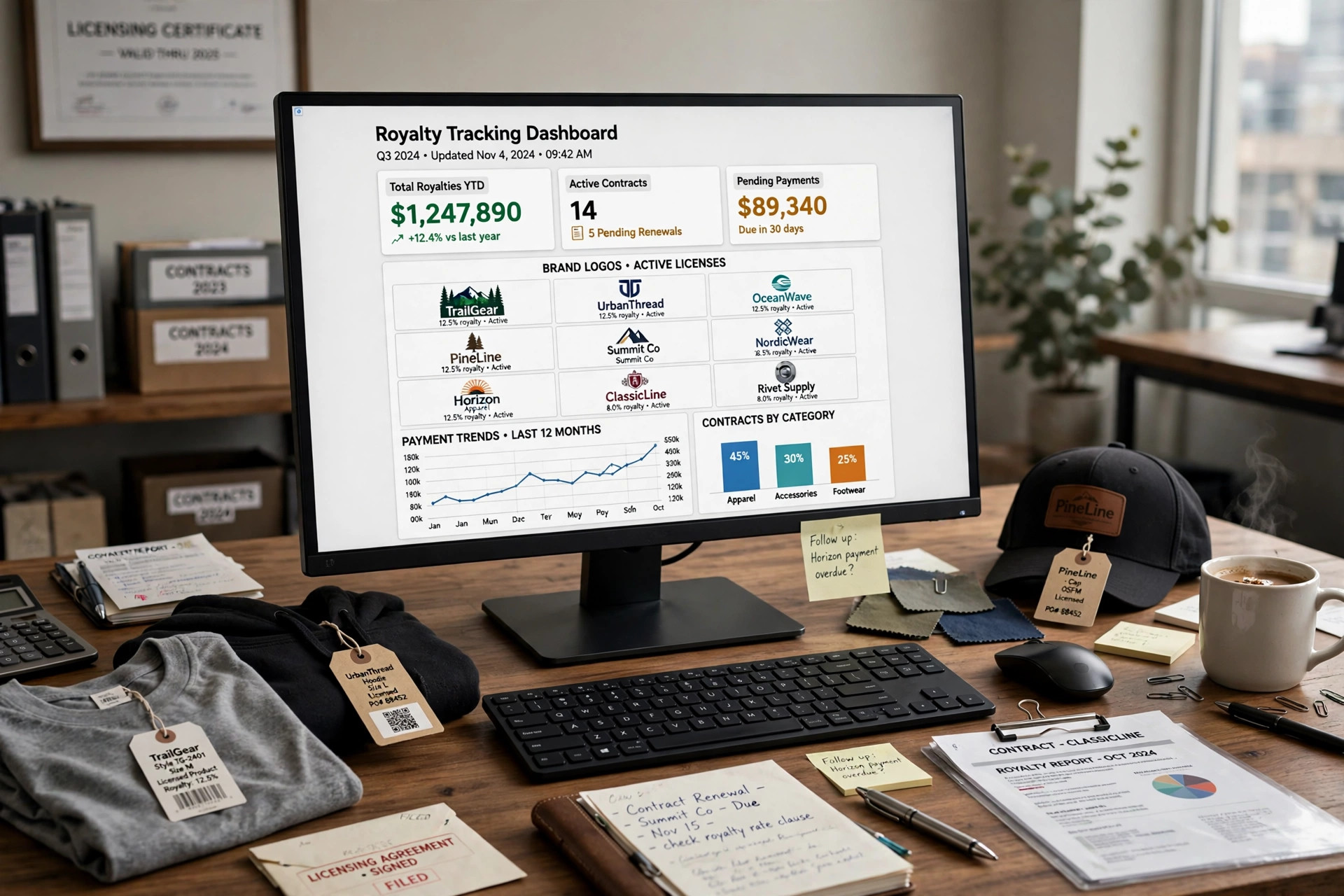
The heart of a licensing system is the deal record: which rights were granted — property, product category, channel, territory, term — and the financial structure attached to them, including royalty rates, guarantees and advances. Royalty tracking then applies those formulas to the sales licensees report, flagging under-reporting and errors that are easy to make by hand and expensive to miss: managing royalty obligations on licensed intellectual property is time-consuming and complex, and full of opportunities for error.
Financial compliance is the second half of the work. Systems reconcile reported sales against contract terms, manage statements and payments in both directions, and keep the audit trail a licensor needs when numbers are questioned. For licensees, the same systems structure what they must report and when, which reduces the spreadsheet improvisation that causes most disputes.
Creative Approvals and Product Compliance
Money is only half of licensing; the other half is protecting the brand on the product. Licensed goods pass through approval stages — concept, prototype, pre-production sample, final product and packaging — and approval software gives that flow a system: licensors review submitted images and samples, annotate what must change, and keep a digital record of every decision. An online system keeps users on task and shortens the entire approval cycle while preserving the history of concepts, prototypes, CAD drawings and final marketing materials.
That record matters commercially as well as legally. It proves what was approved, prevents unapproved product from reaching the market unnoticed, and lets agents and licensors across several countries run the same process the same way — the fashion industry is one of the core verticals these systems serve, alongside sports, entertainment, corporate brands, celebrity likenesses, video games and characters.
Licensing Software Suppliers in This Directory
Vistex's Counterpoint Suite addresses rights and royalty management for licensors. Dependable Solutions, Inc. offers a portfolio automating contract management, financial, royalty and creative operations for licensors, agents and licensees, drawing on more than 100 years of combined licensing-systems experience; its Dependable Rights Manager is implemented in more than 50 licensing organizations across eight countries. CTI Solutions' ProofTrak is an online image approval system with a dedicated uploader and annotation browser, from a company that has supplied data asset management, custom catalogs and order entry solutions to the footwear and apparel industry since 2002.
MetaComet Systems' Royalty Tracker simplifies royalty obligations on licensed intellectual property. The Eclipse Royalty and Rights Management system and Royalty Worx are also listed here; RoyaltyZone's founder Lou Ellman started the company in the fall of 2006 after finding the commercial options for his own small licensing business over budget and not web based. Two of these suppliers' pages no longer respond or have moved, so those entries are kept unlinked as records; the live vendor pages are in the references below.
More Software Guides
Common Questions
What does licensing management software do?
It administers brand licensing: recording contracts and the rights they grant, calculating and tracking royalties on licensee sales, checking financial compliance of royalty reports, and managing the creative approval of licensed products before they reach the market.
Who uses licensing software — licensors or licensees?
Both, plus licensing agents. Licensors and agents manage rights, royalties and approvals across their whole portfolio; licensees use the same systems to report sales, pay royalties correctly and submit products for approval on schedule.
Why is product approval software part of licensing?
A license grants the use of a brand, so the brand owner must approve how it appears on every product. Approval systems route concept, prototype and final-product submissions to the licensor with annotations and a permanent digital record, replacing email chains and shortening the approval cycle.
References & Further Reading
- Counterpoint Suite
- Dependable Solutions, Inc.
- Meta Comet Systems
- Royalty Worx
- ProofTrak by CTI Solutions — online product approval system; the product page listed here no longer responds, and the entry is kept as a record without a link.
- The Eclipse Royalty and Rights Management system (Eclgrp) — the product page listed here returns a 404; entry kept as a record.
- RoyaltyZone — web-based licensing software founded in 2006; its website no longer responds, so the entry is kept unlinked.