Korea Flag Information
Apparel Search world clothing industry directory — the Korean flag and its symbols, for the fashion industry.
Korean flag information for the fashion industry, from the Apparel Search world clothing industry directory for Korea.
Korea Fashion Industry Resources
The T'aegukki and Its Symbols
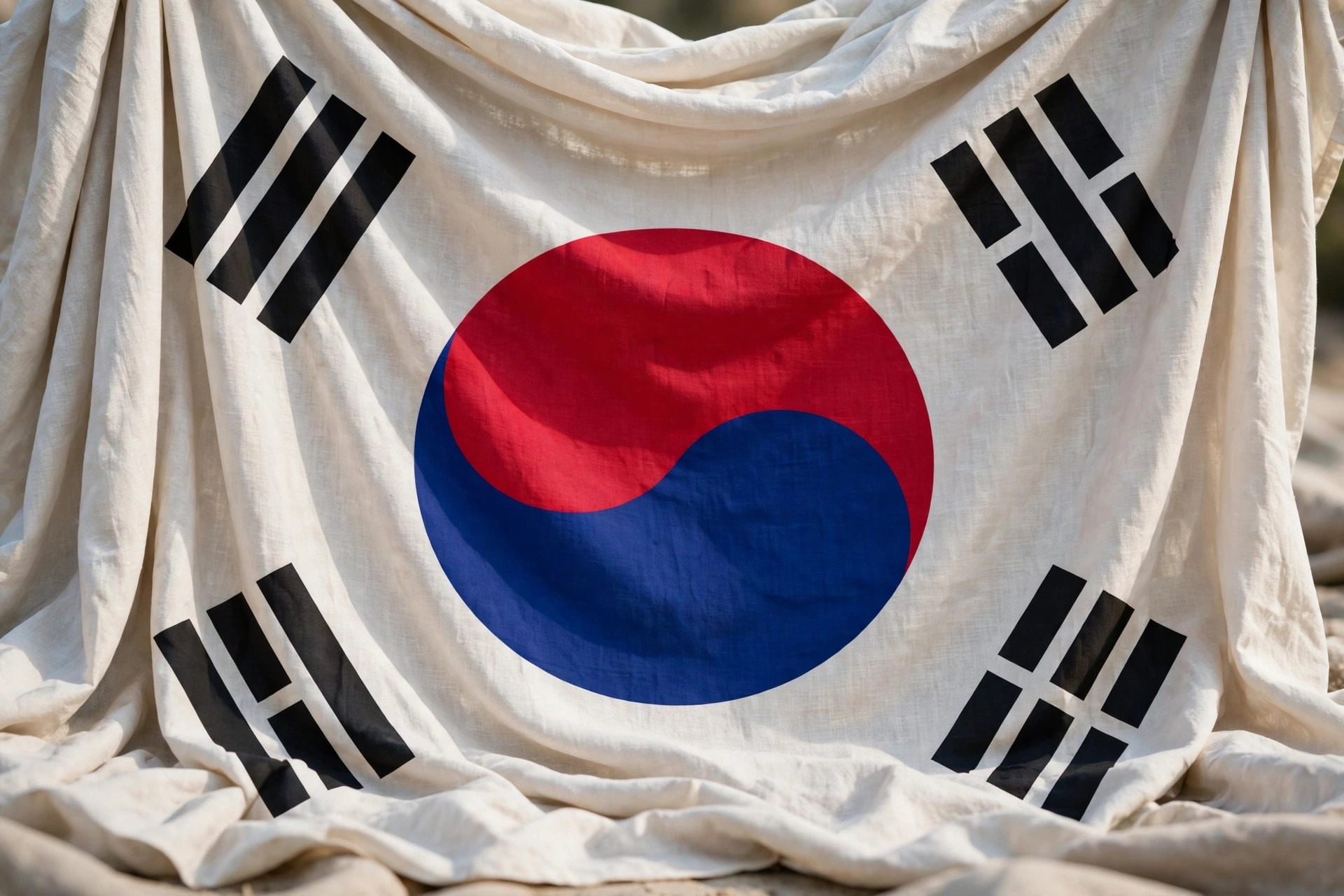
The Korean flag is called t'aegukki. Its design symbolizes the principles of the yin and yang in Oriental philosophy. The circle in the center of the flag is divided into two equal parts. The upper red section represents the positive cosmic forces of the yang. Conversely, the lower blue section represents the negative cosmic forces of the yin. The two forces together embody the concepts of continual movement and balance and harmony that characterize the sphere of infinity. The circle is surrounded by four trigrams, one in each corner. Each trigram symbolizes one of the four universal elements: heaven, earth, fire and water.
Reading the Design
Every element of the flag carries that balance further. The white field behind the symbols is the ground of the design: in Korean tradition white clothing was everyday dress for centuries, and the plain field keeps the flag's meaning in the symbols themselves rather than in decoration. The taegeuk circle's S-shaped division is the heart of it — red yang rises above, blue yin settles below, and because the two halves turn into each other, the design expresses movement rather than a static split: day into night, summer into winter, action into rest, each force containing the seed of the other. For a country whose textile industry exports around the world, it is fitting that its best-known symbol is fundamentally about two contrasting elements held in proportion.
The four corner trigrams extend the same idea outward. A trigram is a stack of three lines, each line either solid or broken. The heaven trigram uses three solid lines; the earth trigram three broken lines; fire combines solid, broken, solid; and water combines broken, solid, broken. Placed diagonally opposite one another — heaven across from earth, fire across from water — the corners repeat the centre's lesson at the scale of the whole flag: opposites paired, balanced, and held in one design. The diagrams in the Photos section below show each trigram on its own: heaven, earth, fire and water, together with the full flag.
The Flag as a Textile
For the fashion and textile industry, the taegeukgi is also a piece of precision printing. A flag is a manufactured textile, and this design tolerates no drift: the central circle must divide into two exactly equal halves, the red must sit above the blue in the correct rotation, and each trigram must appear in its proper corner with its lines the right way up — a flag printed with a trigram reversed is simply wrong, in the same way a misprinted logo is wrong. Manufacturers producing Korean flags, embroidered flag patches, or apparel and accessories that carry the design therefore work to fixed specifications for proportions, placement and colour, and buyers checking flag stock should verify the circle division, the four corner symbols and the colour balance before accepting a production run. The Korea clothing industry directory linked above lists the textile and apparel companies behind Korean manufacturing, including the fabric, embroidery and printing specialists who do this kind of work.
Photos


Common Questions
What is the Korean flag called?
The Korean flag is called the t'aegukki, named for the taegeuk - the red and blue circle at its centre. The upper red section represents the positive cosmic forces of the yang, and the lower blue section represents the negative cosmic forces of the yin.
What do the four symbols in the corners of the Korean flag mean?
The four trigrams in the corners symbolize the four universal elements: heaven, earth, fire and water. Each trigram is made of three lines, broken or unbroken, arranged around the central taegeuk circle.
Why does the Korean flag matter to the fashion and textile industry?
Flags are printed and woven textiles, so the taegeukgi's exact geometry and colours matter to any manufacturer producing Korean flags, patches, or flag designs on apparel: the circle must be divided into two equal parts, the four trigrams must sit one in each corner, and the red, blue, black and white colours must reproduce accurately on fabric.