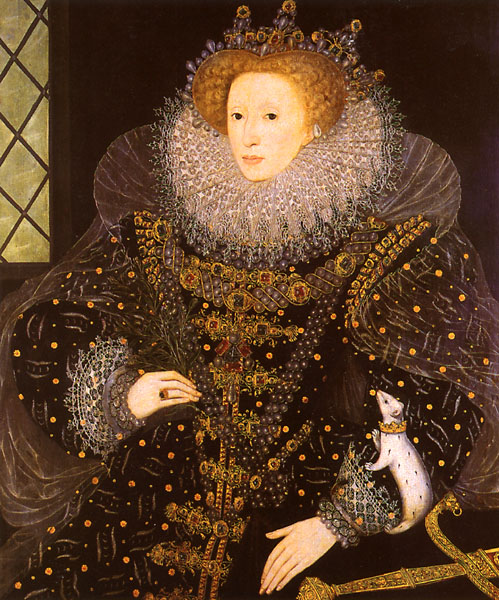
 Fashion in the period 1550-1600 in
Western European
clothing is characterized
by increased opulence, the rise of the
ruff, the expansion of the
farthingale for women,
and, for men, the transition from
hose to
breeches Fashion in the period 1550-1600 in
Western European
clothing is characterized
by increased opulence, the rise of the
ruff, the expansion of the
farthingale for women,
and, for men, the transition from
hose to
breeches.
General trends
The wide, broad-shouldered silhouette
of the 1540s and 1550s gradually shifted
to a tall, slender look.
Sleeves
and shoulders became narrower in the 1560s,
expanded through the 1570s and 1580s, and
narrowed again at the end of the period.
Waistlines dropped toward a low point
in front for both men and women.
The severe fashions of the Spanish court
under Philip II of Spain were dominant through
the early part of the period every where
except France; black garments were worn
for the most formal occasions. Regional
styles were still distinct. Janet Arnold
in her analysis of Queen Elizabeth's wardrobe
records identifies French, Italian, Dutch,
and Polish styles for
bodices
and sleeves, as well as Spanish.
Ruffs increased in size throughout the
period and then began to disappear everywhere
except Holland, where they remained in fashion
well into the next century.
The general trend toward abundant surface
ornamentation in the
Elizabethan era was mirrored in clothing,
especially among the aristocracy in England:
shirts
and
chemises
were
embroidered
with
blackwork
and edged in
lace, and
heavy cut
velvets
and
brocades
were further ornamented with applied lace,
gold and silver embroidery, and jewels.
Leather and fabric garments continued
to be decorated by slashing and punching
the fabric in regular patterns, and
linings could be pulled through the
slashes in small puffs.
Men's Fashion
Men's fashionable clothing consisted of:
- A
linen
shirt
with a ruff and matching wrist ruffs
early, replaced by a
collar
and matching
cuffs
later in the period.
-
Hose,
in variety of styles, worn with a
codpiece
early in the period.
- A
doublet
with separate sleeves tied or laced
to the shoulders.
- Optionally, a
jerkin,
usually sleeveless and often made of
leather, worn
Outerwear
Short
cloaks
or
capes,
usually hip-length, often with
sleeves,
or a miltary
jacket
like a
mandilion, were fashionable. Long cloaks
were worn for inclement weather. Gowns
were increasingly old-fashioned, and were
worn by older men for warmth indoors and
out. In this period gowns began their transition
from general garments to traditional clothing
of specific occupations, such as scholars
(see
Academic dress).
Hairstyles and headgear
Hair was generally worn short, brushed
back from the forehead. Longer styles were
popular in the 1580s. In the 1590s, young
men of fashion wore a lovelock, a
long section of hair hanging over one shoulder.
Hats, of
various shapes and fashions, but generally
tall and trimmed with a jewel or feather,
were worn indoors and out.
Close-fitting caps covering the ears
and tied under the chin called
coifs or
biggins continued to be worn by children
and older men under their hats or alone
indoors; men's coifs were usually black.
More images:
Philip II of Spain
(d. 1598) in old age.
Spanish fashion changed
very little from the
1560s to the end of
the century.
Henry Wriothesley, 3rd
Earl of Southampton,
1594. Note the lovelock
hanging over one shoulder,
the wide lace-trimmed
collar, and gloves with
deep embroidered cuffs.
Trunk hose are still
worn, but without the
prominent codpiece.
Sir Martin Frobisher
in a peascod-bellied
doublet with full sleeves
under a buff jerkin
with matching hose.
Henri III of France
wears a short cape over
doublet and hose.
Sir Christopher Hatton
wears a fur-lined gown
with hanging sleeves
over a slashed doublet
and hose, with the
livery collar of
the
Order of the Garter,
c. 1590.
The wide "trumpet"
sleeves characteristic of
Tudor England disappeared
with the accession of Elizabeth,
in favor of French and Spanish
styles with narrower sleeves.
Bodices could be high-necked
or have a broad, low, square
neckline, often with a slight
arch at the front early
in the period. French, Spanish,
and English bodices were
stiffened into a cone shape
or worn over
corsets.
The wide-shouldered look
of the 1580s was emphasized
with padded and jeweled
shoulder rolls. Bodices
fastened with hooks in front
or were laced at the side-back
seam; high-necked bodices
styled like men's doublets
might fasten with hooks
or buttons.
A low neckline could be filled in with
a partlet, usually of embroidered
linen with matching sleeves. Embroidered
sets of partlet and sleeves were frequently
given to Elizabeth as New Year's gifts.
Alternatively, a high-necked chemise with
a standing collar and ruff could be worn.
Gowns with hanging sleeves in various
styles, often lined in
fur, were
worn as an extra layer indoors and out through
the period. Loose gowns of the 1560s hung
from the shoulders, and some had puffed
upper sleeves. Loose gowns could be worn
over a one-piece kirtle or under-dress,
usually laced at the back.
Later gowns were fitted to the figure
and had full or round sleeves with a wristband.
These were worn over a bodice and matching
skirt or
petticoat
and undersleeves. Extremely long hanging
sleeves came into fashion at the end of
the period.
The fashion for skirts worn open at the
front to display a rich petticoat or separate
forepart continued into the 1580s.
The forepart was a heavily decorated panel
to fill in the front opening; it might be
sewn to a plain petticoat or pinned in place.
Underwear
During this period,
underwear
consisted of a
linen
chemise
or
smock and
(optionally) linen drawers. The chemise
could have a low, square neckline or a high
collar and ruff like a man's shirt. Fine
chemises were embroidered and trimmed with
narrow
lace.
To shape the figure, the fashionable
lady wore a
corset
called a pair of bodies. Her skirts
were held in the proper shape by a
farthingale
or
hoop skirt.
In Spain, the cone-shaped Spanish farthingale
remained in fashion into the early 17th
century. It never really caught on in France,
where a padded roll or French farthingale
held the skirts out in a rounded shape at
the waist, falling in soft folds to the
floor.
In England, the Spanish farthingale was
worn through the 1570s, and was gradually
replaced by the French farthingale. By the
1590s, skirts were pinned to wide wheel
farthingales to achieve a drum shape.
Outerwear
Hooded cloaks were worn overall in bad
weather.
Hairstyles and headgear
Early in the period, hair was parted
in the center and fluffed over the temples;
later front hair was curled and puffed high
over the forehead. Wigs and false hairpieces
were used to extend the hair.
In keeping with tradition, married women
wore their hair pinned up and covered. A
close-fitting linen cap called a
coif or
biggins was worn, alone or under
other hats; many embroidered and lace-trimmed
coifs survive from this period. A cap wired
or starched into slight heart-shape is called
by costume historians a Mary Stuart cap
after the
Queen of Scots who wears one in several
portraits.In this period, women began
to wear
hats similar
to those worn by men, a fashion which was
deplored by
Puritan commentator
Philip Stubbes in his Anatomie of
Abuses 1583.
First-time
brides wore their hair down in token
of virginity and wore orange blossoms in
their hair.
More images:
- In this
allegorical painting c. 1572,
Elizabeth I wears a fitted gown
with hanging sleeves over a matching
arched bodice and skirt or petticoat,
elaborate undersleeves, a high-necked
chemise with a ruff, and a Spanish farthingale.
-
Lettice Knollys wears an embroidered
black high-necked bodice with round
sleeves and skirt over a gold petticoat
or forepart and matching undersleeves,
a lace cartwheel ruff and lace cuffs,
and a tall black hat with a jeweled
ostrich feather. C. 1580s.
-
French fashion: A open ruff fastens
at the base of the neck, and the skirt
hangs in soft folds over a French farthingale.
-
Mary Queen of Scots in capitivity
wears French fashions (open ruff and
French farthingale) and a cap and veil.
-
Elizabeth I, 1592, wears a dark
red gown (the fabric is just visible
at the waist under her arms) with hanging
sleeves lined in white satin to match
her bodice, undersleeves, and petticoat,
which is pinned to a cartwheel farthingale.
She carries leather gloves and an early
folding fan.
Time Line of Fashion From the Victorian Era Through the 1950's
Designer Definition
(from U.S Department of Labor)
Clothing
Definitions
Fashion Accessories
Style
Catwalk
|
