Women's Maternity T-Shirts Guide
The maternity t-shirt is the hardest-working casual garment of pregnancy: a knit tee with side ruching and extra length that turns a trimester of growth into one size.
Shop Women's Maternity T-Shirts Now
Shop Women's Maternity T-Shirts on Amazon Shop Women's Maternity T-Shirts on eBayThe Amazon and eBay links on this page are affiliate links. If you make a purchase through them, Apparel Search may earn a commission.

Every maternity wardrobe runs on t-shirts. They layer under everything, they stand alone in warm months, they wash without ceremony — and the maternity version is a small masterpiece of one idea: side ruching. Gathers sewn into both side seams let the tee stretch vertically over a growing bump and spring back flat afterward, so a shirt bought at week fourteen is still a shirt at week forty. Our original guide pointed readers to the cotton maternity tee pages as the category's core, and cotton jersey remains its home fabric.
This page covers the tee specifically. Its structured cousin, the maternity shirt, and its dressier one, the blouse, have their own guides; the umbrella tops guide maps the whole family.
Anatomy of the Maternity Tee
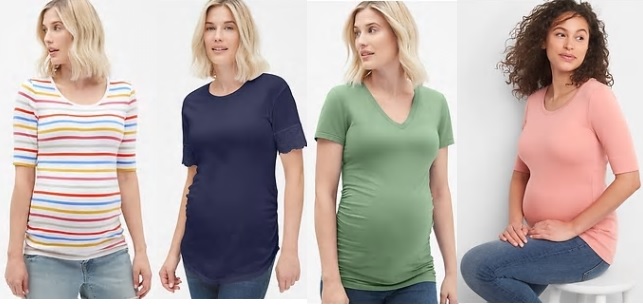
Beyond the ruching, three details define the garment. Length: maternity tees are cut several inches longer than regular ones, because the bump consumes front length; a tee that ends at the hip in month four ends at the waistband in month eight if it wasn't cut for the job. The neckline: scoop and v-necks dominate because they sit well over a changed bust and layer under cardigans; crew necks work early. The sleeve: cap and short sleeves are standard, three-quarter sleeves are the transitional-season heroes, and the sleeve should have enough ease not to bind a fuller upper arm.
Nursing versions add a lift-up outer layer or crossover front — worth choosing from mid-pregnancy onward, since the tee's career extends months past delivery.
Fabrics and Fit
Cotton jersey is the classic: breathable, washable, honest. Cotton-modal and viscose jerseys drape softer and look dressier; slub jerseys hide a multitude of wrinkles; anything with 3–5% elastane recovers best from the ruching's workout. Weight matters by season — a substantial jersey reads as a top, a tissue-weight one reads as an underlayer, and you'll want both.
Fit follows the maternity rule — your pre-pregnancy size — judged by the shoulders and bust, with the ruching trusted for the rest. The tee should skim, not cling like a second skin or hang like a tent; if the ruching is fully extended with months to go, that tee has done its service and the next size up takes over.
The Tee Rotation
Styling is arithmetic again: three to five tees — white, black or navy, a stripe, one color that makes your face look awake — under cardigans, blazers, open shirts and over every maternity bottom in this section, is most of a casual wardrobe. Print and slogan tees exist in maternity cuts too; the bump gives them a billboard they were clearly designed for, should you enjoy that, and many women do.
After the birth the tees keep working — nursing versions obviously, ruched regulars as forgiving, comfortable tops that no one will identify as maternity. Our original guide also recommended reading on the benefits of cotton for this most cotton of categories; that article is linked below, along with the cotton maternity t-shirt guide and the general women's t-shirt and tops guides.
The Slogan Question and Other Tee Decisions
Maternity tees attract novelty prints — arrows, announcements, jokes about the bump — and the category is more fun for them. The practical word is proportion: one novelty tee is a delight at the shower and in the weekly photograph; five are a wardrobe problem, because the plain tees are the ones that layer, repeat and go anywhere. Buy the plains first (they are the infrastructure), then the joke tee with a clear conscience. Two more decisions worth a sentence: neckline depth — a scoop that is modest now will be ambitious at a fuller bust, so size the neckline for the trimester of wear — and sleeve band tightness, which you will feel at hour six, not in the fitting room. The tee is simple; that is why its details are the whole purchase.
Photos From Our Original Guide
Related Women's Guides
Looking for Women's Clothing Stores?
This guide helps you choose women's maternity t-shirts. To browse where to buy, visit our women's clothing store directory, where you can find retailers that carry them.