1850's Fashion History presented by Apparel Search
Fashion Industry Fashion History Color Trend Forecasting Artist Guide Merchandising Fashion Industry News Definition List
|
|
1850s fashion in European and European-influenced clothing is characterized by an increase in the width of women's skirts supported by crinolines or hoops, and the beginnings of dress reform.
Women's Fashion
In the 1850s, the domed skirts of the 1840s continued to expand. Skirts were made fuller by means of flounces (deep ruffles), usually in tiers of three, gathered tightly at the top and stiffened with horsehair braid at the bottom.
Early in the decade, bodices of day dresses featured panels over the shoulders that were gathered into a blunt point at the slightly dropped waist. These bodices generally fastened in back by means of hooks and eyes, but a new fashion for a jacket bodice appeared as well, buttoned in front and worn over a chemisette. Wider bell-shaped or pagoda sleeves were worn over falso undersleeves or engageantes of cotton or linen.
Evening dresses were very low-necked, falling off the shoulders, and had short sleeves.
The introduction of the steel cage crinoline in 1856 provided a means for expanding the skirt still further, and flounces gradually disappeared in favor of a skirt lying more smoothly over the petticoat and hoops. Pantalettes were essential under this new fashion for modesty's sake.
Outerwear
Coats were impractical over the very wide skirts, and the fashionable outer garment was an Indian shawl or one woven in Paisley, Renfrewshire in a paisley pattern in imitation of Indian styles. Hooded cloaks were also worn.
Hairstyles and headgear
Hair was dressed simply, in a chignon with the sides puffed out over the ears or with clusters of curls to either side in imitation of early 17th century fashions. Deep bonnets were worn outdoors.
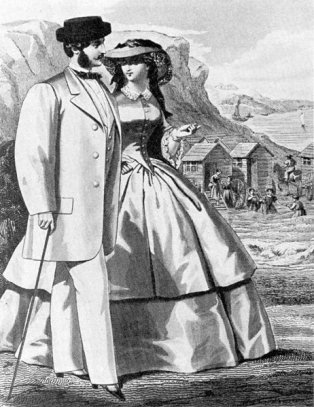
1859 fashion plate from the "Gazette of Fashion", showing both male and female daywear, with sea bathing scene in the background (including bathing machines). Scanned by H. Churchyard
| The above article is licensed under the GNU Free Documentation License. From Wikipedia, the free encyclopedia https://en.wikipedia.org/wiki/1850s_in_fashion 1/13/06 |
Designer Definition (from U.S Department of Labor)
|
Learn about another era in fashion: 1980's Fashion History (terms section) |
|
|
