1600-1650 period in Fashion History presented by Apparel Search
Fashion Industry Fashion History Color Trend Forecasting Artist Guide Merchandising Fashion Industry News Definition List Fashion Museums and Exhibits
Fashion in the period 1600-1650 in Western European clothing is characterized by the disappearance of the ruff in favor of broad lace or linen collars. Waistlines rose through the period for both men and women. Other notable fashions included full, slashed sleeves and tall or broad hats with brims. For men, hose disappeared inn favor of breeches.
The silhouette, which was essentially close to the body with tight sleeves and and a low, pointed waist to around 1615, gradually softened and broadened. Sleeves became very full, and in the 1620s and 1630s were often slashed to show the voluminous sleeves of the shirt or chemise beneath. Waistlines rose.
Dense surface ornament fell out of fashion in favor of solid-color satins, and ribbon bows were common as trim.
Spanish fashions remained very conservative. The ruff lingered longest in Spain and Holland, but disappeared first for men and later for women in France and England.
The social tensions leading
to the English Civil War
were reflected in English
fashion, with the elaborate
French styles popular at
the courts of James I and
his son Charles I contrasting
with the sober styles in
sadd
or somber colors favored
by Puritans and exported
to the early settlements
of New England.
Women's Fashions
Overview
In the early years of the new century, fashionable bodices had high necklines or extremely low, rounded necklines, and short wings at the shoulders. Separate closed cartwheel ruffs were worn. Long sleeves were worn with deep cuffs to match the ruff.
The low, round neckline and ruff disappeared in England by 1613.
By the mid-1620s, styles were relaxing. Ruffs were discarded in favor of wide collars similar to the linen collars worn by middle-class women in the previous century. Over the next decades, bodices became shorter, with wide, low, straight necklines, and were worn with contrasting stomachers that ended in a broad, rounded point below the higher waist. Sleeves became very full and could be slashed to show the sleeves of the chemise; later sleeves were looser at the wrist and three-quarters length, without slashes. Short strings of pearls were fashionable.
Skirts might still be open in front to reveal an underskirt or petticoat, or closed all all around.
Shoes tied over the instep and were decorated with shoe roses, ribbon bows. Low heels were worn.
Underwear
Underwear consisted of a linen chemise or smock and (optionally) linen drawers. The chemise could have a low, square neckline or a high neckline; either style could be worn with ruffs (to c. 1625) or the newly fashionable broad collars.
Corsets were shorter to suit the new bodices, and might have a very stiff busk in the center front extending to the depth of the stomacher. Skirts were held in the proper shape by a padded roll or French farthingale holding the skirts out in a rounded shape at the waist, falling in soft folds to the floor.
In conservative Spanish court fashion, the cone-shaped Spanish farthingale of the last century lingered well into the period, to be replaced by wide French farthingales toward the 1650s, long after they had gone out of style elsewhere.
Hairstyles and headgear
To about 1613, hair was worn feathered high over the forehead. Married women wore their hair in a linen coif or cap, often with lace trim. Tall hats like those worn by men were adopted for outdoor wear.
In a characteristic style of 1625-1650, hair was worn in loose curls or waves to the shoulders on the sides, with the rest of the hair gathered or braided into a high bun at the back of the head. A short fringe or bangs might be worn with this style. Very fashionable married women abandoned the linen cap and wore their hair uncovered or with a hat.
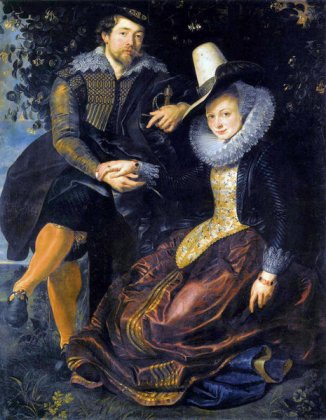
Image: Peter Paul Rubens and his first wife Isabella Brant by Rubens, 1609-1610.Image from http://www.wga.hu/
|
The above article is licensed under the GNU Free Documentation License. From Wikipedia, the free encyclopedia https://en.wikipedia.org/wiki/1600-1650_in_fashion 1/13/06 |
Designer Definition (from U.S Department of Labor)
|
|

|