Hemstitch
Sewing Definitions — stitches, seams, quilting and sewing terms from Apparel Search
Hemstitch, or hem-stitch, is a decorative drawn thread work or openwork hand-sewing technique for embellishing the hem of clothing or household linens. Unlike an ordinary hem, hemstitching can employ embroidery thread in a contrasting colour so as to be noticeable. In hemstitching, one or more threads are drawn out of the fabric parallel and next to the turned hem, and stitches bundle the remaining threads in a variety of decorative patterns while securing the hem in place. Multiple rows of drawn thread work may be used for a richer effect.
Hemstitch or hem-stitch is a decorative drawn thread work or openwork hand-sewing technique for embellishing the hem of clothing or household linens. Unlike an ordinary hem, hemstitching can employ embroidery thread in a contrasting color so as to be noticeable.
In hemstitching, one or more threads are drawn out of the fabric parallel and next to the turned hem, and stitches bundle the remaining threads in a variety of decorative patterns while securing the hem in place. Multiple rows of drawn thread work may be used.
Hand hemstitching can be imitated by a hemstitching machine which has a piercer that pierces holes into the fabric and two separate needles that sew the hole open. There are also hemstitcher attachments for home sewing machines, and simple decorative stitches can be used over drawn threads to suggest hand-hemstitching.
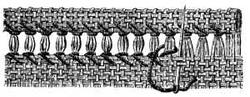
Image of ladder hemstitch
References
- Dillmont, Thérèse de (1884). Encyclopedia of Needlework.
- Reader's Digest (1992). Complete Guide to Needlework. Reader's Digest Association, Inc. ISBN 0-89577-059-8.
| The above article is licensed under the GNU Free Documentation License. From Wikipedia, the free encyclopedia https://en.wikipedia.org/wiki/hemstitch. Modified by Apparel Search July 25, 2013. |
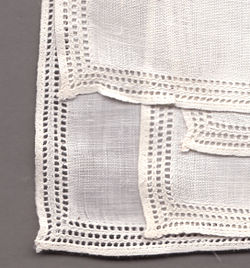
Hemstitched Handkerchief
Openwork That Holds the Hem
Hemstitch belongs to drawn thread work, the family of embroidery techniques that create pattern by removing threads from the fabric and working over those that remain. The hem is turned up first in the usual way. Then, parallel to the fold and just beside it, one or more threads are carefully drawn out of the woven fabric across the full width of the piece, leaving a narrow open band with exposed vertical threads. The hemstitch itself is worked along that band: the needle gathers a small group of the remaining threads, draws them together with a stitch that also catches the folded hem, and moves on to the next group. The hem is therefore secured and decorated by the same stitches, and the bundled threads form the repeating pattern, most simply a row of small ladder-like openings, known as ladder hemstitch.
The technique demands a fabric that cooperates: an even, plain weave, traditionally linen, in which threads can be counted, withdrawn cleanly and bundled evenly. That is why hemstitching belongs historically to household linens, table cloths, napkins, towels, sheets and handkerchiefs, and to the hems of fine blouses and dresses in linen and cotton. On a hemstitched handkerchief the openwork band frames the whole square, turning a purely practical edging into the object's chief ornament. Multiple rows of drawn thread work may be used together, with different bundling patterns, to build wider decorative borders.
Patterns, Threads and Machines
Variation comes from how the threads are grouped and crossed. Bundling threads straight across gives a ladder effect; taking them diagonally, crossing groups, or combining hemstitch with other drawn thread stitches builds zigzags, diamonds and knotted effects. Thread choice changes the character again: thread matched to the fabric makes the pattern read as texture and shadow, while embroidery thread in a contrasting colour makes the hemstitching deliberately noticeable, advertising the handwork. References such as Therese de Dillmont's Encyclopedia of Needlework documented the standard patterns that generations of needlewomen worked from.
Machine methods imitate the look by a different route. A hemstitching machine has a piercer that pierces holes into the fabric and two separate needles that sew the hole open, producing the characteristic wing-needle perforation without any threads being drawn. Hemstitcher attachments for home sewing machines do similar work, and simple decorative stitches used over drawn threads can suggest hand hemstitching. The machine versions are faster and more regular, but the hand technique remains distinct in structure: real drawn threads, real bundles, and a hem held in place by the ornament itself rather than by a hidden line of plain stitching.
Common Questions
What is hemstitch?
Hemstitch is a decorative drawn thread work or openwork hand-sewing technique for embellishing the hem of clothing or household linens. Threads are drawn out next to the turned hem and the remaining threads are bundled with stitches into decorative patterns.
How does hemstitching differ from an ordinary hem?
An ordinary hem simply turns and secures the edge, ideally invisibly. Hemstitching is decorative: it creates openwork patterns at the hem and can use embroidery thread in a contrasting colour so as to be noticeable.
Can hemstitching be done by machine?
Yes. Hand hemstitching can be imitated by a hemstitching machine with a piercer and two needles that sew the hole open, and there are hemstitcher attachments for home sewing machines; decorative stitches can also be used over drawn threads.