Women's Knit Tops Guide
Knit tops are the broad family behind most everyday wardrobes: tees, tanks, camisoles and fine-gauge pullovers, all cut from fabrics that stretch with you instead of against you.
Shop Women's Knit Tops Now
Shop Women's Knit Tops on Amazon Shop Women's Knit Tops on eBayThe Amazon and eBay links on this page are affiliate links. If you make a purchase through them, Apparel Search may earn a commission.
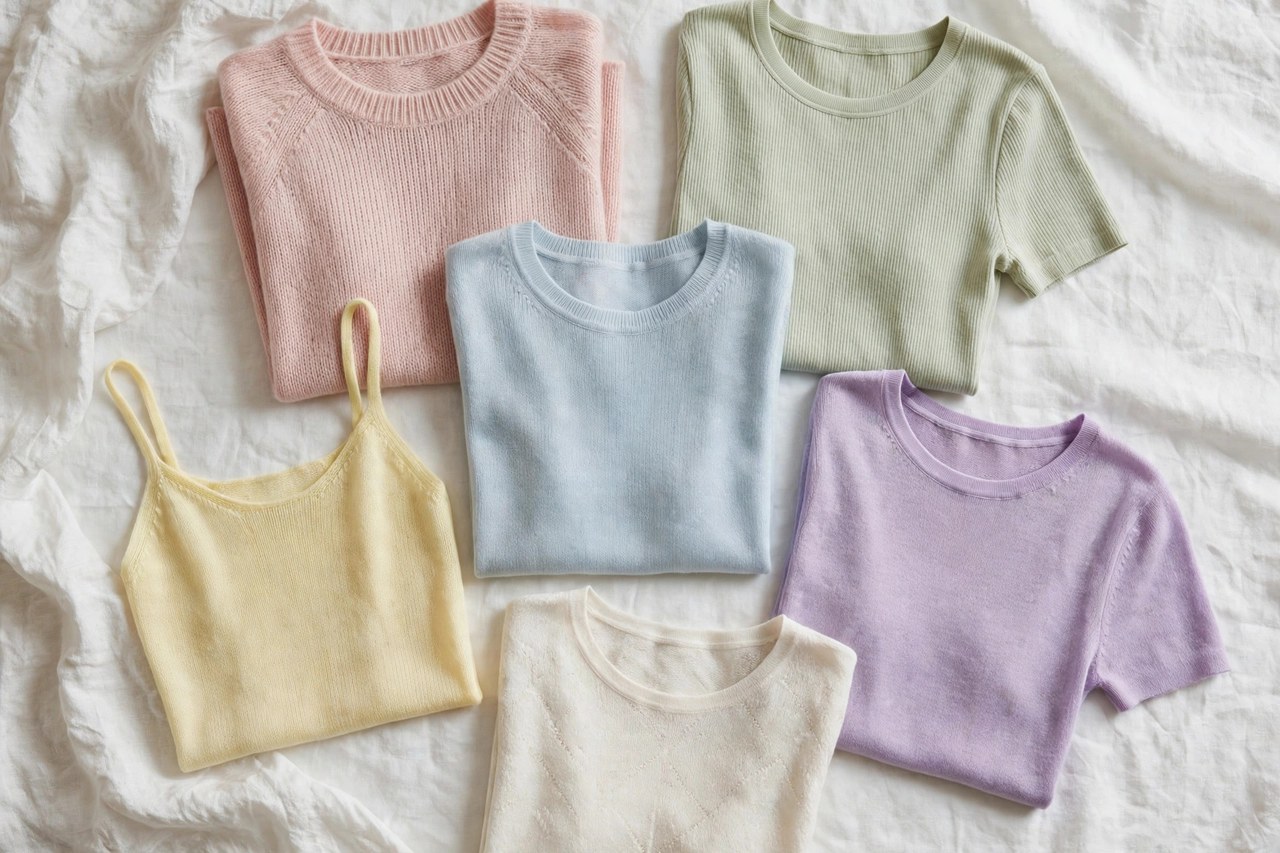
A knit top is any upper-body garment made from a knitted fabric, which is why the term covers so much ground. T-shirts, tank tops, camisoles, long-sleeved tees, fine-gauge pullovers and soft henleys are all knit tops, united not by a single silhouette but by the way their fabric is made: yarn looped into a structure that gives in every direction. That give is what makes knit tops comfortable for long days, travel and layering, and why most women own more of them than of any woven style.
It helps to separate the umbrella from one of its branches. Knit shirts, covered in their own guide, are the shirt-like members of the family, with details borrowed from tailored shirting such as collars, plackets and button fronts. Knit tops is the wider category: it includes those shirts, but also every collarless tee, tank and camisole. When a retailer labels something simply a top, expect a simpler neckline, fewer structured details and a shape designed to work alone in warm weather or as a layer when it turns cool.
Knit Fabrics: Jersey, Rib and Modal Blends
Jersey is the classic T-shirt fabric: smooth on the face, fine on the back, light and fluid, with a natural tendency to curl at cut edges that finished hems keep in check. Rib knit alternates raised and recessed columns, which makes it far more elastic across the width; ribbed tanks and fitted tees cling without feeling tight and recover their shape well. Interlock is a double-faced knit that is thicker, smoother and more opaque than jersey, a good choice when a light color must not turn sheer.
Fiber changes the character of the same fabric. Cotton jersey breathes and feels familiar but can hold moisture and fade over time. Modal and other rayon-based fibers add a silky hand, clean drape and rich color, and are often blended with cotton for softness. Polyester blends dry quickly and resist wrinkles, which suits travel tops, while a small percentage of elastane throughout the fabric keeps necklines from sagging and sleeves from bagging. Turn a top inside out and stretch it gently: good knit fabric snaps back instead of staying widened.
Styles From Tanks to Fine-Gauge Tops
The tee is the foundation style, varying by neckline from crew to scoop to V, by sleeve from cap to three-quarter, and by fit from shrunken to relaxed. Tank tops and camisoles remove the sleeve and narrow the shoulder, making them the layering pieces that sit under cardigans, blazers and sheer blouses without adding bulk at the arm. A camisole with adjustable straps and a little lace or a clean satin trim can also stand alone as an evening top with trousers or a skirt.
At the dressier end, fine-gauge knit tops blur the line between a top and a light sweater. Knitted at many stitches to the inch, they have a smooth surface, hold a tuck neatly and polish an outfit in a way a slubby tee cannot. Long-sleeved knit tops fill the gap in the other direction, giving coverage and warmth without sweater weight. Building a small rotation across these styles, in colors that share trousers and jackets, is the simplest way to make a wardrobe feel larger than it is.
Layering, Fit and Care
Knit tops layer best when each layer has a distinct job. Use a camisole or tank as the smooth base, a tee or fine-gauge top as the visible middle, and an open cardigan or jacket as the frame. Watch neckline combinations: a crew under a V, a scoop under a cardigan, a camisole under a low wrap front. If a base layer shows, let it show deliberately, in a color or trim that looks chosen rather than accidental. Length matters too, since a base that ends an inch below the top layer reads as an intentional detail.
Fit should follow the fabric. Rib knits are cut to stretch, so a close fit is correct; jersey tees usually look best with a little ease through the waist unless they are designed to tuck. Check that armholes do not gap, that a fitted top does not pull across the back, and that the hem stays put when you sit. For care, wash knit tops in cool water, turn printed or dark pieces inside out, and dry them flat or on low heat, because high dryer heat is the fastest way to shrink cotton knits and tire out elastane. Fold or hang on padded hangers, and your most useful tops will keep their shape season after season.
Related Women's Guides
Photos


More to Explore on Apparel Search
Looking for Women's Clothing Stores?
This guide helps you choose women's knit tops. To browse where to buy, visit our women's clothing store directory, where you can find retailers that carry them.