Women's Knitwear Guide
Everything made by looping yarn instead of weaving it: how knitwear is constructed, why gauge changes the feel of a garment, and how to keep knits in shape for years.
Shop Women's Knitwear Now
Shop Women's Knitwear on Amazon Shop Women's Knitwear on eBayThe Amazon and eBay links on this page are affiliate links. If you make a purchase through them, Apparel Search may earn a commission.
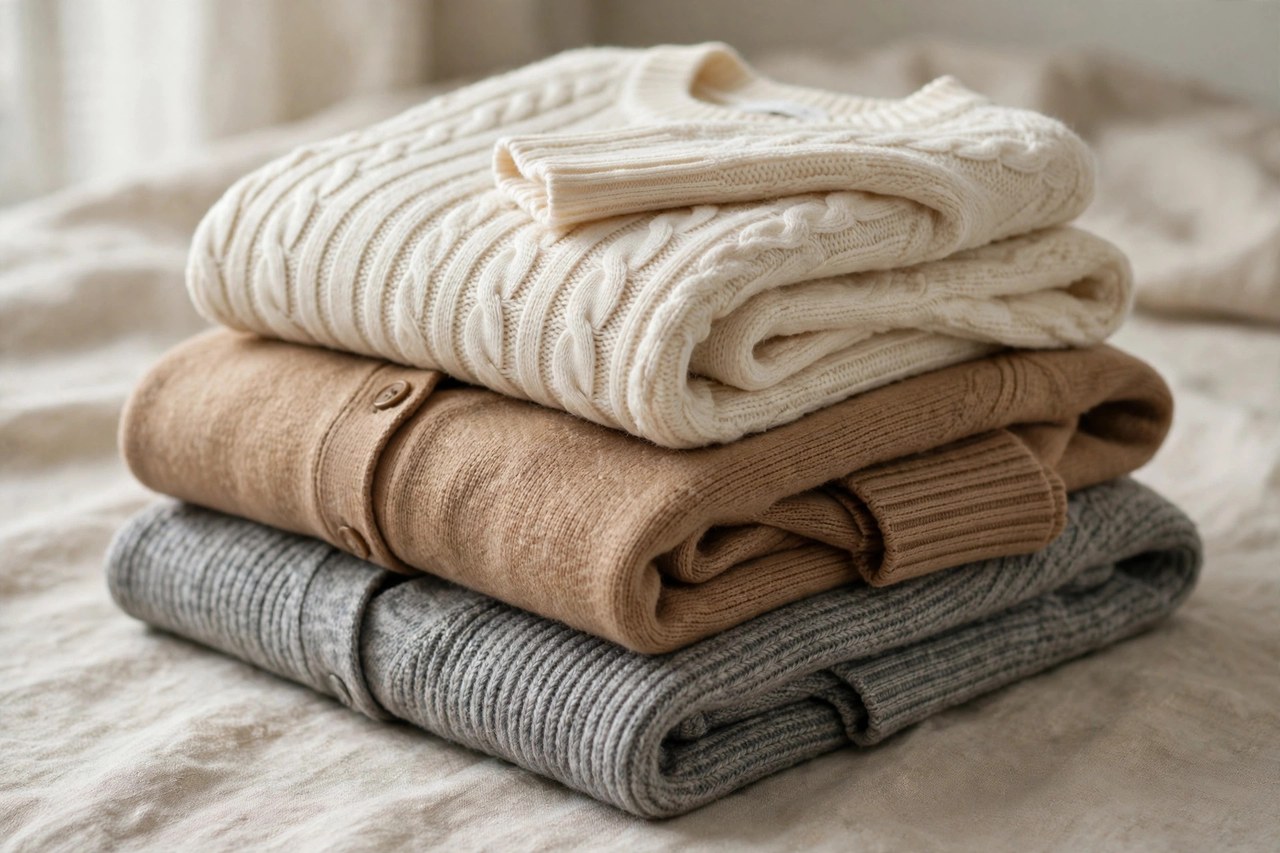
Knitwear is clothing made by knitting: a construction that manipulates yarn into a series of intermeshing loops called stitches. Each new row of loops is pulled through the row before it, so the finished fabric is really one continuous yarn, looped back on itself hundreds or thousands of times. That looped structure is what gives knitwear its defining qualities — it stretches, it drapes, it springs back, and it can be shaped as it is made rather than cut to shape afterwards.
Knitting is done by hand, with needles, or by textile machinery in factories, and women's knitwear covers far more than sweaters. Dresses, skirts, pants, shirts, tops and pajamas are all knitted, from fibers that include cotton for breathability, wool for warmth and natural recovery, and cashmere for softness at very light weight. Blends often add elastic yarns, and ribbed fabrics — knitted with alternating raised and recessed columns — bring extra stretch and body to cuffs, waistbands and whole garments.
Weft Knits and Warp Knits
Most clothing knitwear is a weft knit. In weft knitting, a single yarn travels across the fabric, forming loops row by row, much as hand knitting does. Jersey, rib and purl fabrics are all weft knits. They stretch readily, especially across the width, which makes them comfortable and forgiving to wear. Their weakness is the ladder: because one yarn runs through a whole row, a snagged stitch can unravel in a vertical run if it is not caught early.
Warp knits are built differently. Many yarns run lengthwise at once, each looping around its neighbors, which produces a more stable fabric that resists runs and stretches less freely. Tricot and raschel are the familiar warp-knit families, used for linings, lace, athletic mesh and smooth undergarment fabrics. As a shopper you rarely need the technical name, but the hand-feel gives it away: warp knits feel firmer and flatter, weft knits softer, springier and more sweater-like.
Gauge, and Hand vs Machine Knitting
Gauge is the fineness of a knit, counted as the number of stitches across a set width of fabric. A low gauge — three or five, say — means thick yarn, big visible stitches and a chunky, warm garment. A high gauge of fourteen or eighteen means fine yarn, tiny stitches and a smooth, almost T-shirt-like surface that layers under blazers and suits warm-weather wear. Neither is better; gauge simply tells you the weight, warmth and formality to expect before you ever try a piece on.
Hand knitting and machine knitting make the same loops at very different scales. Hand knitters work one garment at a time, which allows unusual textures, cables and colorwork but keeps output slow and sizing personal. Flat-bed and circular machines knit at speed, can be programmed for intricate patterns, and can knit a sweater body largely to shape so there is little cutting waste. Fine-gauge knitwear is almost always machine-made; the hand-knit look in stores is usually machine knitting designed to imitate it.
How Knitwear Is Made: Construction in Depth
This guide covers knitwear as something to choose and wear. For the factory side of the story — how weft and warp knitting differ, what the stitches and structures are, how gauge is set, and how intarsia, jacquard and fully-fashioned shaping actually work — Apparel Search has a dedicated technical series: the Knitwear Construction Guide, which follows knitted fabric from the yarn cone to the finished sweater.
Caring for Knitwear: Folding, Pilling and Blocking
Store knits folded, not hanging. A knit garment on a hanger slowly stretches under its own weight, growing longer at the body and developing points at the shoulders that pressing rarely removes completely. Fold sweaters and knit dresses on a shelf or in a drawer, with the heaviest pieces at the bottom of the stack. Wash gently and cool, reshape the garment while it is damp, and dry it flat so the loops dry in the alignment you want them to keep.
Fuzzy balls on the surface — pilling — happen where short fibers work loose and tangle under friction, especially under the arms and where a bag strap rubs. A fabric shaver or knit comb removes pills without harming the garment, and pills do not mean a knit is worn out. Blocking is the finishing counterpart: dampening a knit and easing it to its intended measurements, then letting it dry in place. Blocking evens out stitches, restores shape after washing, and can recover a surprising amount of a garment that has twisted or shrunk slightly out of true. Finally, put knitwear away clean at the end of its season: moths are drawn to natural fibers, and to any trace of food or perfume left on them, far more than to the yarn itself.
Related Women's Guides
Photos

More to Explore on Apparel Search
Looking for Women's Clothing Stores?
This guide helps you choose women's knitwear. To browse where to buy, visit our women's clothing store directory, where you can find retailers that carry them.