Women's Plus Size Clothing Guide
Plus size clothing is women's clothing designed at plus proportions from the start — typically starting around size 14W to 18 and running through 6X, depending on the brand.
Shop Women's Plus Size Clothing Now
Shop Women's Plus Size Clothing on Amazon Shop Women's Plus Size Clothing on eBayThe Amazon and eBay links on this page are affiliate links. If you make a purchase through them, Apparel Search may earn a commission.
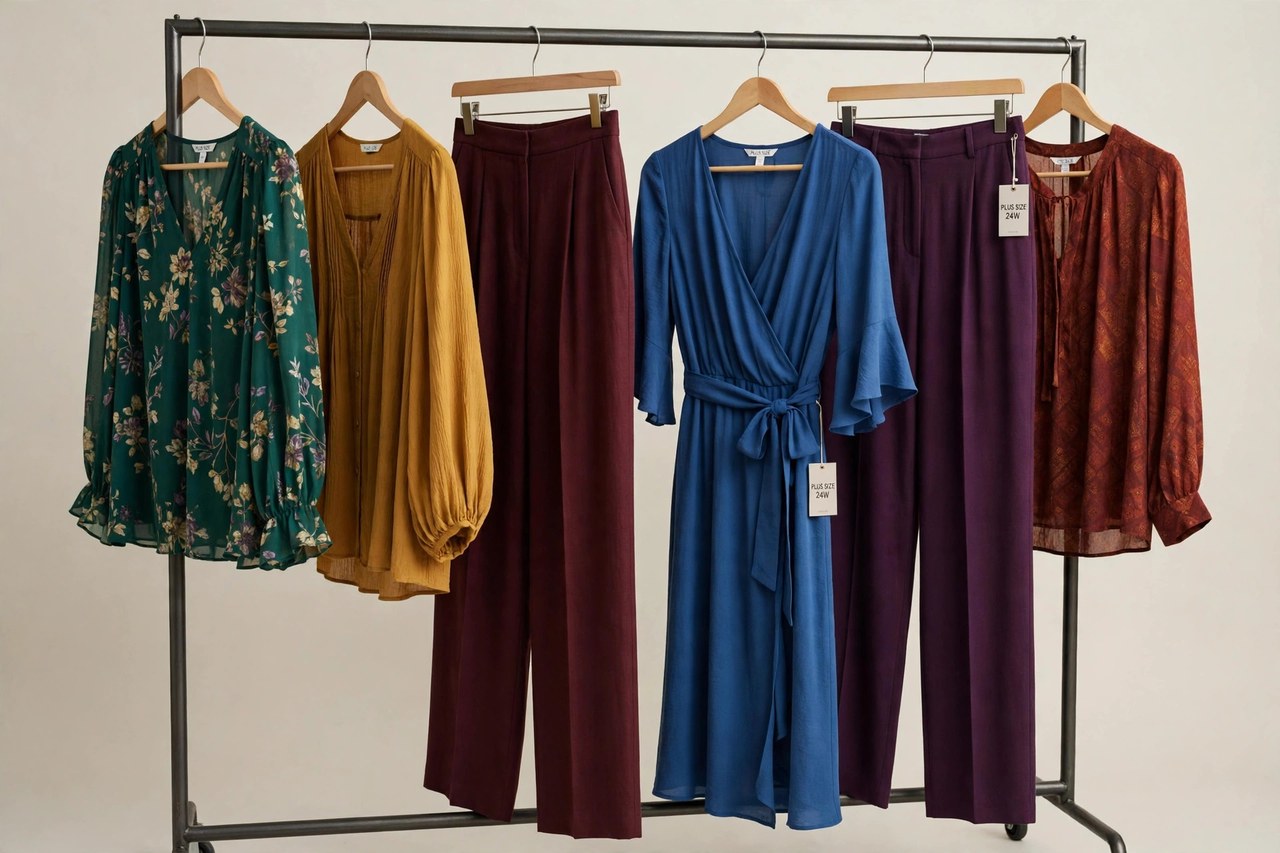
Plus size clothing is the umbrella term for women's clothing made in plus proportions, and this page is the umbrella guide to the category: what the sizes mean, how dedicated plus ranges differ from simply larger straight sizes, the fit principles that separate well-made plus clothing from scaled-up afterthoughts, and the fabrics and cuts that work hardest. Specialist guides for individual plus garments are linked below; this page gives you the map and the judgment to use across all of them.
A note on numbers first, because the category's sizing is genuinely confusing. Plus sizes typically begin at 14W or 18 and run upward, but the system varies by brand: some ranges use women's sizes with a W (14W, 16W, 18W through 32W and beyond), others use the X scale (1X, 2X, 3X through 6X), where 1X roughly equals 14W/16W. Neither scale is universal, and the same body may be a 2X in one brand and an 18W in another — which is why every fit principle below starts with measurements rather than labels.
Dedicated Plus Ranges vs. Extended Sizes
The most important distinction in the category is between dedicated plus ranges and extended sizes. A dedicated plus range is patterned on a plus fit model: the proportions themselves are designed for a fuller body, with bust, waist, hip, arm and rise measurements in plus relationships to each other, necklines and armholes placed for that body, and styling details scaled to suit. An extended size is a straight-size pattern graded up: bigger everywhere in the original's proportions, which often means shoulders too wide, sleeves too long, and a waist in the wrong place.
In practice, dedicated ranges fit most plus wearers noticeably better, and the gap widens at the upper end of the size range, where grading errors compound. How to tell them apart when shopping: dedicated plus brands and lines photograph their clothes on plus models, publish plus-specific size charts with real measurements, and offer depth at the higher sizes rather than stopping at 18. Extended-size lines often show the garment on a straight-size model with sizes 'also available' upward.
Fit Principles That Actually Work
Fit in plus clothing follows the same laws as all good fit, applied honestly. Structure at the shoulder anchors every top and dress: a shoulder seam that sits at the shoulder point makes even a soft garment look intentional. Waist placement should follow your waist, not the pattern's assumption — empire, natural and dropped waists each flatter different proportions, and the mirror test is whether the garment's narrowest point meets your own.
Two practical principles save the most returns. First, fit the largest measurement and tailor the rest: a dress that fits the bust can have its waist taken in, but no alteration adds room at the bust. Second, respect ease: woven plus garments need wearing ease to sit, bend and reach, and a fit that only works standing still in the fitting room will fail at a desk by ten o'clock.
Fabrics With Structure, and Styling
Fabric choice does more for plus fit than any styling trick. Fabrics with structure and recovery — ponte, wool crepe, denim with a little elastane, crisp cotton, quality jersey with body — hold a garment's designed shape on the body, so the silhouette you bought is the silhouette you wear at hour eight. Very flimsy fabrics collapse onto every line beneath them, and very stiff fabrics stand away and add bulk; the productive middle is a fabric that skims and holds.
Styling plus clothing well is mostly styling, full stop: define a focal point (a neckline, a waist, a great shoe), let one piece carry pattern or color while the rest support, and use vertical elements — a long necklace, an open cardigan's edges, a trouser crease — where you want length. Monochrome and tonal dressing lengthens; so does matching shoe to trouser.
Where the Category Is Heading
Plus size clothing is the fastest-evolving part of the women's market. The changes with staying power are structural: more brands patterning on plus fit models rather than grading up, size ranges extending to 30 and beyond as standard, plus lines shown on runways and in main campaigns rather than separate ones, and better data — fit reviews by size, model measurements published with photos, and size charts stated in inches and centimeters — replacing the old guesswork.
For the shopper today, the strategy that works is: know your measurements in inches, favor dedicated plus ranges for tailored and fitted garments, read the size chart for every new brand as if you have never shopped before (because its sizes are new to you), and keep a short list of the brands whose blocks fit your proportions — that list, once built, is worth more than any trend. The category's direction is toward clothing designed, at last, with the same care at size 24 as at size 4.
Related Women's Guides
More to Explore on Apparel Search
Women’s Clothes Guide by Letter: Women's Apparel Directory N · Women's Clothes Directory O · Women's Apparel Directory Q · Women's Fashion Directory R · Women's Clothing Directory S · Women's Clothes Directory T
Looking for Women's Clothing Stores?
This guide helps you choose women's plus size clothing. To browse where to buy, visit our women's clothing store directory, where you can find retailers that carry them.