Women's Printed Swimwear Guide
Printed swimwear puts pattern on performance fabric — florals, geometrics, stripes and abstracts printed onto stretch swim cloth that must hold its color in chlorine, salt and sun.
Shop Women's Printed Swimwear Now
Shop Women's Printed Swimwear on Amazon Shop Women's Printed Swimwear on eBayThe Amazon and eBay links on this page are affiliate links. If you make a purchase through them, Apparel Search may earn a commission.
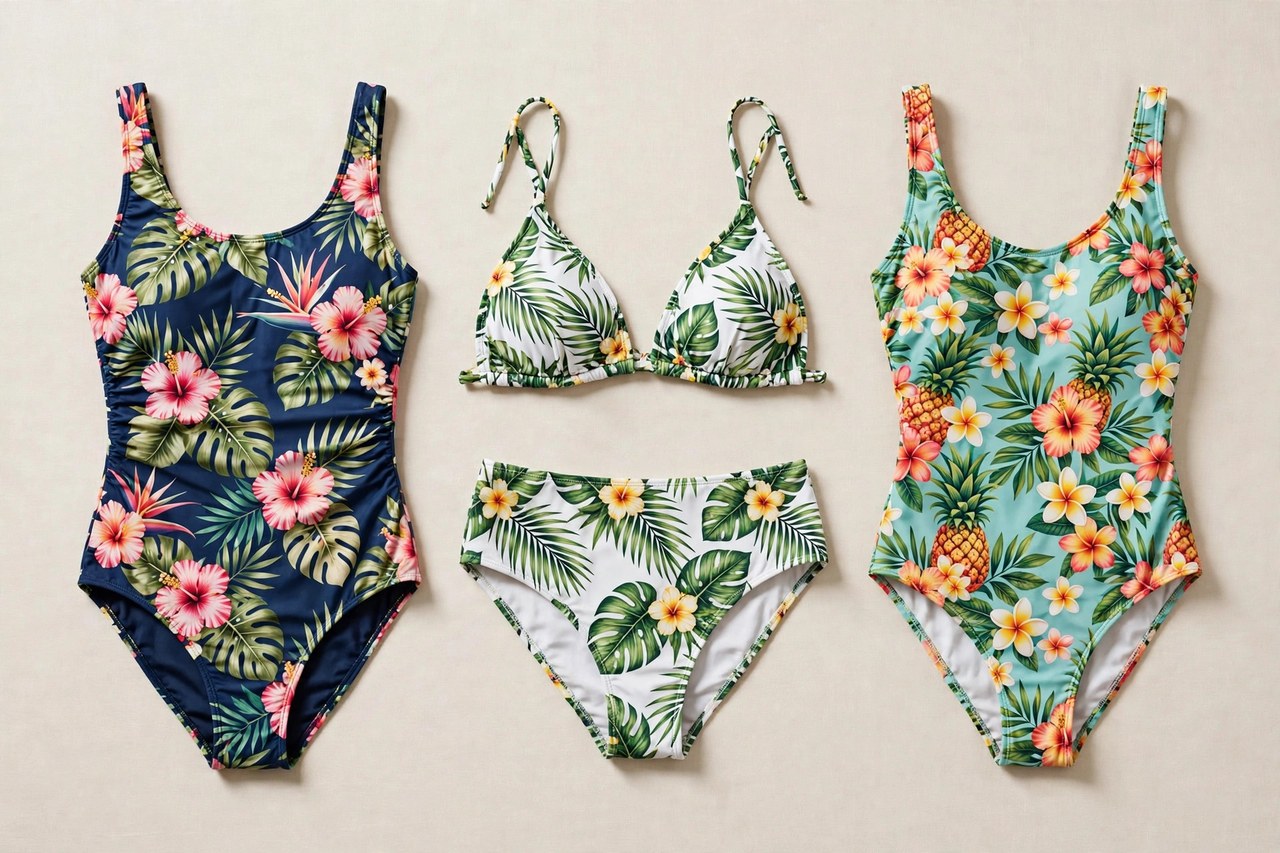
Printed swimwear is swimwear whose pattern is applied to the fabric rather than woven into it: the base cloth is a stretch swim fabric, usually pale before printing, and the design — a floral, a stripe, a geometric or an abstract — is printed onto its surface or through its fibers. The category covers one-piece suits, bikinis, tankinis, swim skirts and rash guards, and it is the largest decorative branch of swimwear because printing can put any image on any cut.
This is a strictly product-focused guide to the garment itself: how prints are made on swim fabric, why the printing method decides whether a pattern survives a season of chlorine, how print placement and scale interact with cut, and how to size and care for a printed suit. Print quality, construction and fabric are the whole subject here.
Print Types on Swim Fabric
Most printed swimwear is made by sublimation printing, in which dye is transferred into polyester fibers with heat and becomes part of the fiber itself. Sublimation is the quality standard: the pattern cannot crack or peel, and the colors resist chlorine and sunlight better than any surface coating. It works fully only on polyester, which is one reason polyester dominates printed swimwear.
The alternatives explain themselves by their limits. Screen printing lays ink on the fabric surface and is used for small logos, chest motifs and simple bold designs on nylon blends; it is crisp when new but can crack as the fabric stretches repeatedly. Digital wet printing on nylon gives softer hand feel and fine detail, with colorfastness that depends heavily on the maker's dye quality. Whatever the method, judge a print the same way: stretch the fabric firmly and look closely — a good print stays saturated and sharp when stretched, while a weak one pales, blurs or shows white fiber between the colors.
Prints, Placement and Scale
Printed swim patterns fall into families. All-over prints repeat across the whole garment: florals, tropical leaves, polka dots, ditsy patterns and geometrics. Placement prints put one designed image in one position, usually the front of a one-piece or the center of a top, and demand precise cutting so the image sits where intended. Border and engineered prints run a designed edge along a neckline, hem or side seam. Stripes and color-block effects are often printed rather than pieced, which keeps seams smoother. Each family behaves differently on the body of the garment, so choose by construction, not just by the pattern's charm on a screen.
Scale and direction matter practically. Small, dense prints disguise chlorine fading longest, making them the practical choice for suits worn weekly. Large-scale prints are dramatic but depend on where the pattern falls at the seams. Vertical stripes lengthen the line of a one-piece; horizontal stripes widen it. Dark prints hide fading and show less transparency when wet; pale prints show both sooner and deserve a full lining check.
Construction, Fabrics and Sizing
The fabric under the print decides the suit's working life. Polyester-elastane blends resist chlorine and UV fade best and suit regular pool swimming. Nylon-elastane blends feel silkier, suiting holiday wear, but lose stretch and color faster in chlorinated water. Stretch content around 15 to 25 percent holds the print flat without distortion. Look for a full front lining at minimum — printed fabric can turn sheer when wet, especially in light colorways — and flat, smooth seams at the leg openings.
Size a printed suit by the maker's chart and your torso measurement, as with any one-piece: the print is an honest fit indicator, because a suit that is too small stretches the pattern visibly pale across its widest points, and a suit that is too large lets the print wrinkle and shift. Fit should be snug and even, with the pattern undistorted when you raise your arms and bend. For two-piece printed sets, check whether tops and bottoms are sold separately in different sizes, and whether the print direction matches between pieces — a stripe that runs vertically on the top and horizontally on the bottom was not designed, it was assembled.
Chlorine, Sun and Print Care
Print care is fabric care with one extra enemy: ultraviolet light fades printed dye even when the fabric itself survives, so the routine protects color as much as stretch. Rinse the suit in cold fresh water immediately after every wear to remove chlorine and salt, hand wash occasionally with a mild soap, and never use bleach or hot water. Dry flat or folded over a rail in shade, never in direct sun and never in a heated dryer, and keep the suit out of hot tubs, where hot chlorinated water attacks both elastane and dye at once.
When buying, weigh print against purpose. A suit for daily lap swimming earns its keep in a dark, dense, sublimated polyester print that hides a season of fading. A holiday suit can carry a paler, larger pattern, because its hours in water and sun are few. Read the fiber label, stretch-test the print and check the lining, and the pattern you chose in the shop will still be there at the end of the season.
Related Women's Guides
Photos

Looking for Women's Clothing Stores?
This guide helps you choose women's printed swimwear. To browse where to buy, visit our women's clothing store directory, where you can find retailers that carry them.